What Is a Good Domain Rating? a Practical Benchmark Guide
Find out what is a good domain rating for your niche, how to benchmark DR against competitors, and why traffic and relevance matter more.
A good Domain Rating has no universal number such as 50 or 70. A useful benchmark is a score at or above the median of comparable competitors in the same niche, backed by real traffic and relevant referring domains.
That makes the usual advice to chase a higher score incomplete. Before you approve a publisher or judge your own website, you need to know who you're competing with, which pages need support, and whether the links behind the score come from credible websites.
For a link-building analyst, DR is a relative filter, not a quality grade. It helps narrow a prospect list. Traffic, topical relevance, editorial judgment, and target-page results determine whether a placement deserves your budget.
Reading Domain Rating Bands for a Quick Verdict
A DR band can help you orient yourself, but it can't tell you whether a website is competitive for your keywords. Treat the descriptions below as screening shorthand, not measured categories or official Ahrefs grades.
Start by locating your website or prospective publisher. Then ask whether comparable sites attract relevant search traffic in that market. A small specialist publisher and a broad national publication shouldn't face the same acceptance criteria.
Domain Rating bands and what they usually mean
| DR band | Typical site profile | How to read it |
|---|---|---|
| 0-20 | New or small sites with few referring domains | Workable mainly in local or emerging niches, and only if real traffic exists |
| 21-40 | Established small businesses and niche blogs | Potentially competitive for local and specialist topics, subject to competitor checks |
| 61-80 | Large publishers and major brands | Treat as an ambitious outreach category; confirm topical fit before pitching |
| 81-100 | Major global properties | A reference point, rarely a practical default target |
These are illustrative reading bands, not evidence that every website in a band shares the same characteristics. Don't infer age, readership, editorial quality, or ranking potential from a site's position alone.
Turn the band into a question
For your own website, ask whether businesses with comparable backlink profiles rank for the searches you want to win. For a publisher, ask whether its audience and existing articles make it a credible place to discuss your subject.
Those are different decisions. A website may be a realistic search competitor without being a useful outreach prospect, especially if it doesn't publish material relevant to your buyers.
Practical rule: Use a DR band to decide what to investigate, never to decide what to buy.
Keep exceptions visible in your prospect sheet. A modest-score publication with a clear specialist readership deserves investigation; an impressive-score domain with unrelated content deserves scrutiny. Find your band, then confirm its meaning against genuinely comparable competitors.
What Domain Rating Measures and How It Works
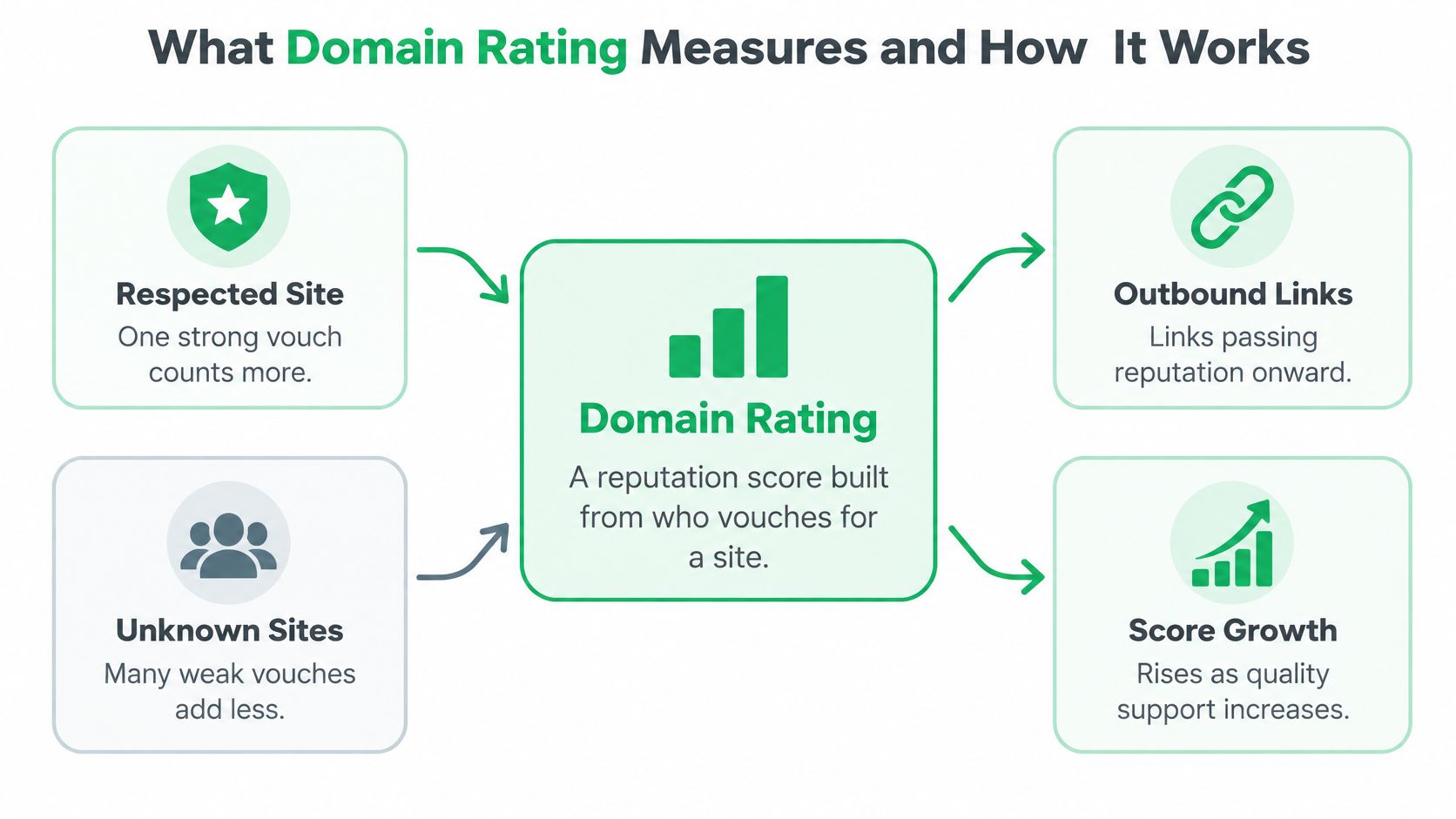
Think of DR as a reputation score built from who vouches for a website. A recommendation from a well-connected source can carry more modeled influence than recommendations from poorly connected sources, but the strength of the source isn't the only consideration.
According to the Ahrefs Domain Rating glossary, DR measures backlink-profile strength on a logarithmic scale from 0 to 100, using unique referring domains, their DR, and how many other domains they link to. Moving from 20 to 21 is substantially easier than moving from 70 to 71, because equal point changes don't represent equal increases in backlink strength.
The diagram summarizes those relationships.
Follow the endorsement, not just the count
Say a specialist software company earns coverage from an industry publication. To understand the possible effect on DR, look beyond the existence of the backlink: consider the referring publication's backlink strength and the breadth of its outbound linking.
Now suppose that publication mentions the software company in several more articles. Those mentions may create additional opportunities for readers to discover the company, but they don't become additional independent referring domains.
The counting rules matter:
- Unique domains matter: Several links from the same website still represent the same referring domain.
- Source strength matters: A referring domain's own backlink profile contributes to the calculation.
- Outbound reach matters: The number of other domains a source links to affects its modeled influence.
- Attributes matter: Nofollowed links don't improve DR, although the metric isn't a complete measure of their usefulness to readers.
None of this evaluates whether an article answers a searcher's question, whether a business is trustworthy, or whether a proposed placement fits the surrounding text. Backlink strength and search quality aren't interchangeable.
A reusable definition follows: a good DR is credible for the niche, supported by genuine referring domains, and improving relative to direct competitors. That definition keeps the score useful without asking it to measure things it wasn't designed to assess.
Where to Check DR and How It Differs From Other Scores
Check DR through Ahrefs' Website Authority Checker or an Ahrefs report. Record the lookup date and use the same domain scope for every entry, rather than comparing a whole domain with a subdomain or individual page.
Put the results in a shared spreadsheet. Include the domain, DR, referring domains, estimated organic traffic, relevant ranking keywords, and a short note on topical fit.
Keep the measurements consistent
- Use Ahrefs for DR: Don't replace a missing DR value with another provider's authority score.
- Keep traffic estimates comparable: Pull the same type of report for every prospect, using consistent country settings where appropriate.
- Separate domain and page checks: Record sitewide metrics separately from observations about the proposed linking page.
- Preserve the date: A later lookup may produce a different result as the provider updates its index.
Moz Domain Authority and Semrush Authority Score are separate proprietary metrics. Don't merge them with DR into a shared average or treat similarly sized scores as equivalent.
You can use those tools for additional investigation, but label their outputs clearly. The purpose of the spreadsheet is a reproducible comparison, not a collection of impressive-looking numbers.
Why Niche and Competitors Change the Benchmark
Consider a local plumbing directory and a national SaaS comparison publisher with the same DR. Their scores match, but the competitive questions don't.
The directory needs to be assessed against websites serving the same place and service category. The SaaS publisher needs to be assessed against sites competing for the same software searches, buyer questions, and comparison topics.
A broad industry label isn't enough. A software company publishing technical documentation may face a different competitive set from a software company targeting purchasing comparisons.
A hypothetical comparison
Suppose the plumbing directory's relevant competitors have similar backlink profiles and attract visitors through local service searches. Its DR may be a credible fit for that environment.
Suppose the SaaS publisher competes against established comparison sites with much stronger backlink profiles and substantial coverage of the target topic. The identical DR now indicates a larger competitive gap.
Neither scenario proves whether a particular page will rank. Each tells an analyst where to investigate further.
| Comparison | Useful question | Misleading shortcut |
|---|---|---|
| Local service market | Which sites compete for the same service and location? | Compare with nationally known brands |
| SaaS commercial topic | Which publishers rank for the same buyer intent? | Compare with every software company |
| Proposed placement | Does this article reach the right readers? | Approve the publisher on sitewide DR alone |
Separate the domain from the target page
Sitewide DR summarizes a domain's backlink profile. It doesn't tell you which referring domains support a specific competing page.
Inspect the backlinks to the pages you're trying to outperform. Look at the subjects those referring sites cover, the context of their mentions, and whether they represent plausible editorial recommendations.
This distinction also changes outreach priorities. A relevant publication that already reaches your buyers may warrant consideration even when a larger, less related website has the more impressive score.
The right benchmark comes from the competitors around your target keywords, not from an absolute threshold.
How to Benchmark DR Against Real Competitors
Build the benchmark around a defined commercial objective: a target page, a search topic, and an audience. Otherwise, you can produce an accurate spreadsheet that answers the wrong question.
Ahrefs' explanation of relative Domain Rating supports comparison with similar websites. A practical implementation is to gather roughly 20-30 comparable domains, use their median DR as a baseline, and treat the 75th percentile as a stronger planning target, not a ranking guarantee.
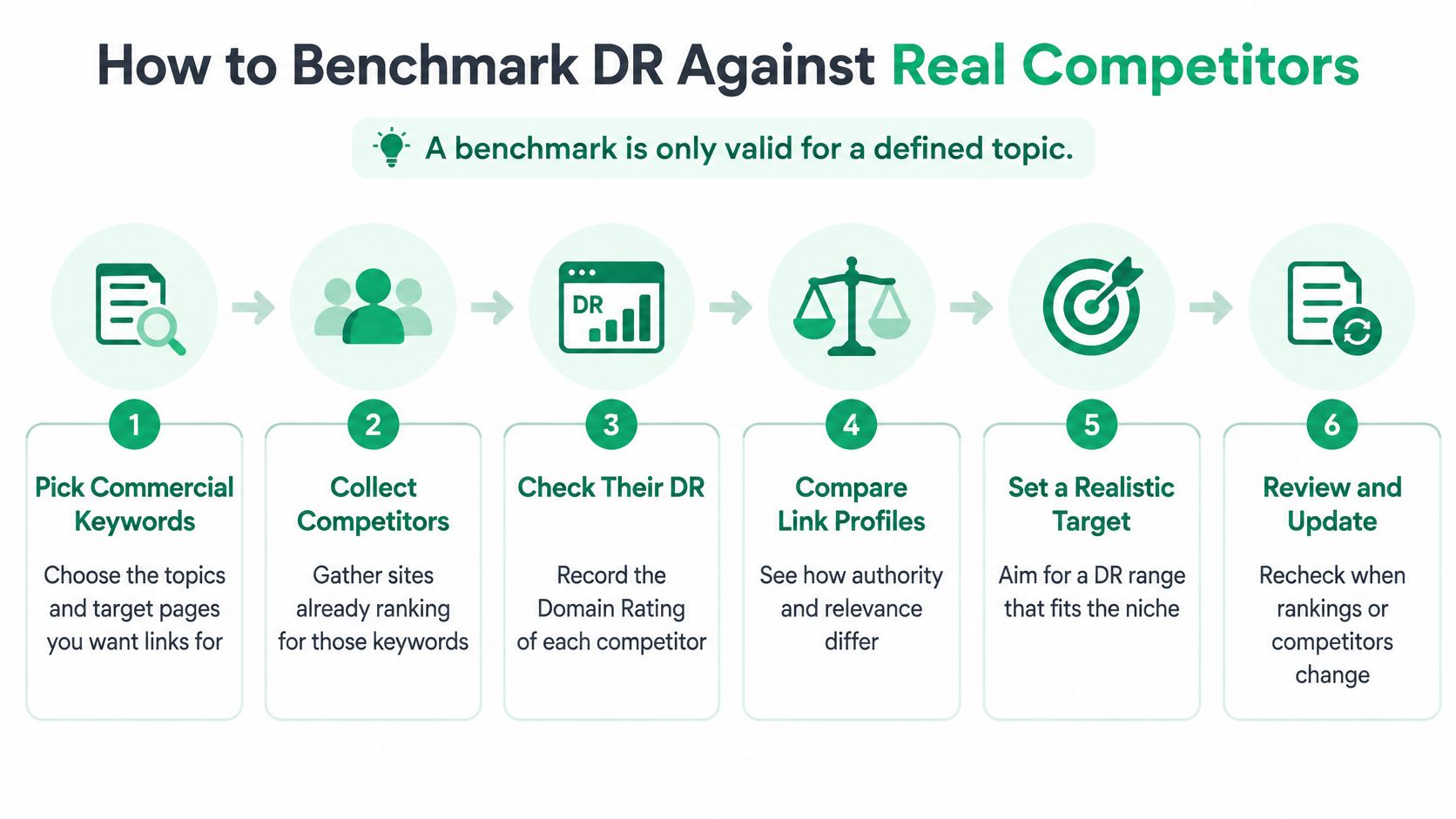
The workflow keeps the comparison tied to the pages you want to support.
Build a comparable set
Pick commercial keywords and target pages. Group searches by buyer intent and identify the page each group should support. A benchmark for technical tutorials shouldn't automatically set the criteria for product-comparison outreach.
Collect comparable ranking domains. Exclude sites that don't address the same audience or search intent, rather than excluding a strong competitor because it's difficult to match. Note unusual results separately so an unrelated platform doesn't define the whole sample.
Record DR and referring domains consistently. Use the same Ahrefs report settings across the set, then add traffic and keyword observations. Inspect the domains linking to competing target pages, not just their sitewide totals.
Convert the comparison into decisions
Calculate the baseline and stretch target. In a spreadsheet, use
MEDIANfor the central value andPERCENTILE.INCfor the chosen upper-quartile target. Treat the latter as a stronger backlink-profile reference, not evidence that those domains win because of DR.Set a provisional publisher minimum. Prioritize candidates at or above the relevant competitor median, then verify organic visibility, ranking keywords, indexation, and topical fit. Record any exception explicitly, such as a specialist publication with a valuable local readership.
Refresh the benchmark quarterly. Recheck sooner if the target topics or ranking competitors change materially. Keep historical entries so you can distinguish a change in your position from a change in the comparison set.
For SaaS link-building campaigns, separate product-category competitors from editorial publishers. Both can inform outreach, but they play different roles.
At Linkbuilding.services, we use Ahrefs, Semrush, and our own research to find publishers that match a client's niche and audience. Our donor metrics tool shows domain rating, referring domains, and keywords for every site, making those checks easier to inspect together.
A competitor median is a prospecting filter. It isn't a mandatory admission score for every useful publisher.
When a High DR Is Still a Weak Link
Consider a hypothetical high-DR publication that links to a very broad collection of unrelated domains. Compare it with a smaller specialist site that links selectively to relevant resources.
The larger publication's score doesn't automatically make its backlink the better choice. Ahrefs' explanation of DR distribution states that a source passes less modeled DR value when it links to more domains, and warns that 1,000 followed referring domains from DR 0 websites are unlikely to help pages rank.
The illustration shows why source strength and outbound-link breadth need to be assessed together.
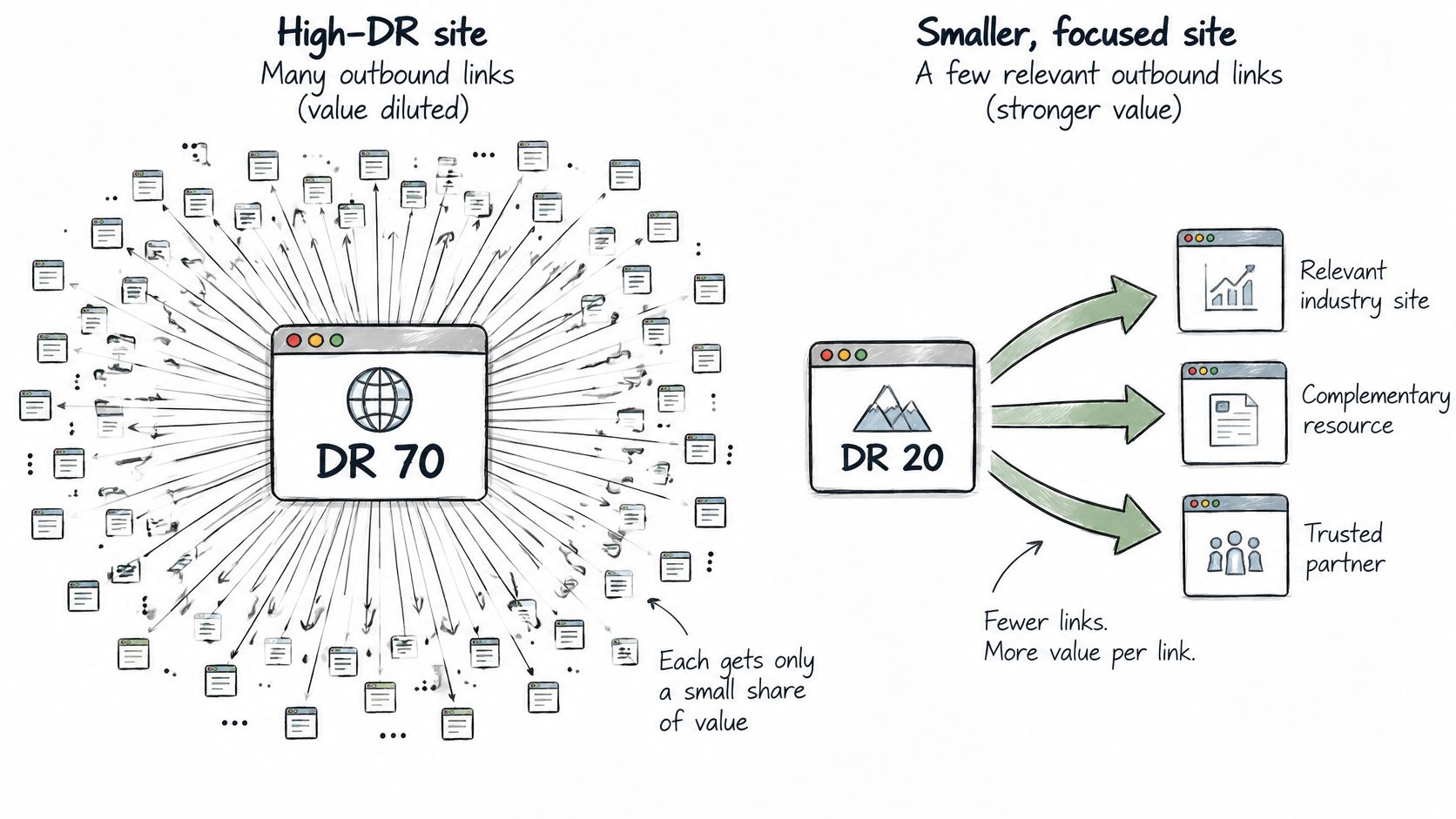
Don't translate that model into a precise prediction of Google ranking value. Use it to challenge the assumption that a recognizable domain or a large backlink count automatically justifies a placement.
Make the publisher decision explicit
The following matrix is a screening policy, not a claim that every publisher fitting a description will produce the same outcome.
Publisher decisions by DR, traffic and relevance
| Publisher profile | DR position | Traffic and relevance | Decision |
|---|---|---|---|
| High DR, no organic traffic | Above competitor median | Little traffic, weak topical fit | Reject; the score is not backed by an audience |
| Mid DR, strong niche traffic | At or above competitor median | Real traffic, relevant rankings | Accept after checking outbound links |
| Low DR, strong local traffic | Below median | Real local audience, relevant to the niche | Accept for local campaigns only |
| Any DR, links from a network | Any position | Unclear or thin audience, many outbound links | Reject; treat as a spam risk |
An acceptance means the publisher can proceed to placement-level review. It doesn't mean approving any article, anchor, or commercial arrangement the publisher proposes.
Check the intended page and neighboring articles. Look for coherent subject coverage, useful explanations, identifiable editorial judgment, and outbound citations that make sense for readers.
This video provides additional context for assessing link prospects.
Check intent and attributes before approval
A dofollow backlink isn't automatically a safe or useful backlink. Google's spam policies identify links created primarily to manipulate rankings as link spam; paid advertising and sponsorship links should carry appropriate nofollow or sponsored attributes.
Before accepting a placement, verify:
- Subject relevance: The article has a natural reason to discuss your target resource.
- Organic visibility: The publisher ranks for relevant searches, rather than unrelated topics.
- Indexation stability: The proposed content is accessible and the publisher maintains its pages.
- Editorial standards: Articles serve readers rather than merely accommodating anchors.
- Link-profile credibility: Referring sources and outbound destinations don't suggest a manufactured network.
We vet every publisher on DR, referring domains, organic traffic, and topical relevance before pitching. We avoid dead sites, PBNs, and domains without an audience.
Our team's stated principle is direct: “Real sites with traffic beat DR games. Every time.”
Why DR Can Rise While Rankings Stay Flat
Your DR climbs after a campaign, but the target pages attract no additional search traffic. That isn't necessarily a contradiction: you've observed a change in a backlink metric, not proof of improved search performance.
Ahrefs confirms that search engines don't use Domain Rating as a ranking factor. The score is an external estimate, so its movement can't establish whether Google valued a particular placement.
Diagnose the mismatch
Start with the destinations and context of the new links. They may support the domain broadly without meaningfully supporting the commercial page you're evaluating, or they may come from sources with little relationship to its subject.
Also distinguish independent endorsements from repeated exposure on the same publisher. A campaign report that emphasizes total links can obscure how concentrated the sources are.
Outcome signals to track beside DR
| Signal | What it shows | Red flag |
|---|---|---|
| Indexed placement | The linking page is discoverable in search; verify crawlability separately | Placement missing from the index or removed after publishing |
| Referring-domain diversity | Links come from independent sites | Many links concentrated on one publisher |
| Topical relevance | The linking site covers the target subject | Unrelated sites or general-interest coverage without a relevant context |
| Target-page impressions and rankings | Whether the page's search visibility changes | Rankings remain flat through repeated review periods |
| Qualified referral traffic | Whether relevant readers arrive through the placement | No meaningful visits from the linking page |
| Link attributes | Whether commercial relationships are qualified appropriately | Paid links without nofollow or sponsored |
Use Google Search Console to inspect target-page impressions, clicks, and query positions. Use analytics to review referral visits and conversions, and keep placement URLs and attributes in the campaign tracker.
Judge the page, not just the campaign total
These signals don't isolate a backlink's causal effect. They help you identify whether the campaign is producing evidence consistent with its objective and where further investigation is needed.
If your goal is to improve Google search rankings, report page-level outcomes alongside delivery metrics. A rising DR is supporting context, not the result you're buying.
Linkbuilding.services provides managed link building with publisher research, outreach, placement verification, and live reporting. Visit Linkbuilding.services to discuss a campaign built around your target pages, competitor benchmarks, and publishers assessed for traffic and topical relevance, not DR alone.