Guest Blogging Outreach: A Step-by-Step Workflow for 2026
Learn guest blogging outreach step by step: vet publishers, write pitches, follow up on schedule, and track real placements with clear metrics.
Scale is the most popular advice in guest blogging outreach, and it's the advice most likely to waste your month. Send more emails, buy a bigger list, add another follow-up. That logic assumes editors say no because they didn't see you. Editors say no because you pitched the wrong publisher, the wrong topic, or a placement you'd only want if it passed ranking credit. Fix the decision before the email, and a small batch does more work than a large one sent blind.
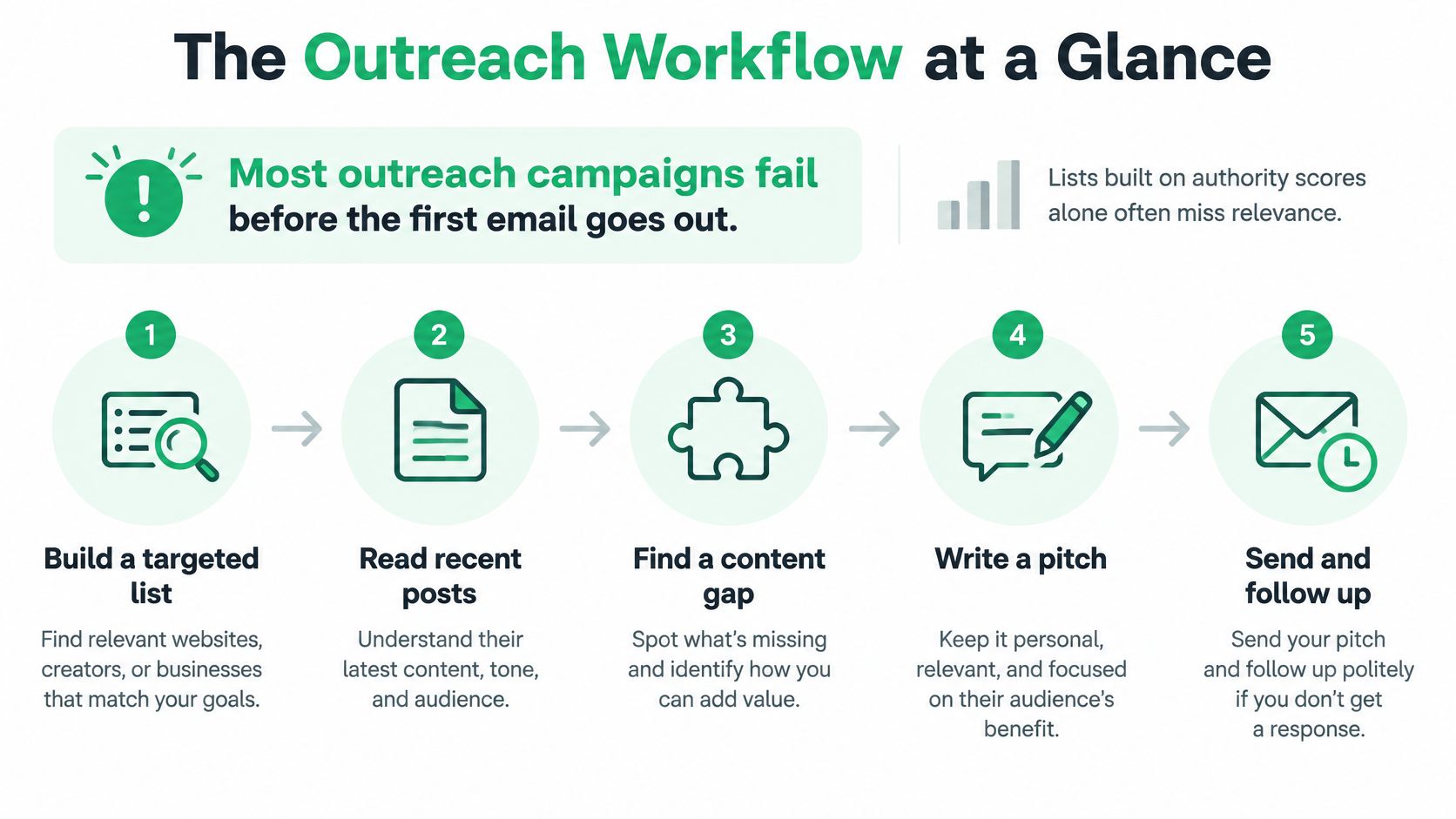
The Outreach Workflow at a Glance
Most outreach campaigns fail before the first email goes out, usually because the list was built on authority scores alone. A high score tells you a domain collected links in the past. It doesn't tell you whether an editor is active, whether readers exist, or whether your client's topic belongs there. When that check is skipped, you don't get an error message. You get silence, cheap accepts from weak sites, and a low placement rate weeks later.
The inbox you're entering is crowded. In 2024, 64.9% of surveyed link builders reported using guest blogging as a link-building strategy, according to Authority Hacker's survey data cited by Ahrefs blogging statistics. Editors aren't short of pitches. They're short of pitches that fit.
Five Stages Each With a Checkable Output
- Vet publishers: Build a qualified list where every domain has a named editor, recent posts, and a visible audience. If you can't name who'd read the piece, drop the domain.
- Pitch: Send a personalized email proposing one specific article matched to an existing gap. One topic forces you to read the site.
- Follow up: Run a short sequence over about two weeks with a clear stop rule. Persistence helps, nagging burns domains you may need next quarter.
- Track responses: Keep reply, positive reply, and placement counts separate. A busy inbox isn't the same as published work, as the wider relationship between guest blogging and SEO results makes clear.
- Verify and comply: Confirm live, indexed links and record disclosure and link attributes. A placement you can't prove compliant is a liability, not an asset.
| Stage | Output | Done when |
|---|---|---|
| 1. Vet publishers | Shortlist of qualified domains | Each domain passes every vetting check |
| 2. Pitch | Personalized pitch with one topic | Editor has the subject, outline and author details |
| 3. Follow up | Up to three messages per thread | Editor replies or the sequence closes |
| 4. Track responses | Five metrics per segment | Every delivered message has a logged outcome |
| 5. Verify and comply | Live, indexed link record | Link, label and anchor confirmed at publication and at 90 days |
Practical rule: If a stage has no output you can open in a sheet, it didn't happen.
Copy this table into your tracker before you build a list. Each stage becomes a column set, and you'll see exactly where threads stall instead of guessing at the end of the month.
Building the Prospect List
Start from topical relevance, not authority. A relevant publication with modest metrics and an engaged editor beats a powerful domain that publishes anything. Relevance also protects you editorially, because a reader benefit that's obvious to you is usually obvious to the editor.
Source Candidates Three Ways
1. Search queries. Pair your client's niche with terms like write for us, contributor guidelines, or guest post. This finds sites that openly accept contributions, which often means clear rules and a named contact, but also more competition.
2. Competitor backlink reports. Pull referring pages in Ahrefs or Semrush and filter to editorial, non-sponsored pages. A competitor's bylined article proves the site accepts outside writers in your niche. Don't copy their exact targets without checking freshness, because a placement from two years ago may sit on a site that's since changed hands.
3. Trusted directories and author networks. Niche publication directories and writers you already know surface smaller sites that never advertise for contributors. These are slower to find and often the best fit.
Clean and Segment the Sheet
Export every candidate to one sheet with its niche, publication type, likely contribution format, and the page where contributor guidelines or an editor contact appear. Remove duplicates and any domain that published a direct competitor on the same topic in the last twelve months, since an editor rarely wants the same argument twice.
Segment by those three labels now, not later. You'll measure each segment separately, and retroactively tagging 80 rows is work nobody does properly.
Find a named editor or author for each candidate from the masthead, author pages, or guidelines, and record where every contact address came from. That source note saves arguments when an address bounces or a colleague asks why you emailed a general inbox.
I would aim for a raw list of around 60 to 100 candidates. Vetting removes a large share, and a bigger raw list only adds triage work. Your output is an unvetted candidate sheet with segment labels and named contacts. Nothing on it is pitch-ready yet.
Vetting Publishers and Setting the Paid-Link Rule
The red flags that sink placements are dull and predictable. No posts in recent weeks means the editor may be gone. No named editor means nobody owns quality. Unrelated categories bolted onto a broad blog signal a site selling space by topic. Hidden sponsored posts and network-style footer links tell you how your article would be treated too.
Run Seven Checks and Keep Only Clean Passes
A domain stays on the list only when it passes every check. Not six out of seven. One failed check usually explains the others.
| Check | Pass signal | Red flag |
|---|---|---|
| Editorial activity | Posts within the last few weeks | Last post months old or dated sitewide |
| Named editor or author | Visible editor and author bios | Anonymous or generic contributor pages |
| Real audience | Comments, shares or organic traffic on recent posts | Thin posts with no visible engagement |
| Topical fit | Existing coverage of your client's niche | Unrelated categories added to a broad blog |
| Outbound link pattern | Few, relevant external links per post | Multiple unrelated outbound links in every article |
| Paid-link signals | Clear sponsored labelling on paid posts | Hidden sponsored posts or network-style footer links |
| Traffic and rankings | Organic traffic and keyword rankings in Ahrefs or Semrush | No organic traffic and no keyword footprint |
Read the outbound link pattern closely. Open three recent articles and count external links that have nothing to do with the topic. A finance blog linking to casinos, essay services, and CBD shops in one week isn't running an editorial program. It's running inventory. That distinction also matters when you weigh guest posts versus niche edits, because the surrounding page shapes the value of either format.
Treat Metrics as Inputs Not Verdicts
We vet each publisher on domain rating, referring domains, organic traffic, and topical relevance before any pitch is sent, and we use Ahrefs and Semrush for those inputs. None of them is a verdict on its own.
Say you find a marketing blog with a strong domain rating. Its last post is eight months old and its estimated organic traffic has fallen almost to zero. I would drop it without debate. A link there passes little value, readers won't see the piece, and an inactive editor won't reply no matter how good the pitch is. The strong score is a record of a site that used to matter.
A metric describes the past. Editorial activity describes whether anyone is home now.
We avoid dead sites, PBNs, and domains with no audience, focusing instead on publishers that rank for keywords and earn traffic from Google. That filter removes most inflated-score domains before they cost you writing time.
Set the Paid-Link Rule Before the First Pitch
This is a decision that teams often postpone until an editor names a price, which is exactly when judgment gets fuzzy. Set it now, per segment, in writing.
Google's link spam policy explicitly includes buying or selling links, optimized anchor text in guest posts, and paid guest-post links that pass ranking credit among examples of link spam, and it says paid links may be acceptable when marked with rel="nofollow" or rel="sponsored". Google also states it has improved detection of low-quality sponsored and guest-post campaigns and may nullify links or apply algorithmic or manual actions when excessive guest posting lacks appropriate link tags.
So ask one question for every domain. Would this placement still be worth having if the link passed no ranking credit? Judge relevant readership, referral potential, editorial fit, author credibility, and durable content value first. If the honest answer is no, you aren't buying audience. You're buying a ranking signal, and you've moved into the policy problem above.
Decide per segment whether sponsored placements are allowed at all. Reject any publisher that hides paid posts, regardless of price, because hidden disclosure tells you the label could disappear from your placement too. Document payment, sponsorship, anchor choices, link attributes, and approval decisions from the start.
Your output is a shortlist where each domain carries the checks it passed and the paid-link rule that applies to it.
Writing a Pitch Editors Answer, Step by Step
A pitch is a short message to an editor, not a link request. The moment your email reads like you're shopping for a backlink, the editor prices you, ignores you, or routes you to a sales rate card. Our team believes editors come first, with valuable contributions rather than link drops, and that order shows in the first two lines.
The image below captures the unglamorous part many people skip, drafting against a real publication rather than a template.

Six Steps in Order
Step 1. Read two or three recent posts. Find one content gap the publisher hasn't covered, a question their readers ask in comments, an outdated guide, a topic covered for beginners but never for practitioners. If you can't name the gap, you don't have a pitch yet.
Step 2. Propose one specific article. Give a working title and a brief outline of three to five points. Editors approve angles, not topic areas. Three vague options signal you don't know which one fits.
Step 3. State the author's credentials in one line. Role, years of practice, and a link to a published example if one exists. Keep it factual. Editors verify, and inflated bios end threads.
Step 4. Name the reader benefit in one sentence. Write it so the editor could repeat it to their audience. Describe what readers gain, never what the piece does for your rankings.
Step 5. Write a subject line that mentions a specific post or topic from the site. A first name alone isn't personalization. Referencing their Tuesday article on churn benchmarks is.
Step 6. Keep the body under about 150 words and end with one question. Would a draft outline help, or should you send the full piece? One easy question beats a paragraph of conditions.
What Personalization Actually Buys You
The 12-million-email SEO outreach dataset found an overall response rate of 8.5%, while personalized subject lines increased responses by 30.5% and personalized body copy by 32.7%.
Treat 8.5% as a broad historical benchmark rather than a guaranteed target. List quality, sender reputation, niche, and offer strength move your number well above or below it. I would use it only to sanity-check whether a batch is broken, not to promise a client a yield.
The short video below is worth watching before you send, mainly as a pacing check on how little an editor needs from you.
Rejected Versus Revised
Rejected: "Hi, I write high-quality SEO articles and would love to contribute to your great blog. I can write on marketing, business, or technology. Please let me know your guidelines and rates."
Nothing there proves the sender read the site, knows the audience, or has an idea. It asks the editor to do the work.
Revised: "Hi Maya, your March piece on onboarding emails covered activation but not the trial-to-paid handoff. I'd like to propose 'The 14-Day Trial Email Map for Small SaaS Teams', covering day 1, 7, and 13 messages with two annotated examples. I lead lifecycle at a B2B SaaS firm, eight years in email, recent byline attached. Your readers get a sequence they can copy into their own trial flow. Would an outline help?"
Same ask, different evidence. The second version names the gap, the reader, and the author in under 100 words.
Follow-Up Timing and When to Stop
Follow up once, because it works. In the SEO outreach dataset summarized by ScaleGrowth, one additional follow-up increased replies by 65.8% relative to the baseline. That result justifies a second message. It doesn't justify a fifth.
Editors aren't ignoring you out of hostility. Your pitch landed during a launch week, under 40 other pitches, or above an inbox rule they'll never explain. A short reminder solves the visibility problem. Repeated reminders create a reputation problem, and editors in a niche talk to each other.
A Three-Message Cadence
| Stage | Timing | Message | Stop when |
|---|---|---|---|
| Pitch | Day 0 | One tailored topic with a short outline | Clear rejection or unsubscribe request |
| First follow-up | Day 4-7 | Restate editorial fit and add one useful detail | Any human reply |
| Final follow-up | Day 10-14 | Offer one alternative topic and close politely | No reply; the sequence ends after this message |
Day 4-7 shouldn't say "just bumping this." Add one useful detail, a proposed structure, an original data angle, a screenshot you could include. Give the editor new information to judge, not new pressure.
Day 10-14 offers one alternative topic and closes the thread politely. Say plainly that you'll assume the timing is wrong and won't write again. Then don't. A clean close keeps the door open for next quarter, and it makes your future emails more credible because you've shown you'll stop.
Stop Rules in Practice
- Clear no or unsubscribe request: The thread ends immediately. Log it, thank them if a reply is warranted, and suppress the address.
- Automated out-of-office reply: It doesn't count as interest and doesn't restart the sequence. Wait for the stated return date, then resume at the next scheduled step.
- Editor asks for a later date or different angle: That becomes a new thread, not a fourth reminder. Agree the date and set a fresh reminder.
Three messages total per thread. Everything after that is a new conversation or nothing.
Say an editor replies "not this quarter" on day 5. Log it as a delay, thank them, and schedule the next check three months out rather than in the day-10 slot. Treating that reply as a soft no to argue with converts a future yes into a permanent no.
Two pitfalls are worth naming. Opens aren't intent, because preview panes and security scanners trigger them. And chasing response volume by accepting weak publishers inflates your reply rate while lowering your placement quality.
Set calendar reminders for each stage when you send the pitch, and mark each thread complete in the tracker when it closes.
Tracking Results and Proving Compliant Placements
A high reply rate can hide poor publication yield. Plenty of editors reply to say no, name a price you won't pay, or offer a sponsored slot you already ruled out. If you report one blended number, you'll celebrate activity while publishing almost nothing. Our team believes reporting should be clean and verifiable, which starts with counting each stage separately.
Five Metrics With the Right Denominator
Use unique delivered emails as the base wherever the table says so. Bounced and undelivered messages never had a chance to be read, so including them punishes your copy for a list problem.
| Metric | Formula | What it tells you |
|---|---|---|
| Reply rate | Replies / delivered messages | Whether the pitch is read and answered |
| Positive reply rate | Interested replies / delivered messages | Whether the offer fits the publisher |
| Topic approval rate | Approved topics / positive replies | Whether the editor accepts your angle |
| Placement rate | Verified live placements / delivered messages | Actual publication yield |
| Retained link rate | Indexed, on-topic links still live at 90 days / placements | Whether the placement is worth keeping |
Worked example. Say you deliver 200 emails and get 18 replies (9%), 6 positive replies (3%), and 3 verified live placements (1.5%). That pattern means your subject lines and targeting get attention, but your offer or publisher fit converts poorly. Fixing the pitch won't help much. Fixing topic fit and segment selection will. The placement rate is the number that reflects real output, and it's the one I'd report first.
Traps That Flatter the Report
- Counting automated replies as interest: Out-of-office messages inflate reply rate without a human decision behind them.
- Reporting opens as intent: Opens measure tracking pixels, not editors.
- Mixing segments: One blended rate across niche blogs and large media hides which segment earns approvals.
- Counting unusable links: A placement that isn't indexed, on-topic, or still live isn't a result. Checking whether each link is followed matters too, so confirm the attribute against the rules for follow and nofollow links.
Keep a Compliance Record for Every Placement
For each live placement, record the byline, the sponsored or advertising label and its position, the link attribute, the anchor text, payment or sponsorship terms, the approval decision, and a screenshot of the live page. It takes two minutes at publication and becomes nearly impossible to reconstruct six months later.
Recheck each live URL at 30 and 90 days for anchor, attribute, and label. Publishers redesign templates, migrate CMS platforms, and sometimes edit commercial posts. Your 90-day retained link rate is where those changes surface.
If a publisher removes or hides the label, pause further placements there and request restoration in writing. Don't negotiate it as a preference. A missing label is a disclosure failure that now sits next to your client's name.
Report by segment so a weak niche appears as its own row. Each week, pause any segment whose placement rate stays below target for two review cycles, and move that effort to segments that approve topics.
Launch Your First 20-Pitch Batch
Start tomorrow with a shortlist of 20 domains that pass every vetting check. Record which checks each one passed in the tracker, next to the named editor and the segment label. Twenty is small enough to personalize properly and large enough to show you a pattern.
Write one pitch per domain with a single topic, not a bundle of ideas. Log each thread with the five metric columns, then set reminders for day 4-7 and day 10-14 in every thread before you send anything. Reminders created after sending are reminders you'll forget.
Your Two-Week Check
Two weeks in, verify three things:
- A reply rate you can calculate from delivered messages, not from messages sent.
- At least one positive reply, which proves an editor found the offer relevant.
- At least one approved topic, which proves the angle survived editorial judgment.
If a segment produced no replies, drop it and move volume to segments that approve topics. If you got replies but no approvals, your topics are close but not editorially useful. Those are different problems with different fixes, and you'll only see them because you measured stages separately.
Teams without spare capacity can hand research, outreach, writing, and verification to a managed guest-posting provider. The in-house route keeps full control of the list and the tracker, which some teams prefer and others can't staff. We provide clear scope and pricing before any work starts, and our guest posting service includes content written by subject-matter experts, domain and topic approval, and transparent reporting with live links. Whichever route you choose, agree scope, topic approval before placement, and live-link reporting before work starts, then check those terms against the metrics you've just set up.
If you'd rather not run vetting, pitching, and 90-day link checks yourself, Linkbuilding.services handles publisher research, outreach, expert-written content, and live-link reporting with domain and topic approval built in. Bring your 20-domain shortlist or start from scratch, and you'll see scope and pricing before any work begins.