Link Building for SaaS: A Practical 2026 Guide
Link building for SaaS starts with the right pages, publishers, and a 90-day way to read results instead of raw link totals.
In 2024, 40% of 20 surveyed SaaS marketing professionals reported spending $500 to $999 per month on backlink building, according to AUQ's SaaS marketing survey. That budget won't buy many credible placements, so the order of decisions matters more than the monthly total. Link building for SaaS works when you choose a few commercial URLs first, approve publishers that already serve buyers, and give editors something useful to cite. Think of a good link as a specific introduction. A relevant publication introduces one page to the right readers and helps search engines find and understand it. A pile of homepage links does neither job well.
Why SaaS Brands Still Need Links
Grand View Research estimates the global SaaS market was worth $464.7 billion in 2025 and projects growth to $1.1092 trillion by 2033, according to the Grand View Research SaaS market report. Say a payroll platform publishes a new integration page for an accounting tool. If the only external references point to its homepage, buyers searching for that stack combination and search systems looking for context get little help reaching the page that answers the query.
An introduction from the accounting ecosystem works better. It can expose the integration to relevant readers and give the destination clear topical context. That's also the practical route if you're trying to improve Google search rank for a commercial term rather than inflate a domain metric.
Three mistakes waste that opportunity. Teams buy homepage-only links, report raw backlink totals instead of movement on target pages, or chase the same monthly quota for every URL. Avoid those errors by deciding, in order, which pages need links, which publishers may provide them, what story earns publication, how fast new referring domains should arrive, and how AI answers change your scorecard.
Links support discovery and relevance. They don't guarantee rankings, and credible results build over months alongside useful pages.
SaaS Pages Worth Building Links To
Build your page map before you contact anyone. Google says links help its systems discover pages and understand relevance, while crawlable HTML anchors with descriptive text make those references usable. Links aren't the whole ranking picture, but they do give a specific URL more paths into the index and more context once it's there.
Start With Pages That Can Create Pipeline
Your homepage rarely needs to be the main target. Integration, comparison, and use-case pages sit closer to evaluation, so relevance transferred directly to those URLs supports the pages that can produce trials and demos. Documentation answers implementation questions that influence technical buyers. Research earns fresh citations. Security and compliance pages help procurement teams trust the product during a regulated purchase.
SaaS pages that should earn links
| Page type | Search intent | Job of the link | Anchor style | Priority |
|---|---|---|---|---|
| Homepage | Brand navigation | Help discovery of the domain | Branded company name | Low, ongoing only |
| Integration page | Partner or stack search | Relevance for tool-plus-platform queries | Integration name plus brand | High |
| Comparison page | Vendor evaluation | Authority on a commercial query | Descriptive comparison phrase | High |
| Use-case page | Job-to-be-done workflow | Category relevance for a buyer scenario | Workflow or use-case phrase | High |
| Product documentation | Implementation | Crawl paths into product tasks | Feature or task phrase | Medium |
| Original research or data | Citation and news | New referring domains and mentions | Study or dataset title | High for new links |
| Security or compliance page | Trust in a regulated buy | Entity trust beside the product | Topic phrase plus brand | Medium |
Measure the Gap at Page Level
Backlinko's analysis of 11.8 million Google search results found the top-ranking result had on average 3.8 times as many backlinks as positions 2 to 10, according to Backlinko's search ranking study. Distinct referring domains also tracked with rankings. Don't turn that benchmark into a promise or quota. It's correlational evidence for checking whether your page is far behind the pages it must beat.
Use this workflow for each keyword cluster:
- Record the leaders: Note the URLs ranking for the integration, comparison, or workflow query.
- Count unique referring domains: Count domains, not every repeated footer or sitewide link.
- Judge relevance: Record whether linking pages cover the same software category, partner ecosystem, industry, or job.
- Set the gap: Subtract your URL's relevant referring domains from the competitive range to create a page-level target.
- Point links at the ranking URL: Send authority to the page designed for that intent, then use internal links to connect related product and support content.
Say your comparison page has thoughtful methodology but almost no independent references. Ten more homepage links won't tell buyers or search systems why that comparison deserves attention. A smaller number of relevant links directly to the comparison URL gives the page its own discovery paths. The same logic applies to an integration page that partners already discuss in their product updates.
Practical rule: Fund the URL that must rank and convert, not the domain in the abstract.
Once the destination list is fixed, the next decision is strict. Which websites are credible enough to make those introductions?
Publisher Checks Before You Accept a Placement
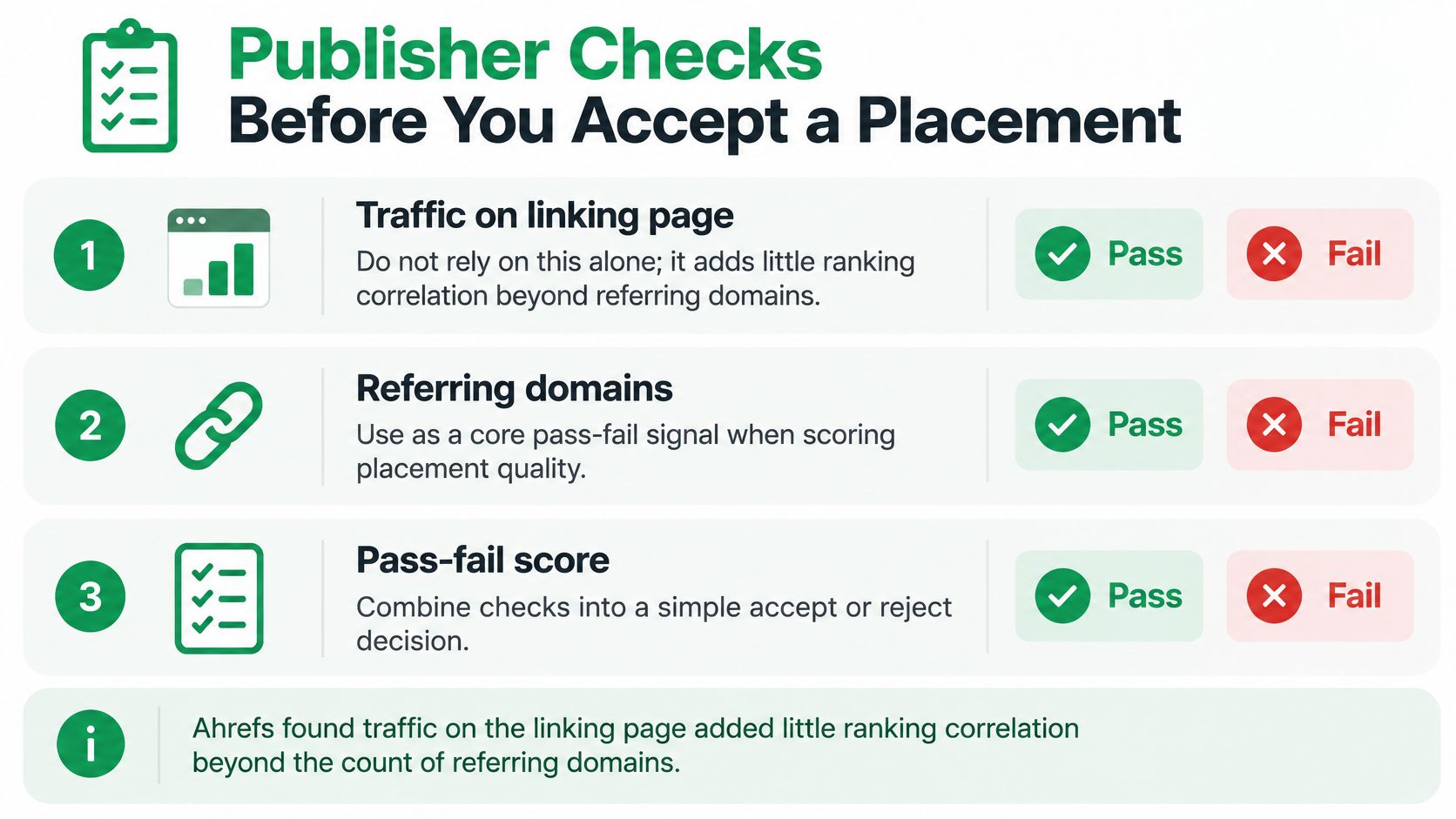
A single Domain Rating score can't approve a placement. Neither can publisher traffic by itself. Ahrefs found referring-page traffic had little additional correlation with rankings compared with the total number of referring domains, and recommended prioritising high URL Rating pages and websites with many referring domains, according to Ahrefs' study of links from pages with traffic.
Use that finding as one part of a pass or fail review. Check whether the article covers your software category, whether Google has indexed it, whether it ranks for related language, and whether the destination matches the reader's task. A large technology blog can still be a poor fit if the article is generic, orphaned, or crowded with unrelated outbound links.
Publisher pass and fail checks
| Signal | Pass | Fail |
|---|---|---|
| Topical fit | Covers the software category, integration, or workflow | Generic roundup unrelated to the product |
| Referring domains | Diverse real sites at the domain level | Inflated authority with few genuine referring domains |
| Linking page | Indexed and ranks for related terms | Orphan, noindexed, or no relevant keywords |
| Organic audience | Earns traffic from Google | No audience or an inactive site |
| Outbound links | A few contextual links in the article | Page saturated with paid or exchanged links |
| Disclosure | Editorial, or paid links marked sponsored or nofollow | Paid dofollow meant to pass ranking credit |
Relevance Can Beat Raw Reach
A specialist operations publication with modest traffic may be the better placement for a warehouse workflow product if its readers already search for that integration and implementation problem. The link's words and surrounding copy also matter, so check what a do-follow backlink would say about the destination before you approve it.
Reject private blog networks, inactive domains, and sites built mainly to sell placements. We avoid dead sites, PBNs, and domains with no audience, focusing on publishers that rank for keywords and earn traffic from Google. As our team publicly states, "Real sites with traffic beat DR games. Every time."
Paid or sponsored placements need correct disclosure, using rel="sponsored" or rel="nofollow" where payment is involved. Links created mainly to manipulate rankings create risk rather than durable authority. Approve the domain and topic before outreach, and keep only placements that pass every row.
Prospecting and Pitching Approved Publishers
Turn your approved list into one prospect sheet. Give each domain a single row with the destination URL, the best contact role, and the publisher article that already covers related terms. This prevents a common outreach failure where the same editor receives three vague pitches for three unrelated assets in one quarter.
Match each row to one clear angle. A partner blog might receive an integration walkthrough. A practitioner newsletter might receive a benchmark. A vertical publication might receive an implementation checklist. The editor should see the reader benefit before seeing your product name.
Write a short first message. Name the specific article you're hoping to improve, state the finding, template, or walkthrough in one or two sentences, and don't drop a link into the opening pitch. Say why the addition helps that article's readers complete a task, compare options, or avoid a mistake.
Run the Follow-Up and Record the Outcome
Send one follow-up on day 4 with a new detail rather than a generic reminder. Send a final note on day 10, then close the thread if there's no reply. Log every outcome as accepted, declined, needs paid disclosure, or no answer.
For accepted work, record the live URL, anchor, rel attribute, target page, and publication date. Check the placement weekly so a removed link, changed anchor, or altered attribute doesn't sit unnoticed. Keep a running count of pitches per publisher. Restraint protects relationships and leaves room for a stronger asset later.
Content Angles Editors Actually Publish
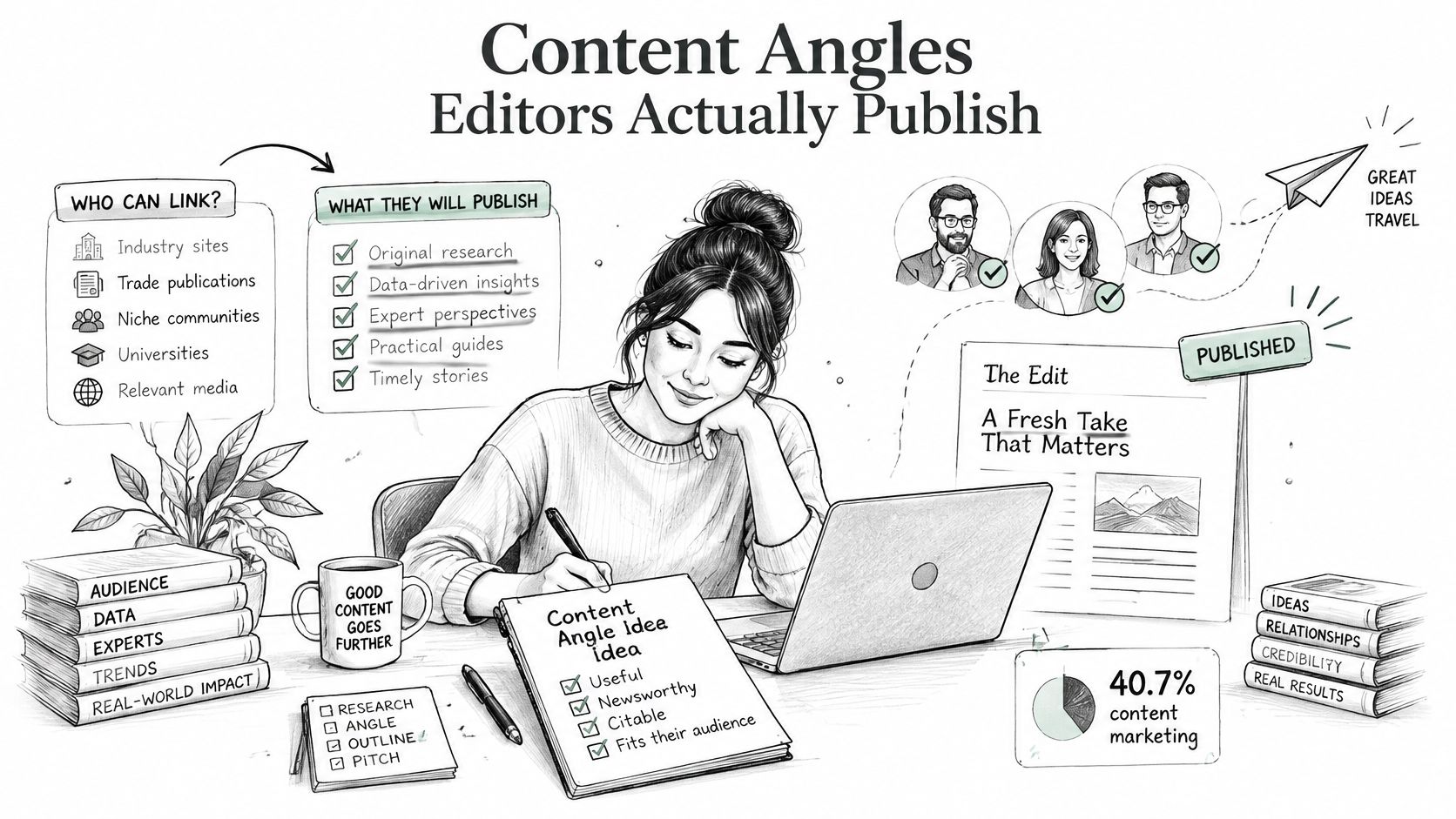
Useful content gives editors a reason to publish even if they never think about your SEO goal. In uSERP's 2024 State of Backlinks study, 40.7% of respondents identified content marketing as the strongest passive link-building method, according to uSERP's SaaS marketing statistics summary.
The visual below is a useful reminder to plan the reader's takeaway before drafting the pitch.
Seven Draftable Angles
- Integration teardown: Show setup steps, data sync behaviour, and failure points, then point readers to the integration page. Pitch the partner or platform blog.
- Implementation checklist: Turn onboarding mistakes into a task list for documentation. A practitioner community or operator newsletter is a natural home.
- Original benchmark: Publish product or industry data with methodology and point coverage to the research page. Analyst and operator publications can cite the result.
- Security questionnaire explainer: Explain how buyers answer common controls and evidence questions, with the trust page as the destination.
- Pricing-model comparison: Compare seat, usage, and platform models without turning the piece into a sales claim.
- Workflow template: Give readers a reusable approval, onboarding, or reporting template tied to one use-case page.
- Migration story: Explain the before-and-after process and choices behind a switch, supporting a comparison or use-case URL.
Don't pitch one study five ways. Assign one angle, one destination, and one publisher type to each asset.
A guest post is a new expert article written for a publication after domain and topic approval. A niche edit adds a contextual reference inside an existing article that already has readers and search visibility. Editors come first in both formats, so the contribution should add a finding, worked example, template, or clearer explanation rather than a thin paragraph built around your anchor.
The video below offers another view on turning expertise into publishable material before you finalise a pitch.
For this month, prepare three pitches only: one data piece, one integration piece, and one implementation piece. That shortlist forces each asset to earn its place.
Link Velocity by Page and Market
A fixed quota such as the same number of placements every month treats unlike pages as if they carry the same news value, competition, and risk. An Ahrefs-based summary of 10,000 non-branded keywords found top-ranking pages tended to gain followed links from new referring domains at roughly 5% to 14.5% monthly, according to Rhino Rank's link building statistics summary.
Treat that band as an observed range, not a safe-velocity formula. Google doesn't publish a monthly pace you can copy. Your job is to decide where each page belongs in the portfolio and whether the acquisition story is credible.
Link pace by SaaS page situation
| Page situation | Pace versus 5 to 14.5% monthly | Anchor mix | Stop signal |
|---|---|---|---|
| New product or launch URL | Upper part of the range if there is real news | Mostly branded and descriptive | Links arrive with no impressions growth |
| Original research or template | Upper part of the range while the asset is new | Study title or descriptive phrase | Citations are off-topic or syndicated copies |
| Integration page | Middle of the range, tied to real partners | Integration name plus brand | Partner sites with no audience |
| Mature comparison or category page | Lower part of the range | Descriptive, limited exact match | Referring domains rise and non-brand clicks do not |
| Low-volume B2B niche | Below the range if relevance would suffer | Branded and niche phrases | Any placement outside the workflow |
| Homepage | Well below the range | Brand only | Exact-match commercial anchors |
New research, a partner launch, or a useful template can justify faster discovery. A mature comparison page with an established citation history usually needs slower growth and tighter topical fit. In a narrow B2B niche, there may not be enough credible publishers to hit the observed band without lowering standards. Don't lower them.
Keep most anchors branded or descriptive. Reviewing a clear anchor text example helps writers describe the destination naturally instead of repeating a money keyword. Exact-match anchors should stay a small share of any month.
Pause a URL when referring domains climb but impressions, qualified non-brand clicks, and conversions stay flat.
That pause isn't failure. It tells you the page may need better intent match, stronger internal links, or a more publishable asset before more outreach makes sense.
Ranking Links and AI Search Citations
Followed links don't capture every way buyers discover a SaaS brand. An analysis of 75,000 brands reported branded mentions, both linked and unlinked, correlated with AI Overview visibility at Spearman r=0.664, while backlink count correlated at r=0.218, according to Maximus Labs' SaaS link building analysis. The same analysis reported YouTube presence correlated at r=0.737.
Those figures don't prove that buying mentions causes AI citations. They're correlations from industry research. Still, they expose a blind spot in reports that count only followed links and keyword positions.
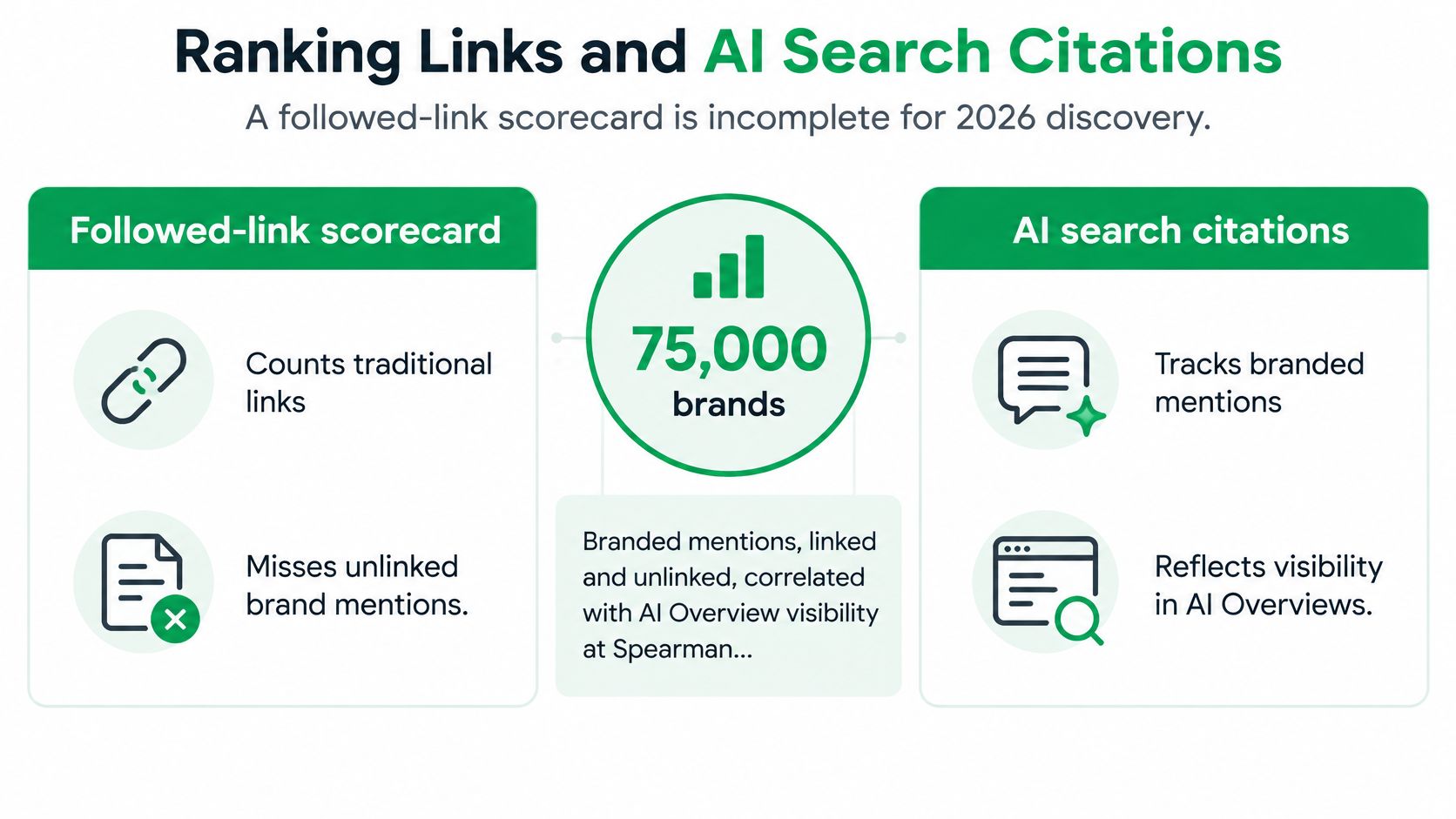
Keep Two Scorecards
Your ranking stack measures unique referring domains to a target URL, relevance of the linking page, anchor context, non-brand impressions, and rankings. Your entity stack measures how often independent sources name the brand, which source types are represented, and whether buyers can corroborate the product across reviews, documentation, communities, video, and editorial coverage.
Read four numbers each month:
- New referring domains: Count unique domains linking to chosen URLs.
- New unlinked mentions: Capture brand references that don't include a link.
- Source diversity: Separate editorial, partner, review, community, documentation, and video sources.
- Branded demand: Watch branded-search interest alongside third-party citations.
Don't replace the page map with mention chasing. A guest post alone won't create entity prominence. Original data, integration explainers, product walkthroughs, and credible customer workflows are stronger because researchers and buyers can cite them again later, with or without the original link.
Google's generative features still rely on core ranking and quality systems, so relevant links retain value for discovery and understanding. Run both scorecards for the same campaign period. Ask whether placements produced rankings, qualified traffic, brand mentions, and citations, not just a longer backlink export.
Run a 90-Day Campaign and Read the Results
Run the campaign as a controlled page-level test, not a shopping exercise. In Editorial.Link's survey of 113 SEO professionals, 53.9% of surveyed SEO specialists reported spending more than $300 to acquire one quality link in 2024, according to Editorial.Link's survey post. Budget for fewer, better placements.
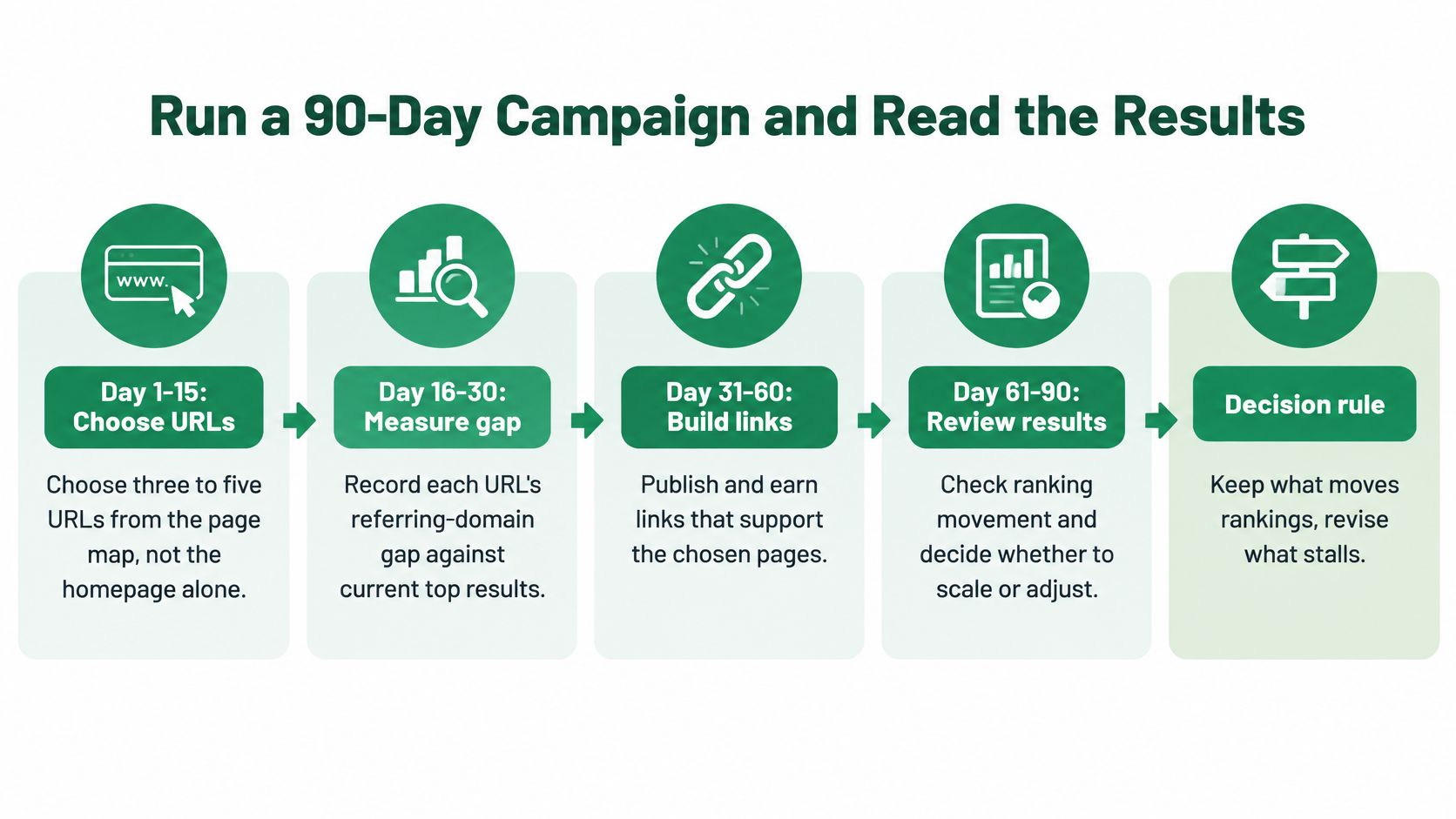
- Choose three to five URLs: Select commercial and citation pages, not the homepage alone.
- Record the gap: Benchmark unique referring domains and relevance against current top results.
- Approve publishers: Accept only sites passing every publisher check.
- Ship three angles: Publish one data, one integration, and one implementation story.
- Control pace and anchors: Keep growth in the page's velocity row, mostly branded or descriptive.
- Check placements weekly: Confirm live URLs and attributes, then revise targets or volume when checks fail.
- Read results at day 60 to 90: Judge the same URL cluster you funded.
90-day SaaS link campaign metrics
| Metric | What to record | What it does not prove |
|---|---|---|
| Referring domains | New unique domains to each target URL | A fixed ranking gain |
| Non-brand demand | Impressions and clicks on the URL cluster | That branded traffic improved the product |
| Assisted conversions | Trials or demos assisted by organic visits | Last-click revenue only |
| Anchor mix | Share branded, descriptive, and exact match | That exact match is safer |
| Placement log | Live URL checked each week | That a high DR score was enough |
| Brand mentions | Linked and unlinked citations by source type | Inclusion in an AI answer |
Continue when relevant referring domains rise with qualified non-brand demand or assisted conversions. Slow down when only the link count moves. We provide clear scope and pricing before any work starts, and we don't guarantee specific rankings, traffic amounts, or revenue outcomes. As proof of what a sustained campaign can support, Linkbuilding.services reports +212% organic traffic for a SaaS client from March to December 2025, without treating that result as a promise for another site.
Write the URL list and publisher rules before buying any placement.
If your SaaS team needs help turning that page map into approved publishers, publishable angles, and verified placements, visit Linkbuilding.services to review scope and pricing before work begins. Bring your priority integration, comparison, and use-case URLs, and ask for a 90-day plan that you can judge by qualified non-brand demand rather than raw link totals.