SEO Costs Per Month and What the Fee Buys
SEO costs per month cluster at $501–$1,000, not one rate. See 2026 bands, what retainers include, and how to judge value.

The most common SEO costs per month are $501 to $1,000, while 68.8% of providers charge $2,000 or less and agencies average $3,209 compared with $1,348 for freelancers. There's no single market rate, and that spread matters more than any average you'll see quoted in a sales deck.
A cheap retainer isn't automatically bad value, and an expensive one isn't automatically complete. You're buying a basket of work, not a ranking. Judge the fee by what you can inspect each month, pages shipped, fixes closed, publishers approved, live URLs reported, and by whether you've paid for enough months to see reliable evidence.
Monthly SEO Price Bands You Can Look Up
Start with the distribution, not a headline average. A single number hides where quotes actually cluster, who is quoting, and how much work could realistically fit inside the fee.
Monthly SEO Retainer Bands From a 439-Provider Survey
| Band or provider | Survey figure | What to assume |
|---|---|---|
| Most common retainer | $501–$1,000 (20.4%) | Narrow local or foundational work |
| $501–$2,000 | 42.8% of providers | Partial ongoing program |
| $2,000 or less | 68.8% of providers | Where most quotes cluster; the average is higher |
| Agency average | $3,209; 57.4% charge $1,001+ | Broader team, still not automatically full service |
| Freelancer average | $1,348; 32.2% charge $1,001+ | One practitioner and a shorter task list |
Treat every row as a 2024 Ahrefs snapshot, not a fixed rate card. The Ahrefs survey of 439 SEO providers reported that 78.2% offered monthly retainers, so recurring payment is the dominant commercial model. The most common price band was $501–$1,000 per month, selected by 20.4% of respondents, while 42.8% charged between $501 and $2,000 monthly.
That clustering explains why averages mislead buyers. Overall, 68.8% charged $2,000 or less per month, so a published average above that level is pulled upward by a smaller group of higher-priced engagements. If you budget to the average without checking the distribution, you'll either overpay for a narrow brief or assume a low quote buys the same scope as a larger program.
Provider Type Changes the Price
Provider type materially affected cost in the same survey. Agencies averaged $3,209 per month, compared with $1,348 for freelancers, and 57.4% of agencies charged at least $1,001 monthly, versus 32.2% of freelancers. That gap doesn't prove agencies do better work. It tells you an agency fee usually spreads across more people, tools, and coordination.
Read a quote against the band it sits in. A fee near the most common band can be sensible for a narrow local or foundational brief, such as cleaning up priority service pages or fixing clear indexation problems. It's unrealistic to expect that same fee to also fund technical implementation, content production, reporting, research, and sustained link acquisition at pace.
Reading rule: Ask which band a quote belongs to, then ask which deliverables explain its position in that band.
A higher fee needs a longer, verifiable task list. A lower fee needs an honest list of exclusions. If a provider can't connect the monthly amount to named outputs, hours, or roles, the price comparison is meaningless even if the number looks familiar from the table.
Use the bands as a sanity check before procurement, not as a negotiation target. Your aim isn't to force every quote toward $501 to $1,000. It's to avoid paying a full-program price for partial work, or expecting a full program from a partial budget.
Why Agencies and Freelancers Quote Differently
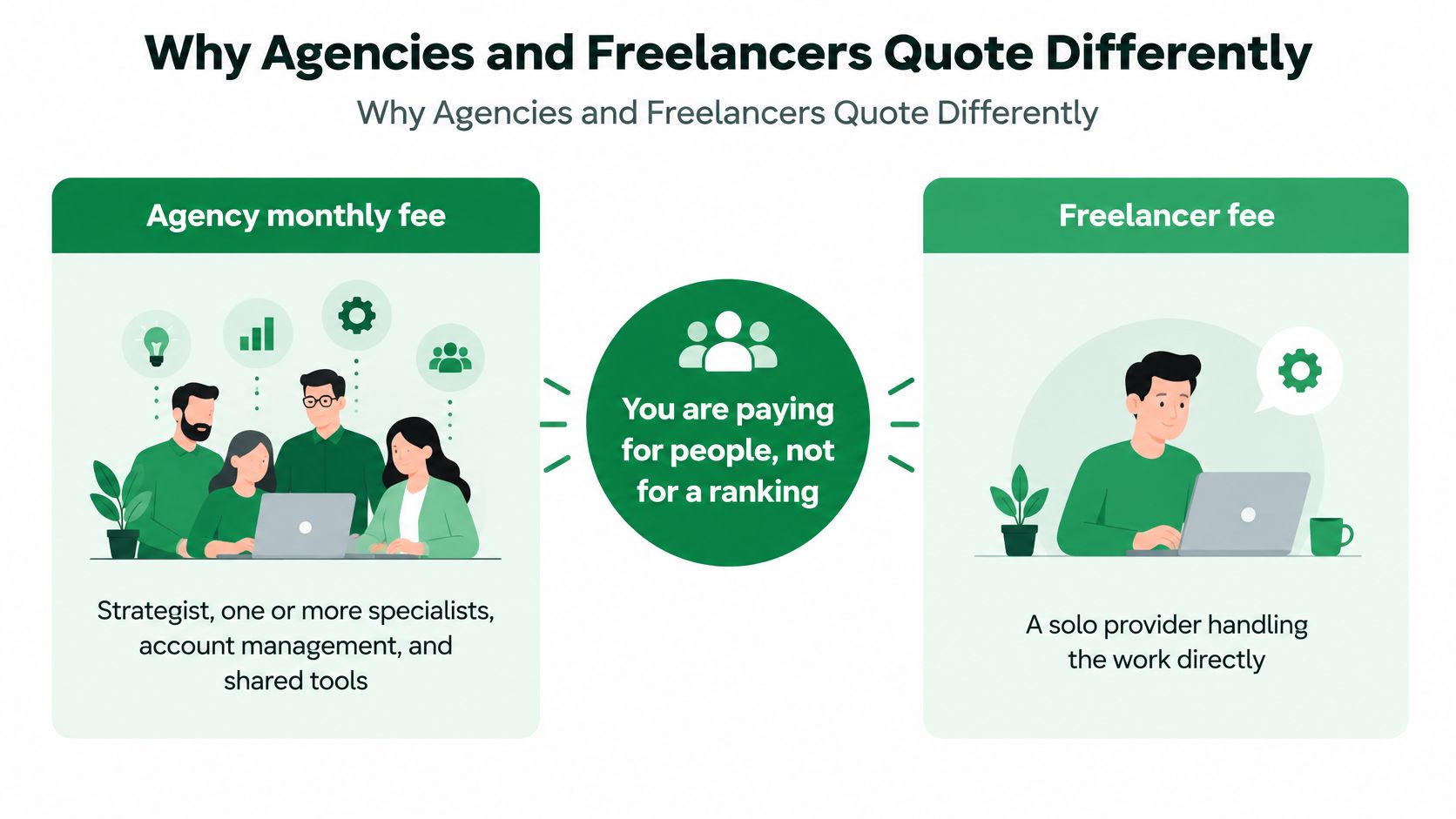
You're paying for people, not for a ranking. That distinction explains most of the gap between agency and freelancer quotes, even when both providers use the same service label.
An agency monthly fee usually covers a strategist, one or more specialists, account management, and shared tools for crawling, keyword research, and reporting. A freelancer fee usually covers one person's time and a shorter task list. A skilled freelancer can outperform a weak agency team, but they can't be in three specialist roles at once.
The comparison below shows the labor behind the invoice.
Price references also depend on who was surveyed. In December 2024, the SE Ranking and Duda pricing survey covering 260 agencies reported that 64% charged less than $1,000 per month and 30% charged less than $500 per month. That's a different population from a broader provider sample where agency averages sit higher, so don't treat the small-agency figure as a typical invoice for every market or scope.
The Third Option Is In-House Labor
An in-house program is a third sum altogether. It includes salary, benefits, and software, plus any specialist work you still outsource, such as technical audits or publisher outreach. Comparing an agency retainer with a salary alone understates the internal cost and ignores the management time needed to turn recommendations into shipped work.
Say you hire one SEO generalist internally. You may still need a developer for template fixes, a writer for content, and outreach capacity for authority work. Those gaps either delay the program or become extra contractor fees on top of payroll.
Four Questions That Make Quotes Comparable
- Which roles are included: Name the strategist, technical specialist, writer, outreach lead, and account contact, or mark the role as absent.
- How much is promised monthly: Convert the fee into hours or concrete deliverables, such as pages edited, issues closed, or placements approved.
- Which tools remain your cost: Confirm whether crawl software, rank tracking, analytics, and content tools are included or billed to you.
- What gets handed back: Check whether your team must implement technical changes, approve copy, or build internal links.
The cheaper quote wins only when the missing roles are work your site doesn't need. If a freelancer excludes technical implementation and your site has serious crawl problems, the lower fee isn't a saving. It's deferred cost.
What Each Monthly Budget Actually Includes
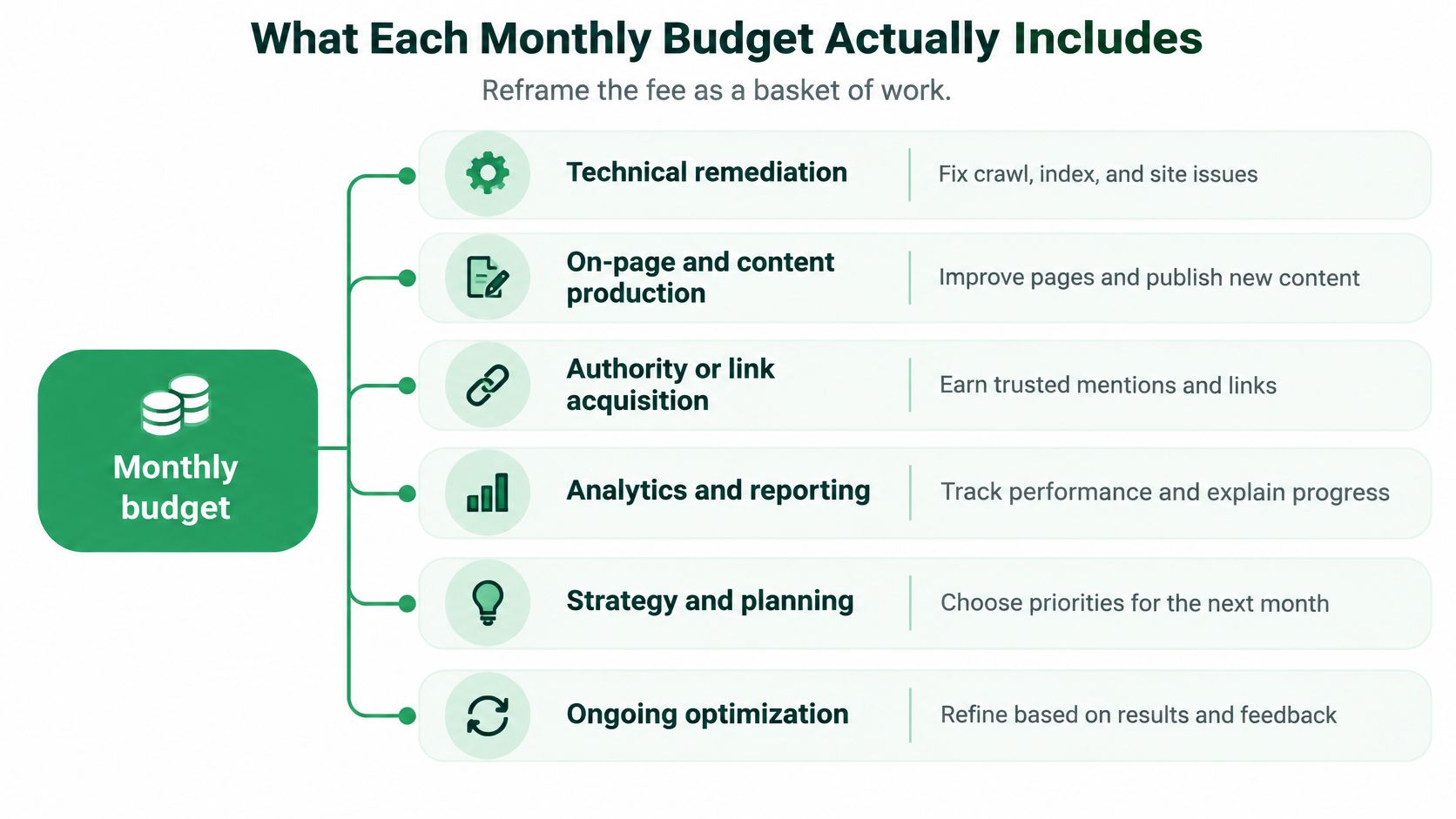
Monthly cost isn't monthly scope. Two retainers with the same sticker price can hold completely different baskets of work, which is why the line items matter more than the package name.
Six categories usually compete for the fee. They are technical remediation, on-page and content production, authority or link acquisition, analytics and reporting, strategy, and account management. A proposal that funds strategy and reporting heavily may leave little capacity for implementation or outreach.
The diagram below reframes the fee as that basket of work.
What a Monthly SEO Budget Typically Includes
The tiers below are a planning model, not a second price survey. Use them to test whether a proposal's scope fits its price.
| Monthly budget | Work that fee can cover | Often excluded |
|---|---|---|
| $500–$1,000 | Audit, limited recommendations, or a small local task set | Implementation, scaled content, outreach |
| $1,001–$2,500 | Recurring on-page work, modest content, basic reporting | Heavy technical builds and sustained link acquisition |
| $2,501–$5,000 | Technical implementation, content, publisher research, monthly reporting | Multi-market or large-catalog programs |
| $5,001–$10,000 | Several specialists, testing, faster authority building | Unlimited scope or guaranteed revenue |
At the lowest tier, the useful output might be a prioritized audit, metadata fixes on priority pages, and Google Business Profile cleanup. That can be enough for a simple site with clear problems. It won't also cover developer implementation, a content calendar, and publisher outreach.
The middle tiers buy repetition. Your provider can revisit templates, publish or improve pages each month, track target keywords, and report on what changed. Authority work becomes plausible, but you still need to check publisher quality, relevance, and approval rights rather than counting links alone, especially when weighing formats such as guest posts compared with niche edits.
A low monthly price is efficient when the brief is narrow, and misleading only when it is sold as a complete SEO program.
Send one question with every proposal. What is delivered this month, what is excluded, and which outputs can be verified? A credible answer names pages, fixes, research tasks, placements, and reports. A vague answer about optimization, authority, or visibility gives you nothing to inspect when the invoice arrives.
How Retainers, Projects, and Hourly Fees Differ
Payment shape is separate from price level. Judge each model by whether the work repeats, not by which option sounds cheapest in the first month.
A monthly retainer fits work that repeats, crawling, content improvements, outreach, and reporting. You get continuity, but you also need a monthly deliverable list or the retainer becomes a standing charge. In 2024, Ahrefs' survey of 439 SEO providers found that monthly SEO retainers ranged from $250 to $10,000, with 63% of providers charging between $500 and $5,000 per month.
That range shows both very small and five-figure monthly fees exist inside ordinary contracts. It doesn't tell you which one fits your site. Fit comes from the task list and the pace at which those tasks must repeat.
Projects and Hourly Billing
A project fee suits a bounded job, such as an audit, a migration plan, or a one-time cleanup. It stops when the project ends, so it doesn't buy the next round of fixes after new pages, products, or templates launch. Ownership is usually clear because you receive a defined document, build, or set of changes.
Hourly billing works for overflow tasks if you set a monthly cap and approve work in advance. Without a cap, it hides the true SEO costs per month until the invoice arrives. Ask for time entries tied to specific pages, tickets, or deliverables, not generic optimization hours.
Performance Deals and the Hybrid
Performance or revenue-share deals sound precise and fail as a plan because rankings, traffic, and revenue lag behind implementation and have more than one cause. Pricing changes, seasonality, stock levels, and site releases can all move revenue independently of SEO work. You'll spend more time arguing attribution than improving pages.
Compare the four models on three points. Check the commitment, what pauses if payment stops, and who owns the work product. Content and link acquisition usually fit a retainer better than a single project because publishers, indexing, and measurement need several cycles.
The hybrid that usually works is simple. Pay a fixed fee for an audit first, verify the task list, then size a retainer to the work you've confirmed.
How Many Months of Fees Before You Judge
Don't judge a retainer against a one-month ranking. Search systems need time to recrawl pages, process changes, and collect performance data, so the evaluation window is part of the budget.
The timeline below sets that expectation before you review results.
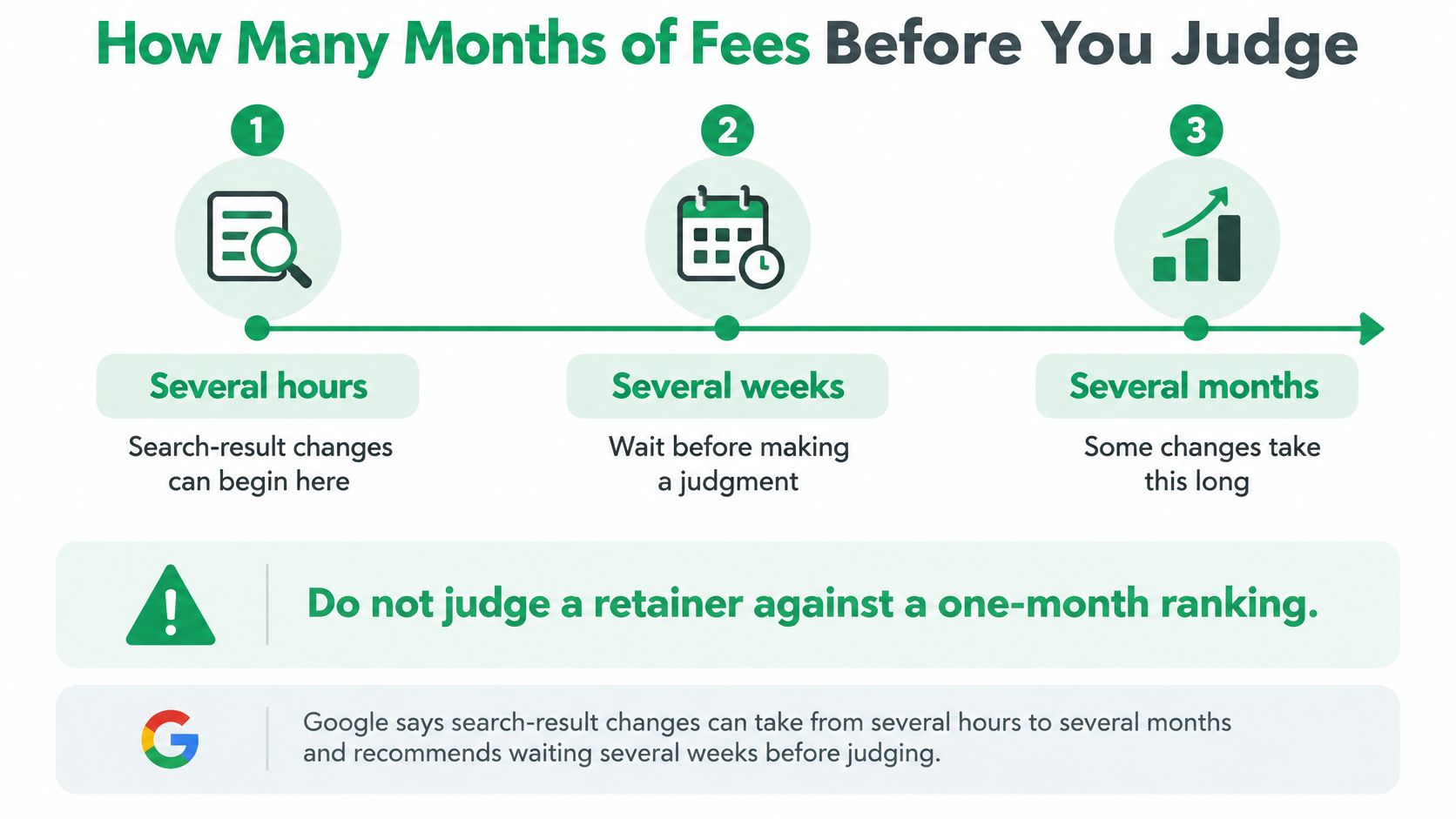
Google's guidance on making site changes states that search-result changes can take from several hours to several months and recommends waiting several weeks before assessing whether an intervention was beneficial. That makes a single monthly invoice a poor unit for judging impact. You need baseline crawling and keyword tracking, technical remediation, content or target-page improvements, relevant authority development, and validation through impressions, clicks, rankings, and conversions.
Budget in Cycles, Not Invoices
Month one is mostly setup. Your provider establishes baselines, fixes tracking gaps, prioritizes technical issues, and ships the first changes. A three-month commitment is often the minimum practical planning horizon for diagnosing early movement.
Competitive sectors and authority-focused work may require longer observation because Google must recrawl pages, reassess signals, and accumulate enough performance data. New domains, international pages, and ecommerce category templates can also need more time, particularly for programs such as link building for SaaS sites where target pages compete against established brands.
Separate two budget types. A testing budget establishes impressions, clicks, rankings, and conversions on a defined page set. A scaling budget expands the pages, content, and authority work that already show signs of life.
The video below reinforces why timing expectations need to be agreed before work begins.
What to Review at 90 Days
Review leading indicators before commercial outcomes. Check crawlability, indexed pages, the quality of new referring domains, target-keyword visibility, and qualified referral traffic. Keep non-brand organic revenue as a later metric, because it depends on ranking gains converting into visits and then into sales or leads.
Change provider, tactic, or budget when the agreed leading indicators are flat and the deliverables don't explain why. Don't cancel solely because revenue hasn't arrived while implementation is correct and early indicators are moving inside the evaluation window.
Sample Monthly Budgets for Three Business Types
The sketches below are planning examples built from the price bands, not survey averages. Use them to map your must-have line items before you request quotes.
Local Service Business at About $750 to $1,500
Say a plumber serves one city from one location. A monthly budget around $750 to $1,500 can cover Google Business Profile and citation cleanup, a handful of service pages, and light on-page work. It usually includes little or no outreach, which is fine if competitors are weak and the site's main problems are missing pages and inconsistent business details.
This sketch sits near the common lower band because the geography and page count are contained. Ask what happens after the cleanup ends. If the same fee continues, it should fund new service or location content, review support, and recurring technical checks rather than repeating a setup checklist.
B2B or SaaS at About $3,000 to $6,000
A B2B or SaaS site usually needs a wider basket. Budget around $3,000 to $6,000 for technical fixes, comparison or feature pages, supporting content, and a steady authority program. One practitioner rarely covers product content, technical SEO, analytics, and publisher outreach well at the same pace.
Linkbuilding.services reports a campaign result of +212% organic traffic for a SaaS client from March to December 2025. Treat that as a reported campaign outcome over a sustained period, not a monthly promise. At the first review, check indexed priority pages, referring-domain quality, and target-keyword visibility before you judge pipeline impact.
Ecommerce at About $4,000 to $8,000
An ecommerce budget around $4,000 to $8,000 can fund category and product-template fixes, supporting content, and links aimed at revenue pages rather than the homepage alone. Large catalogs also need crawl prioritization, faceted navigation control, and internal linking work, so confirm whether developer implementation sits inside the fee.
Linkbuilding.services reports a campaign result of +148% revenue from SEO for an eCommerce client from March to December 2025. We don't guarantee specific rankings, traffic amounts, or revenue outcomes. For your own store, map must-have items onto the nearest sketch, then check which items each quote leaves out before comparing totals.
Check Deliverables Before You Keep Paying
Run a pass-fail check before the next invoice. Don't renew because a report looks busy or a ranking chart moved in the right direction for a week.
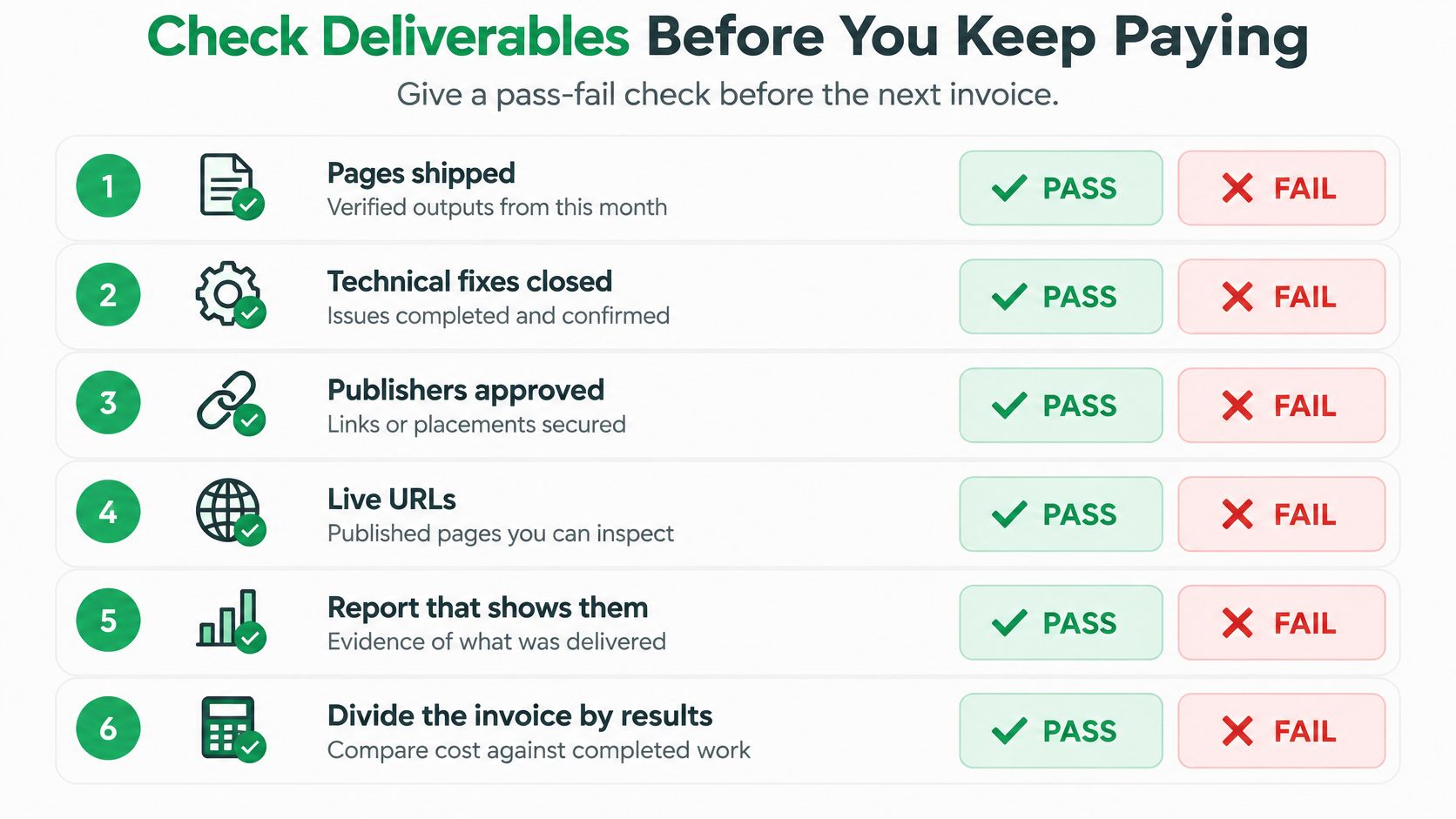
- List verified outputs: Record pages shipped, technical fixes closed, publishers approved, live URLs, and the report that shows them.
- Divide fee by outputs: Drop or renegotiate any line item you can't inspect, following the logic behind how you improve Google search rank through verifiable page and authority work.
- Confirm exclusions in writing: Make sure a low fee isn't mistaken for a full program.
- Price missing outreach separately: Test publishers for real traffic and topical fit, not only a high authority score.
- Separate indicators from revenue: Don't cancel on rankings alone while agreed leading indicators are still moving.
We provide clear scope and pricing before any work starts and live reporting on link building campaigns. Our third step is creating a 90-day roadmap covering target pages, anchor plan, link velocity, publisher criteria, and content angles, with pre-approval built in.
Keep the retainer, narrow it to work you can verify, or replace it. Base that decision on inspected deliverables rather than the sticker price.
If outreach is the missing line item in your monthly budget, we can scope managed guest posting and contextual placements with publisher pre-approval, live URLs, and reporting you can check before you scale spend. Visit Linkbuilding.services to set target pages, publisher criteria, and a 90-day roadmap before the next invoice cycle.