Do Follow Backlink Meaning and Quality Checks
Learn what a do follow backlink is, how Google treats links without nofollow or sponsored, and which quality checks decide if one is useful.
A do-follow backlink is an ordinary crawlable hyperlink without rel="nofollow", rel="sponsored", or rel="ugc", not an official HTML attribute. The missing qualifier alone doesn't create ranking value.
That challenges the most common advice about backlinks: get more followed links and assume they're better. A useful assessment starts with different questions. Why did the publisher include the reference, who reads the page, and does the destination genuinely help those readers?
What a Do Follow Backlink Actually Is
| Link people call it | rel value | Typical reason it exists | How to treat it |
|---|---|---|---|
| Do-follow or ordinary editorial link | None of nofollow, sponsored, or ugc | A publisher cites a page it chooses to endorse | Eligible for discovery, crawling, and ranking evaluation, not a guaranteed lift |
| Nofollow | nofollow | Publisher doesn't trust or want to endorse the destination | A hint, not a promise the link is ignored; the destination may still be discovered another way |
| Sponsored | sponsored | Advertisement, sponsorship, or other compensation | Should be qualified; don't present it as a normal editorial endorsement |
| UGC | ugc | Comment, forum post, or other user-inserted link | Qualify user content; nofollow is the alternative when ugc isn't used |
Do-follow is an operational label, not something you need to add to HTML. Google's documentation on qualifying outbound links distinguishes ordinary links from links carrying qualification values, but it doesn't require a dofollow attribute.
A backlink is an incoming link from another website. The publisher sees an outbound link on its page; you see a backlink pointing to yours. Both descriptions refer to the same HTML element.
For example, an ordinary reference might look like <a href="/inventory-guide">inventory planning guide</a> on the destination website, with an external publisher using that guide's full address in its own href. The href identifies the destination, while rel can describe the relationship between the linking page and that destination.
What the qualification changes
In September 2019, Google introduced sponsored and ugc and changed its treatment of nofollow to a hint, as described in the Google documentation linked above. These values help distinguish editorial references from advertising, user submissions, and links a publisher doesn't want to endorse.
That distinction isn't a ranking switch. An ordinary link can be eligible for evaluation without receiving meaningful ranking weight. A qualified link also doesn't make the destination disappear from search: Google may discover that URL through a sitemap or another website.
Practical rule: Treat link status as a description of the markup, not a verdict on the placement's quality.
An empty qualifier isn't an endorsement certificate
A publisher can omit qualifying values from a thoughtful citation, an irrelevant footer link, or a compensated placement. The HTML alone doesn't tell you which situation you're looking at.
Relevance, editorial context, publisher quality, crawlability, and the surrounding link pattern still matter. A reference inside a useful explanation gives you more to assess than a followed label in an outreach spreadsheet.
Before labeling any placement a do follow backlink, inspect the live link's rel value. A proposal can describe an intended placement; only the published page shows what readers and crawlers can encounter.
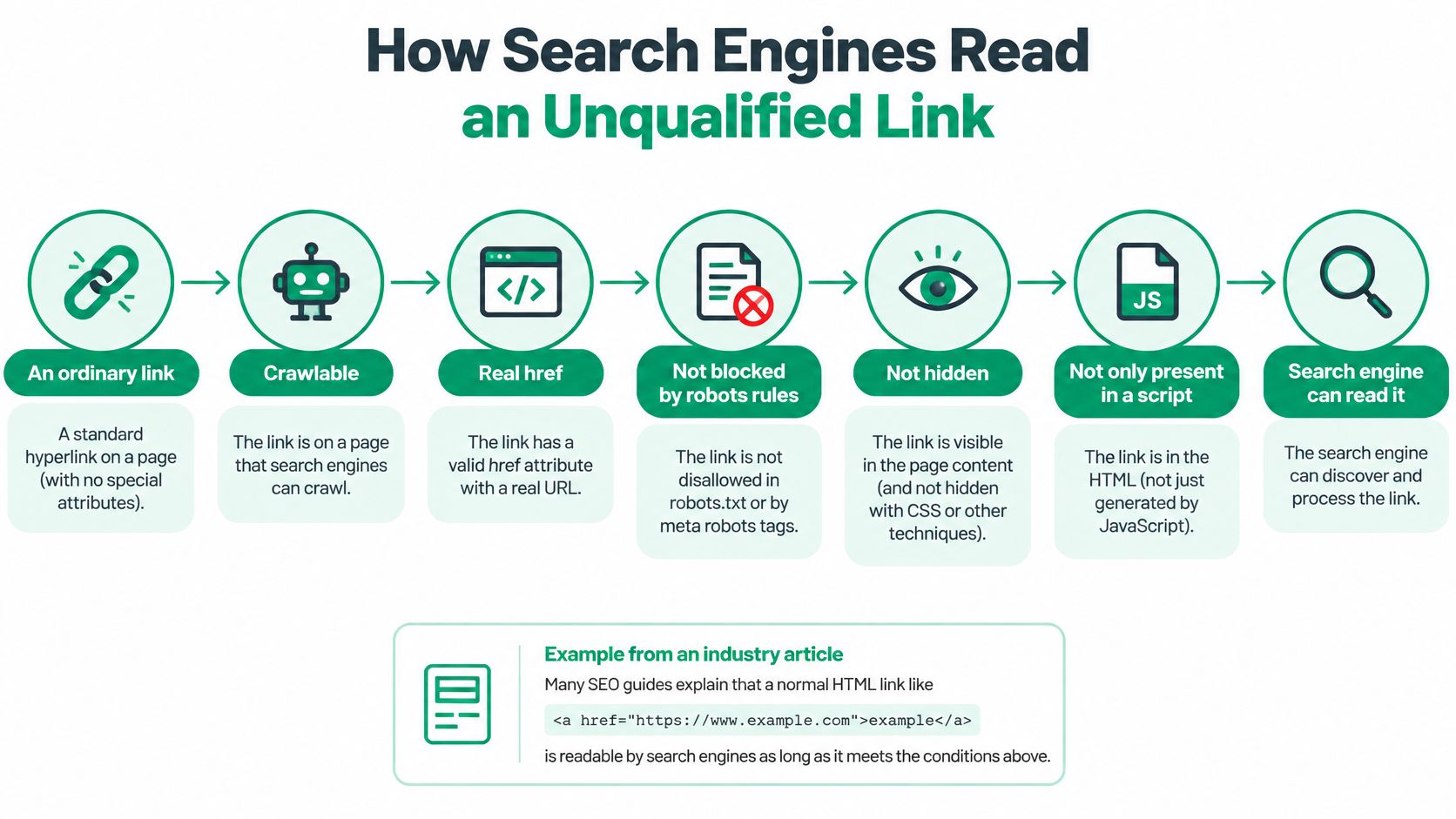
How Search Engines Read an Unqualified Link
Say an industry article explains how manufacturers forecast stock requirements. Its author cites an inventory-planning guide because the guide explains the calculation behind a recommendation. Follow that reference through the process, rather than jumping straight from publication to ranking improvement.
The technical path starts with a link the search engine can extract.
Discovery and crawling are different jobs
Discovery means Google finds a destination URL. The industry article might supply that address, but another website or a sitemap could supply it too. Finding an address doesn't establish that its content deserves a prominent search position.
Start with a real <a> element containing an href. A button that submits a form, a click handler with no usable destination, or text styled to resemble a hyperlink isn't an equivalent implementation.
JavaScript isn't automatically a problem. What matters is whether the crawler can render and extract a usable link, rather than needing an interaction it can't perform. Keep important citations visible and accessible instead of relying on hidden elements.
Crawling means requesting a page and retrieving its content. Check whether robots rules prevent access to the linking page or destination. If Google can't retrieve the article, it can't inspect that page's current reference in the normal way; if it can't retrieve the destination, it can't assess its current content.
Evaluation requires more than an address
Think of a librarian reviewing recommendation cards. An ordinary card can be read without a qualification stamp; a card marked as a paid placement or reader submission supplies additional context about the recommendation. Neither the absence nor presence of a stamp decides whether the recommended book is useful.
For the inventory guide, assess the whole relationship:
- The linking page: Does the article explain inventory planning?
- The anchor: Does its wording accurately describe the guide?
- The surrounding paragraph: Does the citation support a specific point?
- The destination: Does the guide deliver the information the reader expects?
These are practical assessment questions, not a published formula for calculating link value. There's no public conversion rate that turns an ordinary link into a fixed ranking gain.
A reference buried in a repetitive footer and a citation supporting a relevant paragraph can have the same missing rel qualifiers. That doesn't make them equivalent opportunities. The useful question is whether the page and the mention deserve consideration, not merely whether a crawler can read the address.
How to Read a Live Link's rel Value
Open the published page. Use a normal browser, not a screenshot, pitch deck, or copied paragraph. Find the actual anchor text and confirm that it points where you expect.
Inspect the anchor element. In Chrome or Firefox, right-click the linked text and choose Inspect. On Windows or Linux, you can also use
Ctrl+Uto open page source and search for the target domain, although rendered markup can differ from the original source.Read the link's complete
relvalue. A plain<a href="/guide">guide</a>has no link-level qualifier. A value containingnofollow,sponsored, orugcqualifies the link, even when other values appear alongside it.Check page-level instructions. Look in the page's
<head>for a robots meta tag containingnofollow, such as<meta name="robots" content="nofollow">. A page-level instruction applies more broadly than the attributes on the individual anchor.Record what's live. Save the linking URL, anchor text, destination, inspection date, and
relvalue in a shared sheet. Recheck after publication because editors, templates, and CMS plugins can change the markup.
A guest-post example
Suppose an informative guest article contains <a href="/product-guide" rel="sponsored">product selection guide</a>. The paragraph may read naturally, but the published link is qualified as sponsored. Log it that way rather than copying an earlier followed-link promise into the report.
Browser extensions and link checkers can help flag attributes, but confirm the markup by eye. Also separate the observation from the conclusion: missing qualifiers establish link status, not ranking performance.
A live-URL report should let another person reproduce your inspection, not ask them to trust a label.
Quality and Relevance Checks That Matter
Use a candidate's exact linking URL as the unit of assessment. A domain-wide metric can help with screening, but it can't establish whether a particular page has a useful audience or a sensible reason to cite your target.
| Check | Pass looks like | Weak sign |
|---|---|---|
| Topical relevance | Linking page and site already cover the target subject | Unrelated blog, directory, or sidebar with no subject fit |
| Audience | Page ranks and earns organic traffic from real searches | Domain with an authority score but little or no search traffic |
| Editorial context | Link is cited inside a sentence that stands alone | Paragraph written only to insert the URL |
| Anchor | Descriptive phrase a reader would expect | Repeated exact-match commercial keyword |
| Crawlability and rel | Real href, indexable page, no nofollow, sponsored, or ugc | Qualified rel, blocked page, or non-crawlable URL |
| Link pattern | A mention among other useful sources, acquired without manufactured bursts | Many similar placements appearing at once |
A weak sign is a reason to investigate, not proof that every placement on the site is worthless. A qualified link, for example, may be entirely appropriate for advertising. It doesn't meet the specification for an ordinary editorial mention.
Subject fit and a plausible audience
For a SaaS inventory platform, a manufacturing publication's stock-planning tutorial has a clear subject connection. A general entertainment blog with an isolated inventory paragraph has much less. Read the publisher's surrounding coverage instead of accepting a category label in a marketplace.
Check the page in Ahrefs or Semrush for estimated organic traffic and ranking queries. Then inspect those queries: do they match the article's subject, and would their readers plausibly need your destination? Estimates are directional evidence, not access to the publisher's analytics.
A high authority score with little relevant search visibility deserves caution. So does traffic concentrated in unrelated pages while the proposed article appears disconnected from the rest of the site.
A sentence that earns its reference
An editor might cite a returns-policy guide while explaining how shops communicate refund conditions. The sentence should remain useful if the clickable formatting disappears, and the destination should provide the promised detail.
By contrast, a paragraph that abruptly changes subject to introduce a commercial keyword looks manufactured. Compare your proposed wording with these anchor text examples, paying attention to whether a reader could predict the destination from the phrase.
Use authorship as another editorial check. An identifiable contributor, coherent argument, and relevant supporting references give you something to evaluate. A publisher unwilling to explain who wrote the piece or why the reference belongs leaves important questions unanswered.
Technical checks and placement patterns
Open the destination, follow redirects, and check that the source page is accessible and indexable. Don't confuse indexability with confirmed inclusion in Google's index; they're different observations. A public search check is useful evidence, but it isn't the same as inspecting a property you control in Search Console.
Finally, compare the opportunity with the rest of your campaign. Repeated commercial anchors and near-identical paragraphs across unrelated sites warrant a pause. A legitimate publicity event can create a burst of mentions, so investigate the cause rather than treating timing alone as proof of manipulation.
Keep the live URL, anchor, target, and attributes together. Filter for relevance and audience before counting volume, and use authority scores as supporting evidence rather than the decision.
When a Do Follow Link Breaks the Rules
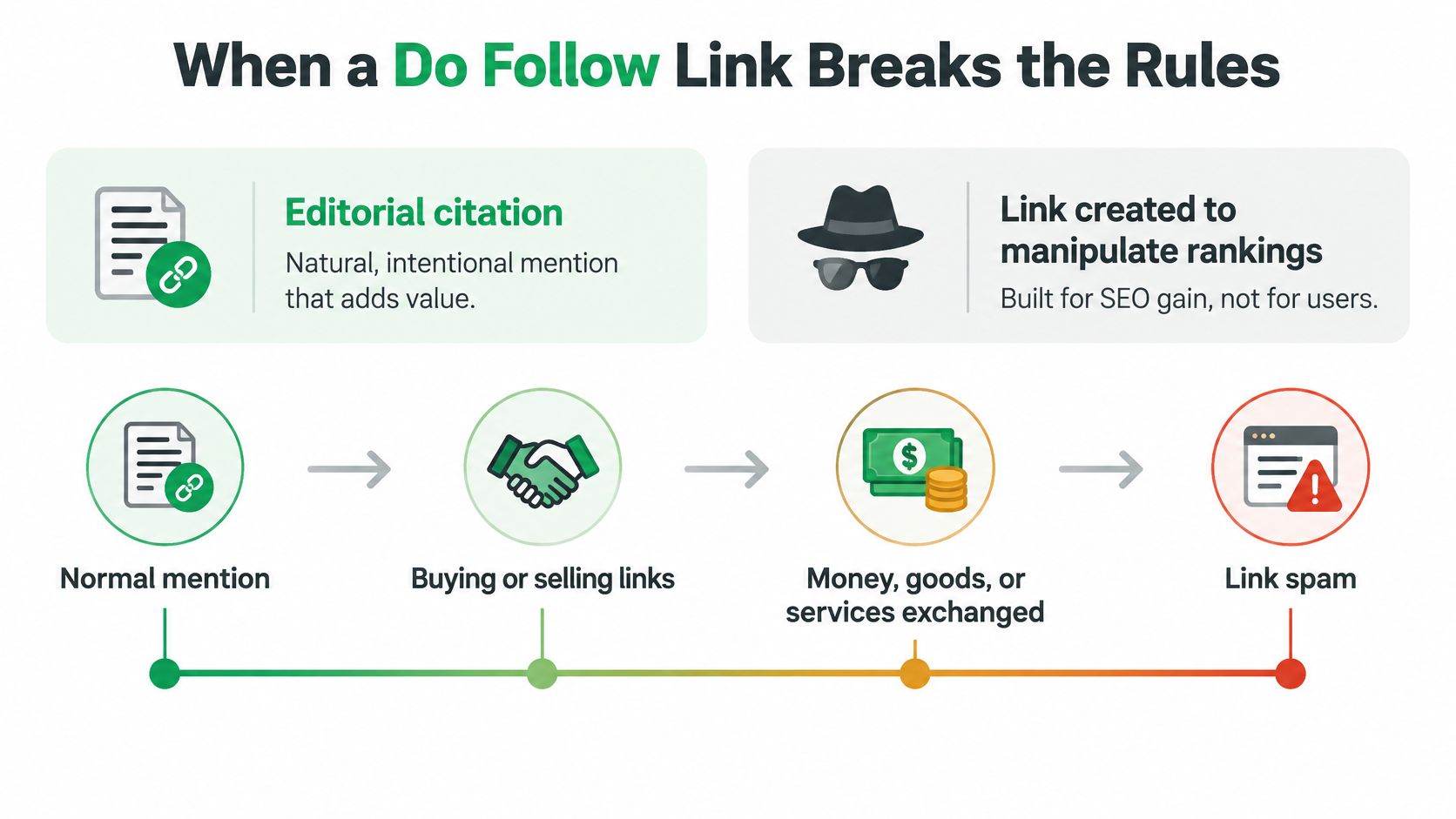
A publisher's willingness to leave a link unqualified doesn't make the arrangement compliant. The important distinction is an editorial citation versus a link created to manipulate rankings.
Google's spam policies classify buying or selling links for ranking purposes as link spam, including money exchanged for links or posts containing links. Advertising can exist, but paid or sponsored links should use rel="sponsored" or rel="nofollow".
The commercial relationship matters before anyone inspects the final HTML.
Can a paid guest post safely remain do-follow?
Not when the arrangement exchanges payment or another benefit for ranking credit. A publisher can technically omit the qualifying value, but that implementation conflicts with Google's guidance for compensated links. Calling the placement a guest contribution or niche edit doesn't change the underlying transaction.
Google's link-spam guidance also addresses exchanges involving goods or services and advertorials with links that pass ranking credit. Excessive link exchanges raise the same concern: the issue isn't limited to a direct invoice for an individual URL.
Paying a writer or outreach team for legitimate work isn't, by itself, the same as paying a publisher for ranking-passing placement. Examine what the publisher receives and what the agreement requires. An arrangement conditioned on an unqualified backlink needs particular scrutiny.
Referral value is a separate outcome
A disclosed sponsored article can introduce a relevant buyer to a product. That referral benefit doesn't require you to describe the link as an independent editorial endorsement.
Keep those outcomes separate in reporting:
- Editorial reference: The publisher independently chooses the citation.
- Sponsored placement: Compensation supports the mention, and the link is appropriately qualified.
- User contribution: A comment, forum post, or similar submission requires suitable treatment rather than an assumption of editorial approval.
The policy distinction doesn't change because a publisher operates in another country or publishes in another language. Nor does a disclosure elsewhere on the page replace the need for suitable link qualification.
Before approving a placement, establish who received compensation, what was disclosed, and which attributes are live. If those answers are unclear, don't certify the placement as an editorial do-follow link.
Where Useful Do Follow Links Usually Come From
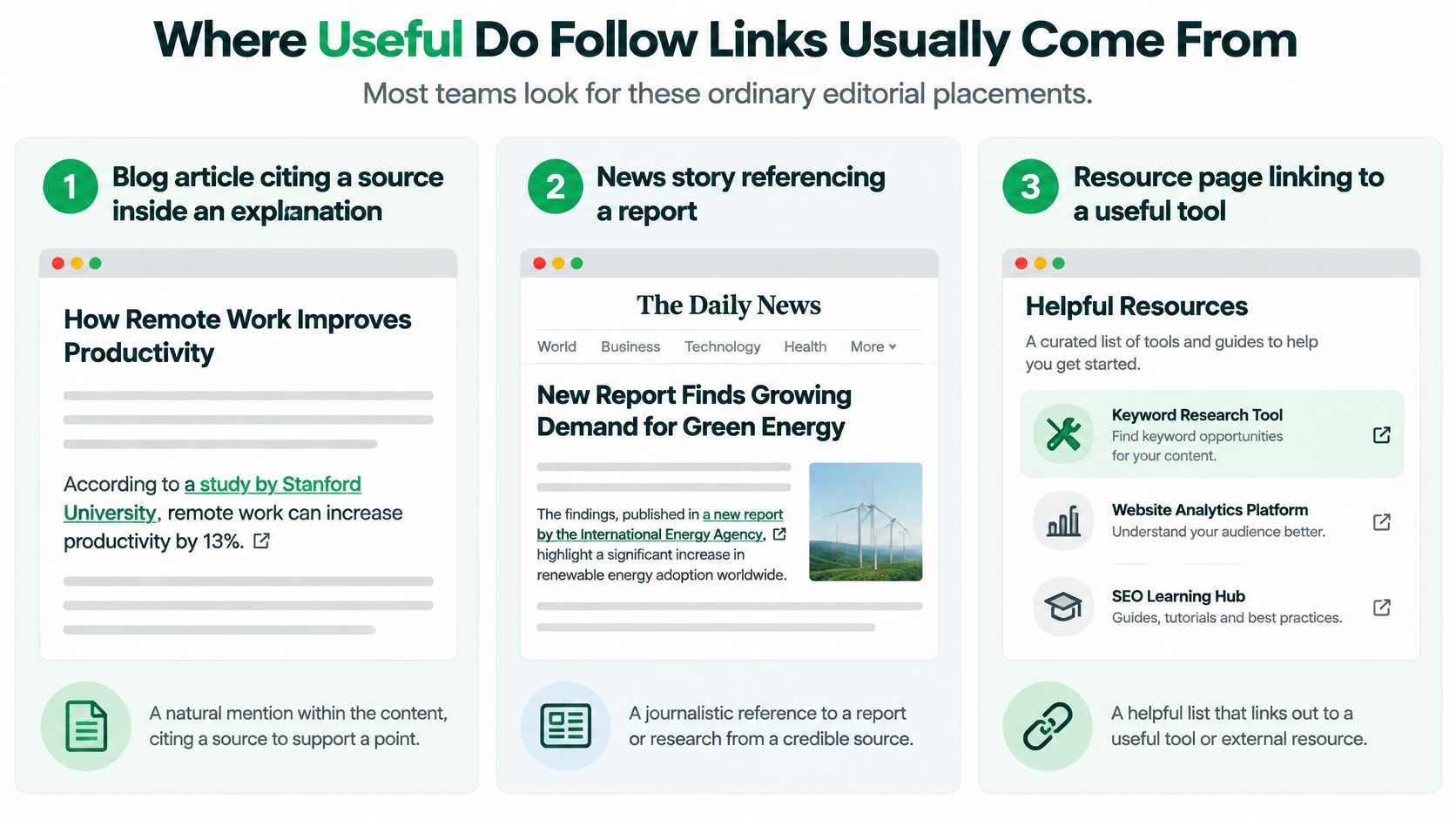
Useful editorial references have recognizable shapes. A publisher needs evidence, an explanation, or a resource, and your page supplies it. The format matters less than that reason for including the citation.
An article needs a supporting explanation
A B2B operations article might cite a SaaS documentation page while explaining how teams synchronize inventory records. The justification is specific: the documentation shows the workflow the author is discussing.
In 2025, 68% of surveyed SEO professionals focused link acquisition on blog content, while 41% focused on product pages, according to the Citation Labs and BuzzStream survey of more than 300 professionals. Those preferences describe where respondents focused their work, not a success rate for either format.
An existing article may also need a missing explanation. Evaluate niche edit links by whether the addition improves that explanation, not just by whether the publisher accepts insertions.
A reporter needs evidence
Say a B2B company publishes original research with an accessible methodology. A trade journalist could reference the report to support an observation about purchasing decisions. The report, rather than the company's homepage, is the appropriate destination.
In 2024, 36.3% of SEO experts said they believed in building linkable assets such as original research, high-quality articles, and infographics, according to a survey reported by Meetanshi. That supports considering assets as an acquisition approach; it doesn't prove that publishing an infographic will earn citations.
A resource page needs a useful destination
An ecommerce buying guide might deserve inclusion in a specialist resource collection because it explains material compatibility. A relevant product page can also justify a mention when it answers a precise availability or specification question.
Choose the URL that fulfills the promise. Sending every reference to the homepage makes readers search again for the information the publisher appeared to recommend.
Build something an editor can use to finish a sentence, verify a claim, or help a reader complete a task.
Qualification itself is common: in 2024, 32.7% of pages used rel="nofollow", according to HTTP Archive's Web Almanac data as reported by MangoThrive. That page-level prevalence figure isn't a measure of backlink quality or the share of all links that are followed.
A source without those qualifiers still needs a readership. If nobody appears to use the site and the article exists only to accommodate placements, the missing attribute doesn't rescue the opportunity.
Why Link Count Alone Does Not Rank a Page
There's no fixed number of do-follow backlinks that guarantees a ranking. Competition, search intent, destination quality, and the publishers providing references make a universal quota impractical.
Think of backlinks as contextual evidence rather than interchangeable units.
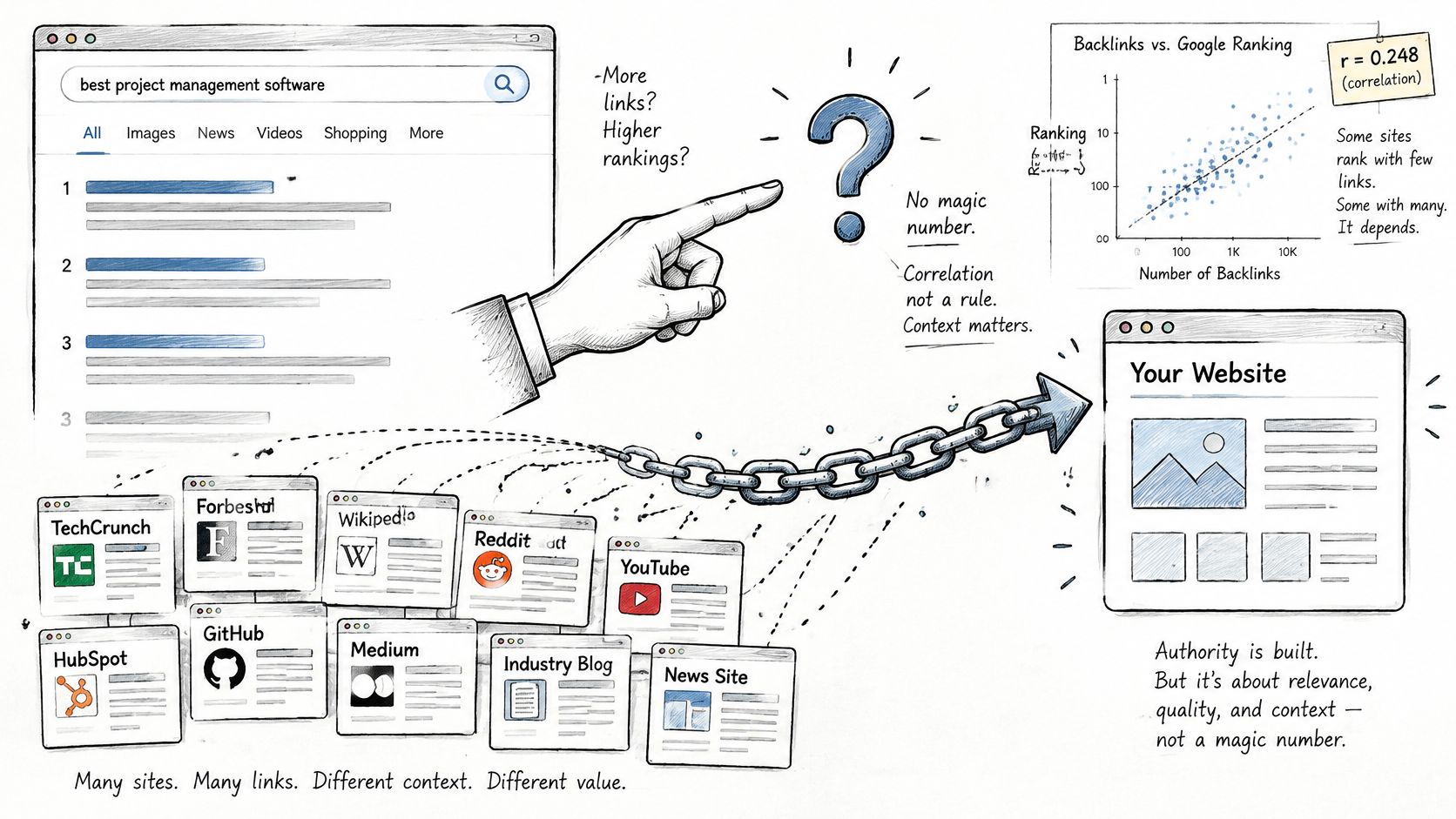
A 2025 BuzzStream synthesis, citing Ahrefs' analysis of 1,000,000 keywords, reported a 0.248 correlation between rankings and backlink count, alongside a positive association with referring domains, in its review of link-building evidence. Correlation describes an association; it doesn't tell you how many links caused a particular page to rank.
That distinction prevents a common planning mistake. Counting the links held by a competitor doesn't establish the number your page needs, especially if the pages answer different questions or serve different audiences.
Measure the campaign at the destination
Use a small set of connected observations rather than a followed-link total alone:
- Relevant referring domains: Distinguish new, suitable publishers from repeated links on a familiar site.
- Linking-page audience: Check whether the actual source pages attract relevant search interest.
- Target-page alignment: Direct references to the guide, category, product, or commercial page that fulfills the citation.
- Acquisition pattern: Investigate sudden batches of similar placements instead of treating delivery speed as proof of progress.
For SaaS, ecommerce, B2B, and enterprise campaigns, an authoritative topical reference may be more useful than a larger collection of low-context mentions. It still isn't a guarantee, and it can't compensate for a destination that fails to answer the query.
Use the video as a companion explanation, not a numerical forecast for your campaign.
Review target-page visibility, qualified referral visits, and ranking movement over several months. Annotate content changes and technical work too, so you don't attribute every change to backlinks.
A broader plan to improve Google search rankings should connect acquisition with useful content and accessible pages. Admit placements into that review only after they pass the quality checks, rather than letting an impressive total substitute for evaluation.
Decide Whether the Placement Is Worth It
Use rel, relevance, audience, and compensation as your go-or-stop tests. A candidate worth retaining has verifiable markup, a clear subject connection, a plausible readership, and an editorial reason to exist.
If money, a free product, or another benefit is part of the arrangement, establish the appropriate qualification before proceeding. Don't count a sponsored placement as an editorial do-follow backlink just because its paragraph sounds independent.
Choose work you can inspect
Prefer relevant referring domains supporting important destination pages over a pile of lookalike placements. Keep the quality-check table beside your candidate sheet so approvals reflect the actual page, not just a sales description.
At Linkbuilding.services, we use white-hat link building methods only. We avoid dead sites, private blog networks, and domains with no audience, focusing instead on publishers that rank for keywords and earn traffic from Google.
Our live campaign reporting makes delivered placements inspectable. That transparency helps you distinguish what was published from what anyone hoped it would achieve.
No provider, including Linkbuilding.services, can promise a specific ranking, traffic amount, or revenue outcome.
Pick a target page and identify the questions it answers better than competing destinations. List candidate mentions that genuinely need those answers, then accept only opportunities that pass the go-or-stop tests. If a candidate fails, revise the opportunity or leave it out rather than lowering the standard to fill a quota.
Linkbuilding.services offers publisher research, outreach, content production, and placement verification for managed link-building campaigns. Visit Linkbuilding.services to discuss your target page and niche, with a focus on relevant publishers, inspectable live links, and clear reporting rather than followed-link counts alone.