Follow and Nofollow Links: What Each Means for SEO
Learn how follow and nofollow links differ, how Google reads each attribute, and when each type is used, with a quick comparison table.
The most popular advice on follow and nofollow links is simple, and it's misleading. It says a followed link passes value, a nofollow link passes nothing, and you should reject the second kind on sight.
That rule would have you turn down a mention in a publication your buyers read, while chasing a followed link on a page nobody visits. It's the wrong test. An attribute tells you how a search engine is asked to treat a link. It doesn't tell you whether the page has an audience, whether the topic fits yours, or whether a reader will ever click.
Google now reads these attributes as hints, not as blocks. So the useful question isn't only which attribute a link carries. It's whether the page sends real discovery and audience value, and whether you can verify what you received.
Follow and Nofollow Links at a Glance
Start with the reference below. It sorts every common link into one of four rows by how it's marked in HTML and how Google reads that mark.
Follow and nofollow attributes compared
| Link type | HTML marker | How Google reads it |
|---|---|---|
| Follow (default) | No rel attribute | Ordinary link that can pass ranking signals and help discovery |
| Nofollow | rel='nofollow' | Hint, not a directive; ranking credit is not guaranteed |
| Sponsored | rel='sponsored' | Hint for paid or commercial placements |
| UGC | rel='ugc' | Hint for user-generated content |
That's the map for everything that follows. When you meet an unfamiliar link, find its row first, then decide what it's worth.
The One-Line Rule
A follow link is an ordinary link. The other three values don't remove the link, stop readers clicking it, or change where it points. They tell search engines how to treat it, with more caution than an unmarked editorial citation.
Practical rule: No attribute means follow by default. An attribute means read the link, but don't assume it carries the same endorsement.
Say an editor cites your guide because it helps her readers. That link normally carries no attribute at all, so it sits in the first row. Say a reader pastes the same URL into a blog comment. The platform usually marks it ugc, because the site didn't choose it and shouldn't be seen to endorse it.
One Link Can Carry More Than One Value
A single link can hold several rel values at once, such as nofollow and sponsored together. Each value adds context, so read the whole attribute rather than stopping at the first word you recognise.
This matters during checks. If you only search the page source for the word nofollow, you can miss a sponsored or ugc value sitting alongside it, and misread why the publisher marked the link.
You can now sort any link you see into one of the four rows in under a minute. Classification is only step one, though. The harder work is judging relevance, audience, and whether the placement is worth paying for, pitching for, or walking away from.
How Follow and Nofollow Attributes Work
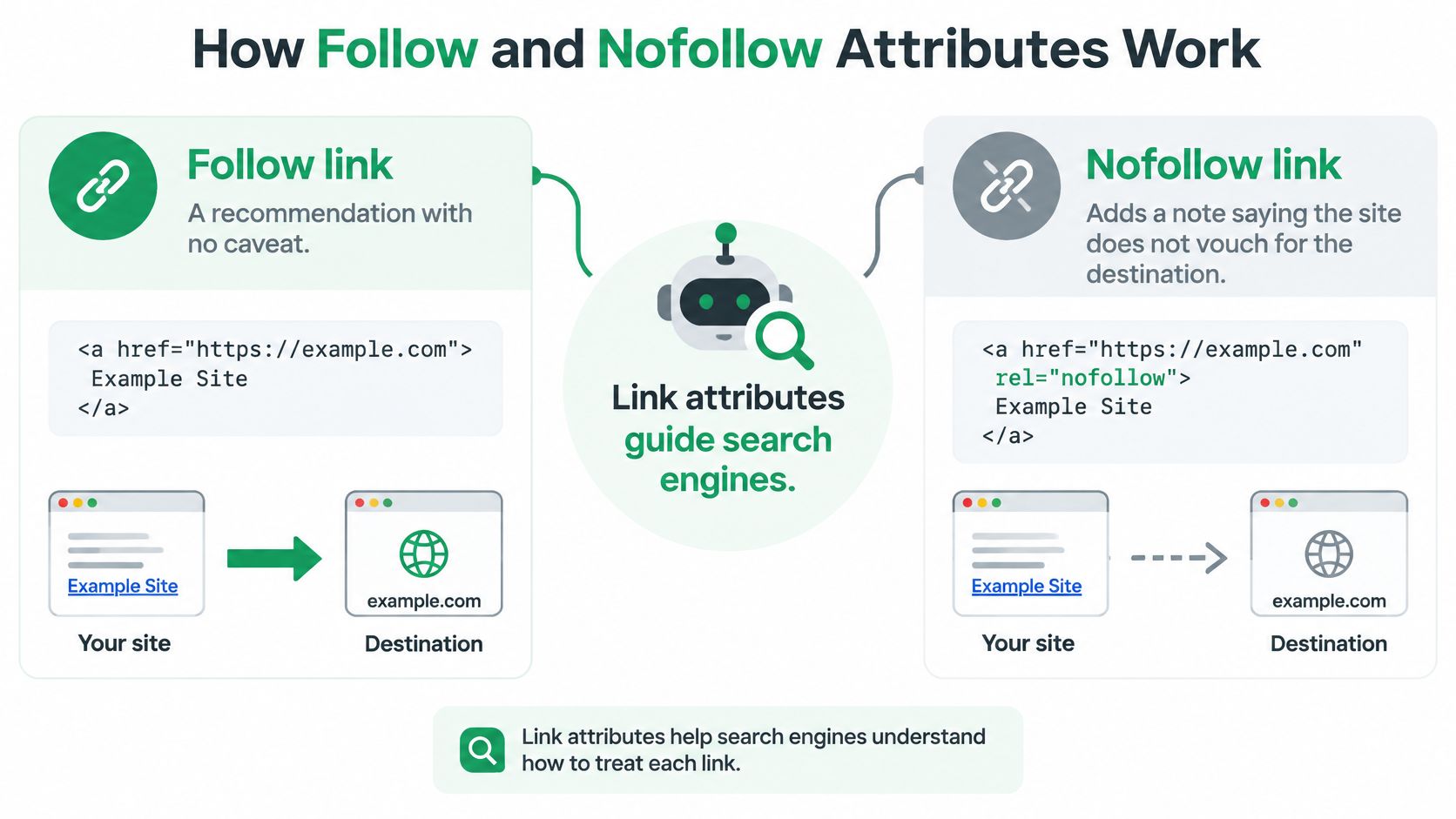
Think of a follow link as a recommendation with no caveat attached. A nofollow link is the same recommendation with a note on it saying the site doesn't vouch for the destination. The reader sees the same clickable text either way.
The diagram below shows how that small note changes what a crawler is asked to do with the link.
What the Code Actually Looks Like
A standard link needs nothing added to it:
- Follow:
<a href='https://example.com/guide'>guide</a> - Nofollow:
<a href='https://example.com/guide' rel='nofollow'>guide</a>
Only one thing changed. The destination, the anchor text, and the reader's experience are identical. The rel value is a message for search engines, not for people.
Here's the part that can be confusing. There's no rel='follow' setting to switch on. A follow link is not a distinct HTML attribute; it's the conventional description for a crawlable anchor element without rel="nofollow", rel="sponsored", or rel="ugc", as set out in Google's guide to its ranking systems. The absence of an attribute is the signal.
That same guidance explains why ordinary links matter at all. Links help Google discover pages and assess relevance, and its link-analysis systems, including PageRank, evaluate how pages connect to one another. A relevant editorial link can therefore offer discovery value and a potential ranking signal, but it doesn't guarantee a ranking increase, because Google also weighs page relevance, link context, and overall quality.
Why the Markup Has to Be Real
Google generally needs a crawlable <a> element with an href. A JavaScript-only control, malformed markup, or a link hidden behind a nonstandard interaction may not deliver the same discovery behaviour. If a button looks like a link but has no href, don't count it as one.
Marking Your Own Outbound Links
When you're the publisher, choose the value that matches the relationship:
- Leave editorial links unmarked: You chose the source and you're happy to endorse it.
- Use sponsored: The placement is paid, gifted, or otherwise commercial.
- Use ugc: A user added the link in a comment, forum post, or profile.
- Use nofollow: You want to reference a page without endorsing it, and neither sponsored nor ugc fits.
Build one habit from this. Find the a tag, read its rel value, and treat an absent value as a standard link. That single check resolves most arguments about what a link is.
Why the Nofollow Attribute Was Created
Nofollow wasn't invented as a link building lever. It was invented to stop spam, and that origin explains how it behaves today.
January 2005 and Comment Spam
In January 2005, Google introduced rel="nofollow" with Blogger to combat comment spam, according to Google's account of evolving nofollow. At that time, links carrying the attribute would not receive credit in its ranking systems and would not pass PageRank to the destination page.
Unmarked links kept functioning as link-based signals. So a blogger could leave a commenter's link visible for readers while removing the ranking incentive that made spamming worthwhile. The purpose was trust and spam control, not link sculpting.
Major search engines, including Yahoo and Microsoft's search engine, adopted or respected the attribute. That made nofollow an industry convention rather than a Google-only mechanism, which is why you still see it everywhere.
June 2009 and PageRank Sculpting
Site owners soon tried a workaround. They nofollowed low-priority internal links, hoping the saved value would flow to the pages they cared about.
By June 2009, Google had changed its treatment to prevent PageRank sculpting. PageRank was divided across all outgoing links, including nofollowed links, while only eligible links transmitted their share. The unused share from a nofollowed link was no longer redistributed among follow links.
So the tactic stopped working. Adding nofollow to selected internal links couldn't concentrate ranking value on the rest.
2019 and the Move to Hints
In 2019, Google added sponsored and ugc, and began treating all three values as hints rather than strict directives. That's the model you're working under now.
The lesson is plain. Nofollow is an old trust signal built for spam control. It was never designed as an SEO switch you flip to steer value around a site.
Whether a Nofollow Link Still Helps SEO
You'll often hear that a nofollow link is worthless because it passes nothing. That claim is too blunt to plan a campaign around, and it leads to bad buying decisions.
The image below sums up the current position, that these attributes guide Google rather than block it.
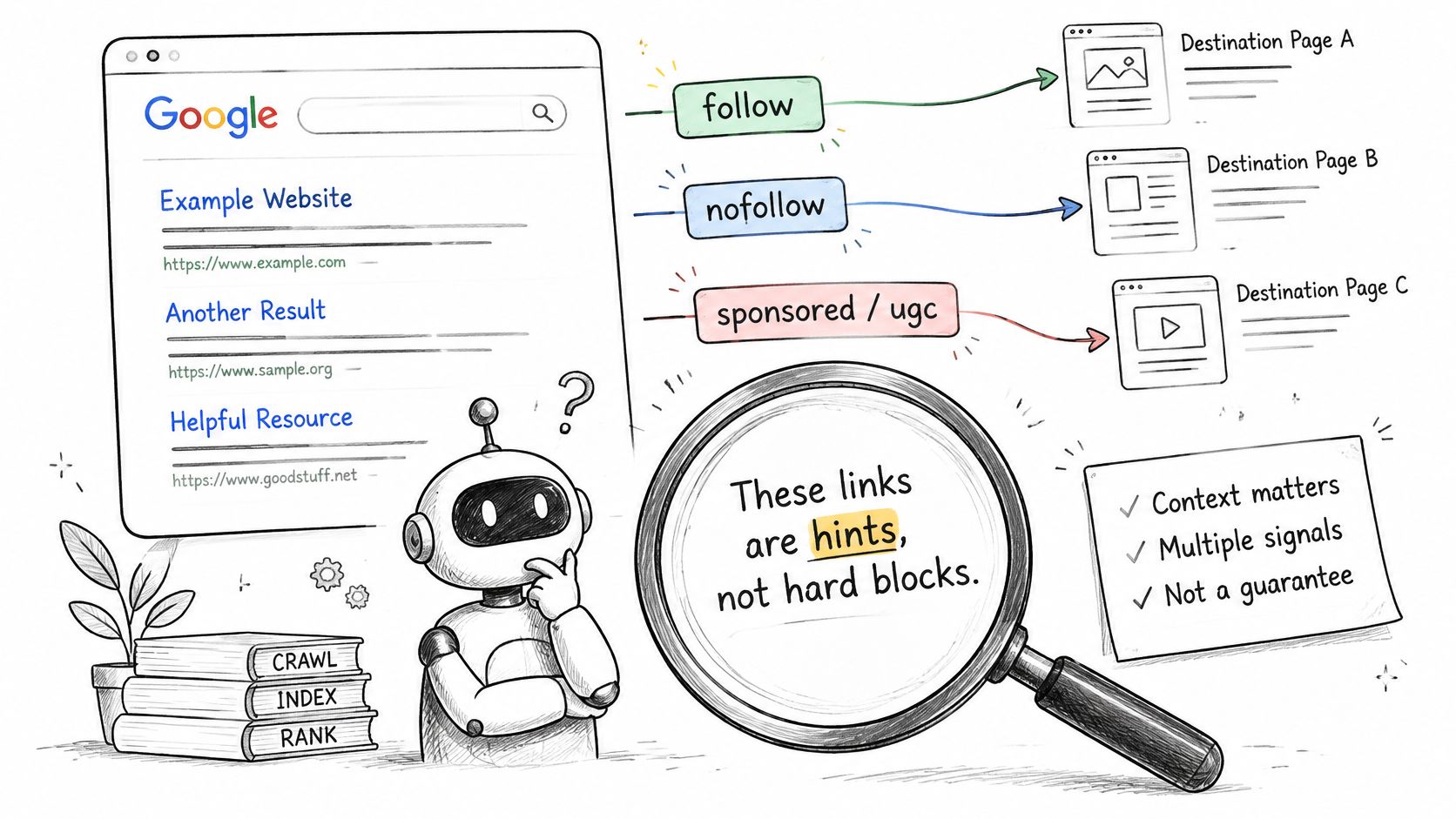
Google's guidance is more nuanced than the binary version. Nofollow, sponsored, and UGC attributes are generally treated as signals or hints, not absolute blocking directives, and Google may still discover the linked page through sitemaps or other links, as explained in Google's documentation on qualifying outbound links.
That's not a promise that a nofollow link will lift your rankings. It means you shouldn't assume the link is invisible, and you shouldn't value it on ranking credit alone.
Separate Three Different Outcomes
Most confusion comes from treating three separate outcomes as one. Pull them apart before you judge a placement:
- Ranking-credit potential: This is the weakest and least reliable part of a nofollow link. Don't budget for a position gain from it.
- Crawl and discovery potential: A link on a page Google visits often can still put a new or updated URL in front of a crawler, even if credit is uncertain.
- Non-ranking value: Referral traffic, brand exposure, assisted conversions, and the chance that another writer notices you and adds a followed citation later.
Once you separate them, the decision gets easier. A nofollow link can fail on the first outcome and still succeed clearly on the third.
The short video below walks through how these attributes are interpreted in practice, which is useful if you're explaining the distinction to a client or a stakeholder.
A Worked Comparison
Say a widely read industry publication mentions your research and links to it with nofollow, because that's the site's blanket policy. Thousands of relevant readers see your brand, some click through, and a few cite you in their own articles afterwards.
Now compare a followed link from an irrelevant site with almost no visitors and no topical overlap. It wins on the attribute and loses on everything else. The nofollow mention is commercially worth more.
Don't ask whether a link is followed first. Ask whether the page has a real audience, topical relevance, and editorial credibility, and whether there's a plausible path to qualified visits.
Two warnings before you act on this. First, nofollow status can change after publication, when a publisher updates a template, migrates a site, or revises a policy. Second, a seller's label isn't proof. A spreadsheet that says dofollow tells you what was promised, not what's live, so verify the rendered HTML yourself.
Rejecting every nofollow opportunity means refusing legitimate media and community placements. Treating every nofollow link as an SEO asset is the opposite mistake. Judge the page, not just the attribute.
Which Links Are Usually Nofollow
Nofollow is common enough that seeing it shouldn't alarm you. In 2024, 32.7% of web pages used the rel="nofollow" attribute on at least one link, up from 29.5% in 2022, according to the HTTP Archive's Web Almanac 2024, as reported in MangoThrive's roundup of link building statistics.
Roughly a third of pages carry at least one nofollowed link. It's a normal part of how the web is built, not a red flag by itself.
Usual Attribute by Placement Context
The pattern becomes clearer when you look at where a link sits and who created it.
| Link context | Usual attribute | Reason |
|---|---|---|
| Editorial mention in an article | Follow | The editor endorses the source |
| Sponsored or advertorial placement | Sponsored or nofollow | Paid placement must be marked as commercial |
| Blog comment or forum post | UGC or nofollow | Written by users, not endorsed by the site |
| Press release distribution | Often nofollow or sponsored | Syndication and paid distribution |
| Social profile or author bio link | Usually nofollow | The platform does not vouch for the profile |
| Own site internal link | Follow | Navigation within the site; no attribute needed |
Read the table as a set of expectations, not guarantees. It's most useful when you're forecasting what a campaign will return, so you don't promise a client a profile made up entirely of followed editorial links.
Why the Same Publisher Marks Links Differently
The site owner chooses the attribute, and most publishers apply different rules in different places. One news site might leave an editor's in-article citation unmarked, add sponsored to a commercial feature, and stamp ugc on every comment automatically.
Templates drive much of this. Comment systems, author bio fields, and profile pages often add the attribute by default, without anyone making a decision about your specific link. So a nofollow result usually tells you about the placement type, not about how the publisher rates your content.
This is also why placement context matters more than the label when you're assessing outreach results. If you're weighing up the SEO value of contributed articles, our guide to guest blogging and SEO covers how editorial context affects what a placement is worth.
Expect a mix. When outreach brings back followed editorial links alongside nofollow mentions and ugc community links, that spread reflects where you were published. Judge each link by its context, audience, and relevance rather than by its label alone.
How to Check a Link Before You Pursue It
You don't need a paid tool to verify a link. You need the page, a browser, and ten minutes. Work through these steps in order, because each one catches a different failure.
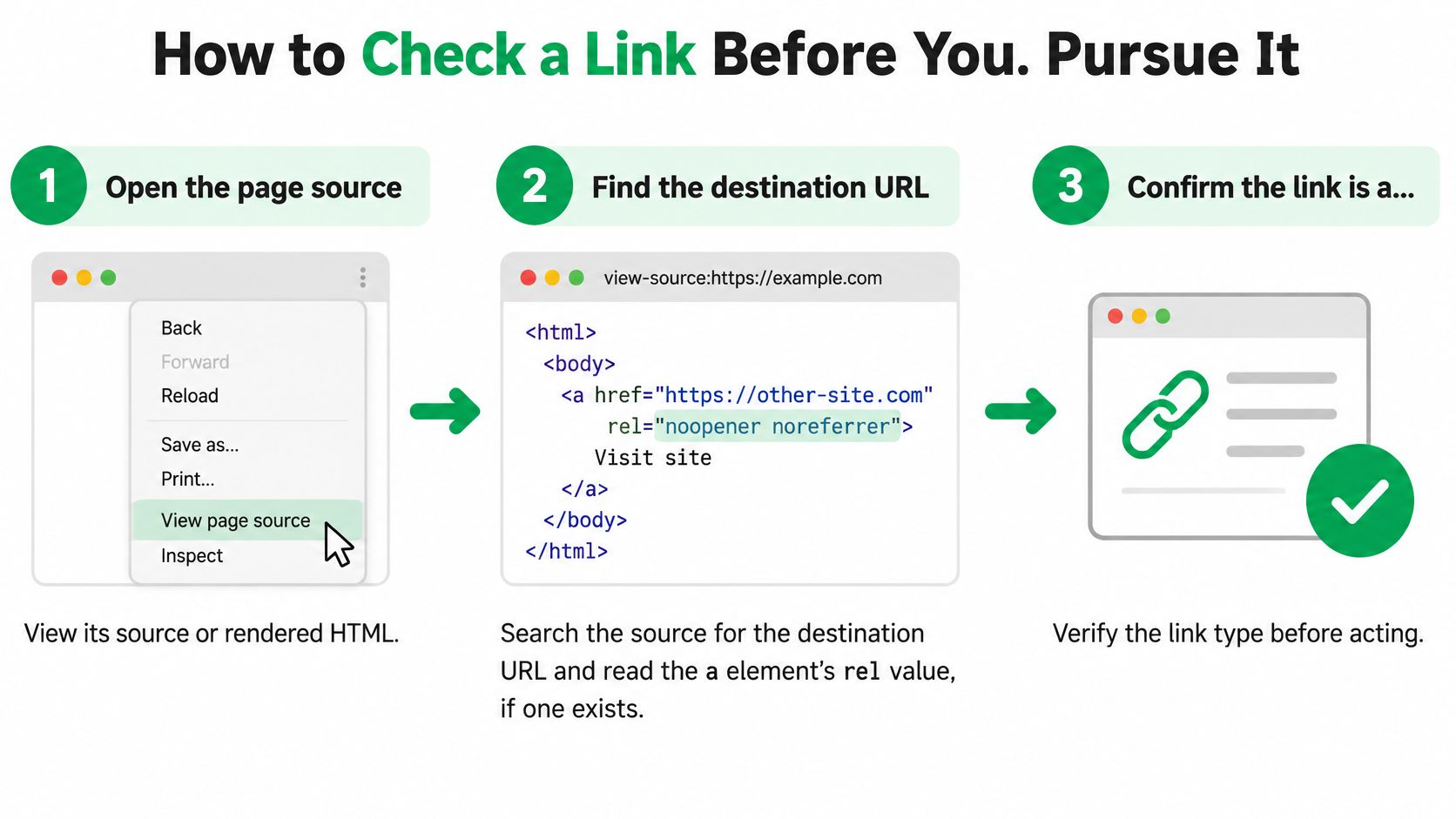
The process below shows the inspection sequence at a glance before you work through it in detail.
The Seven Checks
- Open the linking page and view its source or rendered HTML. Right-click the link and choose Inspect, or view the page source. Rendered HTML is safer when a site builds content with scripts.
- Search the source for your destination URL. Use find on the exact URL, then read the
relvalue on thataelement if one exists. No value means it's a standard followed link. - Confirm it's a real anchor element with an href. A script-only button or a click handler with no href won't behave like a link for crawlers, whatever it looks like on screen.
- Check the destination returns a 200 status and points to the intended canonical URL. A link landing on a redirect chain, a 404, or the wrong version of a page wastes the placement.
- Check the page isn't blocked from indexing. Look for a robots meta tag or an X-Robots-Tag header saying noindex. A perfect link on a page Google can't index has very limited practical value.
- Confirm the link sits in relevant body content with matching anchor text. A link buried in a footer or an unrelated sidebar list reads differently from one inside a paragraph on the same topic. If you need help judging anchor wording, work through a few anchor text examples against your target page.
- Record the page URL, attribute, and date in a tracker, then recheck after 30 days. Attributes change, pages get edited, and links get removed. A dated record turns an argument into a quick lookup.
Slips That Catch People Out
Three mistakes account for most bad link reports:
- Trusting a seller's label: A vendor's spreadsheet describes what was sold. Only the live HTML describes what you have.
- Checking only the homepage: Attributes are set per link and per template. The homepage tells you nothing about the article page your link sits on.
- Treating the attribute as permanent: Redesigns and platform migrations rewrite rel values across whole sites without notifying you.
Pass or fail rule: A link that's crawlable, relevant, and visible in the HTML is worth reviewing, whatever attribute it carries. A link that fails those checks isn't rescued by being followed.
Verification only helps if someone can see it later. We provide live reporting on link building campaigns, because our team believes reporting should be clean and verifiable. That means placement URLs a client can open and inspect themselves, rather than a summary they're asked to take on trust.
Build the same discipline into your own tracker. Add columns for the linking page, the rel value, the status code, the indexability result, and the date you last checked. When a stakeholder asks what a campaign delivered, you'll answer from evidence instead of memory.
Choose the Right Link Mix for Your Site
Chasing a target percentage of followed links is a poor use of time. A better approach is to pick placements by goal, then accept the attribute that best fits each one.
Original editorial coverage is where followed links concentrate. In 2024, 48% of backlinks from analyzed digital PR coverage were followed links, compared with approximately 33% for syndicated coverage, according to Reboot Online's analysis of 371,631 news articles. That's a practical reason to prioritise original stories over syndicated copies when ranking credit is the aim.
Link Priorities by Goal
| Goal | Prioritise | Acceptable alternative | Watch for |
|---|---|---|---|
| Earn ranking credit | Editorial follow link on a relevant page | Nofollow mention on a high-traffic, relevant site | Follow links on irrelevant or low-traffic sites |
| Drive referral visits | Relevant page with a real audience | Nofollow mention on a popular site | Sites with follow links but no visitors |
| Build brand awareness | Mention in a trusted publication | Nofollow syndicated coverage | Syndicated copies with weak context |
| Avoid manipulation risk | Editorial placements | Clearly labelled sponsored placements | Undisclosed paid links |
Notice that a nofollow placement appears as an acceptable alternative in three of the four rows. It only becomes a problem when ranking credit is your sole goal and you paid editorial prices for something else.
Your Next Steps
Start with an audit. Run your existing links through the seven checks, record their attributes, and separate the ones earning visits from the ones doing nothing. You'll usually find followed links on pages with no audience that you can stop defending.
Then set priorities for new work. Favour relevant editorial placements on pages that rank and attract readers, label paid placements as sponsored, and let the resulting mix look natural rather than engineered. If you're mapping that work to outcomes, our guide on how to improve Google search rank shows how link choices fit alongside content and technical fixes.
Our own approach follows the same logic. Linkbuilding.services uses white-hat link building methods only, and we avoid dead sites, PBNs, and domains with no audience, focusing instead on publishers that rank for keywords and earn traffic from Google. We provide live reporting so teams can verify each placement for themselves. We also don't guarantee specific rankings, traffic amounts, or revenue outcomes, because no honest provider controls Google's results.
Keep the test simple. Classify the link, verify it in the HTML, then judge the page on audience and relevance. The attribute informs that judgement. It doesn't replace it.
If you'd rather not verify every attribute, status code, and indexability check yourself, we can run the audit and build placements on publishers with real traffic, with live reporting you can inspect at any point. Visit Linkbuilding.services to see how our managed guest posting and contextual placements work, and to discuss the right follow and nofollow mix for your target pages.