Guest Posting Email Template for Real Replies
Guest posting email template for first pitches, follow-ups, and replies, with personalization fields and compliance lines.
A reply rate can look healthy and still mean almost nothing. In 2025, Belkins measured a 0.45% average reply rate across 7,530,489 emails, according to a summary of Belkins cold email data published by OutreachBloom. That figure reframes how you should judge a guest posting email template. You're not trying to win opens or collect polite replies. You're trying to earn a qualified acceptance, from a real publisher, on terms you can disclose and use.
Guest Posting Email Templates at a Glance
Start with the email that matches the relationship, not with a universal pitch you blast to every editor. A guest posting email template is a fixed skeleton plus fields you fill for each editor: name, site, one article you read, proposed topic, audience benefit, a short credential, and one ask. If any of those fields stays generic, the template isn't ready to send.
Use the table as your index. Pick the row that matches your situation, copy the matching wording later in this guide, and keep the From domain identical on every message in the thread. Switching domains mid-thread breaks trust and makes you look like a different sender.
Which Guest Posting Email to Send
| Send when | Length | Single ask | Minimum personalization | |
|---|---|---|---|---|
| First pitch | No prior contact | 120 to 170 words | Does this topic fit your calendar | Name, site, one article, topic, reader benefit |
| Follow-up 1 | 4-7 days of silence | 60-90 words | Same ask plus one new angle | Original subject and their site |
| Follow-up 2 | 7-10 days after follow-up 1 | 40-70 words | Close the loop yes or no | Name and topic only |
| Acceptance reply | Editor asks for details | 150 to 200 words | Confirm topic, samples, and link policy | Their stated requirements |
| Sponsored disclosure note | A client link or fee is likely | 80 to 110 words | Ask their paid-post and rel policy | Publication name and commercial role |
| Breakup | After two unanswered follow-ups | 40-60 words | Permission to close the thread | Name only |
| Opt-out confirmation | They decline or say stop | 1-2 sentences | Confirm no further email | Address added to suppression |
How to Read the Lengths
The first message stays between 120 and 170 words because that's enough room to prove you read the site, propose one topic, and make one ask without burying the editor. Use plain text or very light HTML, name yourself and your organization, and never open by demanding a do-follow link or a preset anchor. Link terms come after editorial interest, not before it.
Follow-ups get shorter on purpose. Send follow-up one after 4 to 7 days of silence, follow-up two after another 7 to 10 days, then a breakup. Each one replies in the same thread, so the editor sees the original pitch without searching. Don't start a fresh thread to disguise a follow-up as a new idea.
Judge the whole set by accepts that clear your editorial and link-policy checks, not by opens.
Switch to the acceptance email only after the editor asks for details. Use the sponsored note when a client link or payment is likely, even if you're not certain yet. Send the opt-out confirmation the same day someone says no, and suppress that address across every tool, teammate, and agency you work with.
Pitch Categories by Publisher Situation
Sort your outreach before you write a word. Most failed pitches aren't badly written, they're sent in the wrong category. An editor can tell within two lines whether you're proposing a genuine contribution or disguising a commercial request, and that mismatch is what gets you deleted.
Editorial and Contribution Pitches
Cold editorial pitches go to sites that already publish outside writers and have no commercial relationship with you. You have no history there, so proof matters most. Your opening sentence has to show you opened a specific article, and your topic has to connect to what they already publish.
Contribution pitches go to editors you can cite with a specific gap. Say a site runs a monthly how-to series for solo consultants but hasn't covered how those consultants should handle late payments. You're not pitching a random topic, you're naming the missing piece in a series they already run. That gap is the field that changes in this category. Everything else in the skeleton stays put.
Relationship pitches go to editors who published you before or replied to a previous, different topic. Shorten the intro and skip the biography. They already know who you are, so reintroducing yourself at length reads as filler. Reference the earlier piece or thread in one line and get to the new angle.
Commercial and Agency Pitches
Paid or sponsored pitches are a separate category whenever money, a client, or a required anchor is involved. They must say so in the first email rather than hiding inside an editorial pitch. Hiding a commercial motive until after an editor invests time is the fastest way to burn a publisher relationship for good.
Agency pitches name the brand you represent and offer the editor approval of domain and topic before any draft exists. Editors work with agencies all the time. What they object to is discovering the client after they've already agreed to something.
Resource or update pitches, sometimes called niche edits, ask to add a sourced passage to an existing article. They aren't guest posts, and you shouldn't use the guest post skeleton for them. If you're weighing the two formats, this comparison of guest posts versus niche edits lays out when each one fits. The ask, the asset, and the editorial risk are different, so the email has to be different too.
The Four Fields That Change
For each category, change only four things and hold the rest steady:
- The proof you read them: A specific article for cold pitches, a named gap for contribution pitches, a prior thread for relationship pitches.
- The asset you offer: An original article, an updated companion piece, or a sponsored draft written to their standards.
- When the link is discussed: After editorial review for editorial pitches, up front for sponsored ones.
- The ask: Topic fit, a redirect to a better angle, or their paid-post policy.
Keep one topic per email in every category. If you can't name the audience benefit in one sentence, you're in the wrong category and shouldn't send yet. Go back, sort the publisher situation, and the right template usually becomes obvious.
Personalization That Changes the Reply
Personalize four fields or don't send. That's the decision rule, and it applies before you think about subject lines or send times. The four fields are the editor or site owner name, the publication, one article or series you opened, and the reader problem your topic serves. A first name in the subject line is a start. It isn't the pitch.
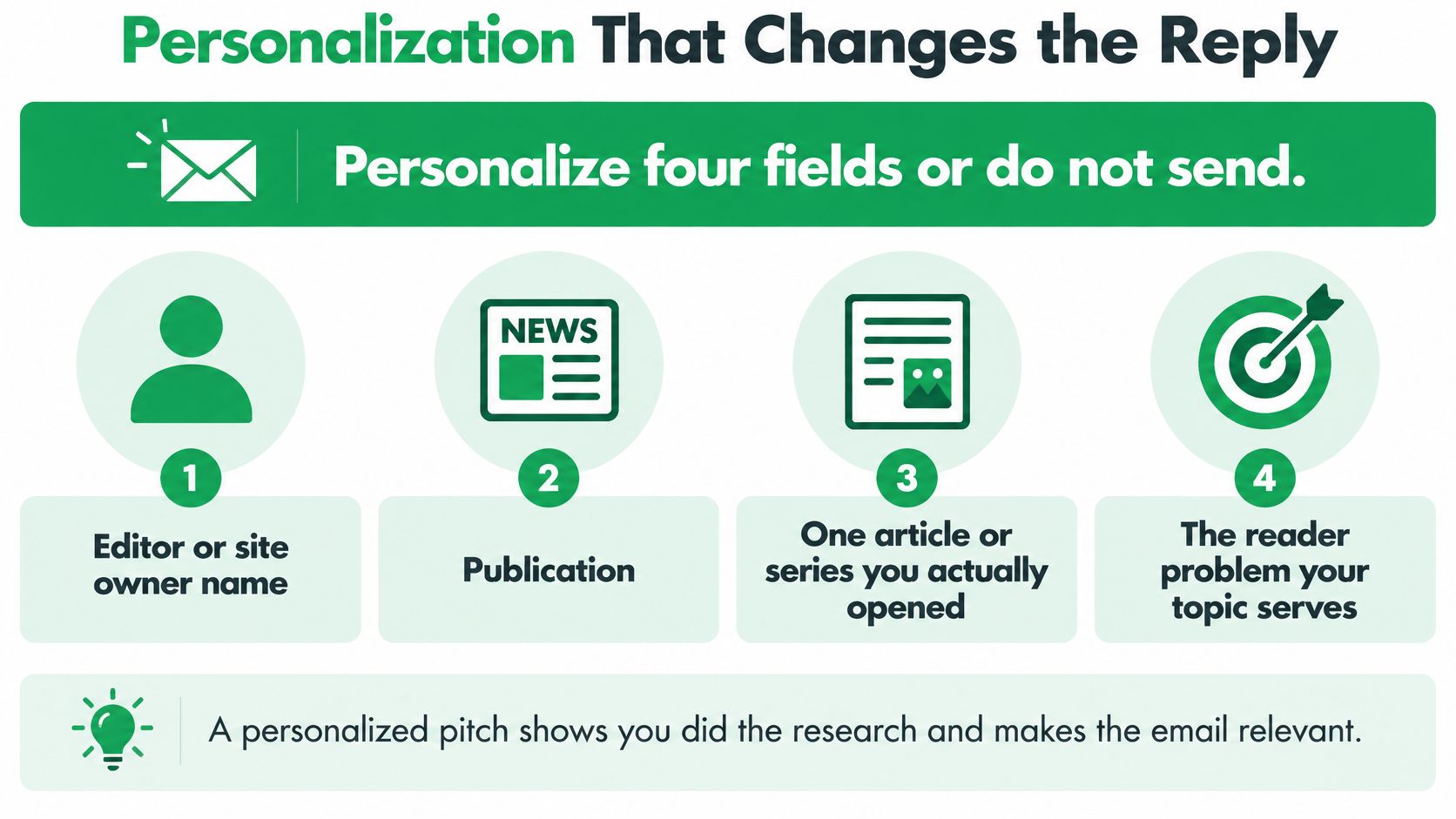
What to Personalize, in Order
Choose the article gap over the compliment every time. "I loved your blog" could be pasted into any inbox. "Your series on onboarding covers setup and training but not what to do when a new hire goes quiet in week two" could only be sent to one editor. Say you're pitching a marketing site that publishes case studies on email campaigns. The useful personalization isn't praising their design, it's pointing out that every case study covers first sends and none covers reactivation, which is exactly the reader problem your topic serves.
That distinction matters because editors sort mail fast. A name token tells them you have a merge tool. A specific editorial observation tells them you did the reading, and it gives them a reason to believe the draft will fit their audience without heavy editing.
What the Numbers Actually Support
The evidence supports tailoring real fields. It doesn't support the idea that a name token wins guest posts on its own. A 2018 study published in Marketing Science found that adding the recipient's name increased the probability of opening an email by 20%, from 9.05% to 10.80%. The same intervention increased sales-lead generation by 31%, from 0.39% to 0.51%, while reducing campaign unsubscribes from 1.2% to 1.0%.
Scale matters too. A 2017 analysis reported by Marketing Dive examined more than 7 billion emails and found that only 2.3% used any subject line personalization. In that dataset, non-personalized subject lines produced a 14.1% open rate, compared with 21.2% when names were used and 22.0% when another form of personalization was applied, and personalized subject lines generated 58% higher click-to-open rates.
More recent summaries point the same direction without settling the question. In 2024, cold emails with advanced personalization achieved an 18% reply rate, compared with approximately 9% for basic or no personalization, according to Woodpecker data reported by Gaidme. Separately, in 2024, personalized subject lines were reported to be 26% more likely to be opened than non-personalized subject lines, according to data summarized by Gaidme.
How to Use This Without Fooling Yourself
Treat these figures as a reason to fill the four fields properly, not as a promised reply rate for your campaign. Opens tell you the subject line and sender cleared a first glance. They don't tell you the editor wants your article.
That's why anchor and link requests stay out of the personalization work at this stage. If you're learning how anchors read in context, an anchor text example shows the mechanics, but your pitch email shouldn't preselect anchor text before an editor has even seen the topic. Personalize the editorial fit first. Track opens, replies, accepts, and placements separately, because each stage fails for a different reason and needs a different fix.
Decision rule: If a field could be pasted into a pitch to a different publication without changing a word, it isn't personalized.
Compliance Lines Every Template Needs
Treat every pitch as commercial email, because that's how the rules treat it. Under the FTC CAN-SPAM Act compliance guide for business, commercial email includes messages promoting a commercial product, service, or content on a commercial website, and the rules apply to business-to-business messages as well as consumer email. Pitching an editor at a company doesn't exempt you.
Lines to Paste Into the Template
Build these elements into the skeleton itself, so no sender has to remember them:
- Accurate routing data: Use correct From, To, Reply-To, and routing information. No spoofed names, no borrowed domains.
- An honest subject line: The subject must match the body. If you're proposing a guest article, the subject shouldn't pretend you're replying to an earlier conversation.
- A named sender and organization: The editor should know who you are and who you write for without opening a link.
- A valid physical postal address: Include it in the signature block of every message in the set.
- A clear opt-out sentence: Use a plain line such as "If guest contributions are not relevant, reply 'no' and no further outreach will be sent."
The opt-out mechanism must remain operational for at least 30 days after sending, and requests must be honored within 10 business days, as set out in the FTC guide linked above. Keep one suppression list across employees, agencies, and sending tools. A follow-up sequence must stop immediately after an opt-out rather than treating each follow-up as a separate campaign.
Sending Limits That Protect the Domain
Copy alone doesn't keep you out of spam folders. Authentication does much of that work. Gmail's email sender guidelines require all senders to use SPF or DKIM, and they define a bulk sender as one sending close to 5,000 or more messages to personal Gmail accounts within 24 hours. Bulk senders must authenticate with SPF and DKIM, publish DMARC, maintain alignment between the From domain and either SPF or DKIM, and support one-click unsubscribe for marketing or promotional messages.
Stay well under that volume by design. Use one authenticated organizational domain, a real monitored Reply-To address, and a plain text or lightweight HTML body. Segment campaigns by niche and publisher type, cap daily volume, and watch bounces and spam complaints. Pause a sequence when authentication or reputation indicators deteriorate instead of pushing through to finish a list.
Honesty About Links and Payment
Don't invent familiarity, and don't guarantee a do-follow link in a pitch. If you're unsure what that term covers, this explainer on a do-follow backlink clarifies the attribute itself. The publisher decides link attributes after editorial review, so promising one in advance is a claim you can't control.
If a fee, affiliate relationship, or client placement is possible, say the post can be labeled sponsored and that the publisher sets link attributes. A quieter, explicit email can lose a few casual replies and still produce cleaner accepts, because the editors who do reply already understand the terms.
First Pitch Template With Field Notes
Copy this first email, keep the bracketed fields intact until you're ready to fill them, and replace every bracket before sending. A leftover bracket is worse than a generic sentence because it proves the merge failed.
The visual below breaks the email into its working parts so you can see where each field sits.
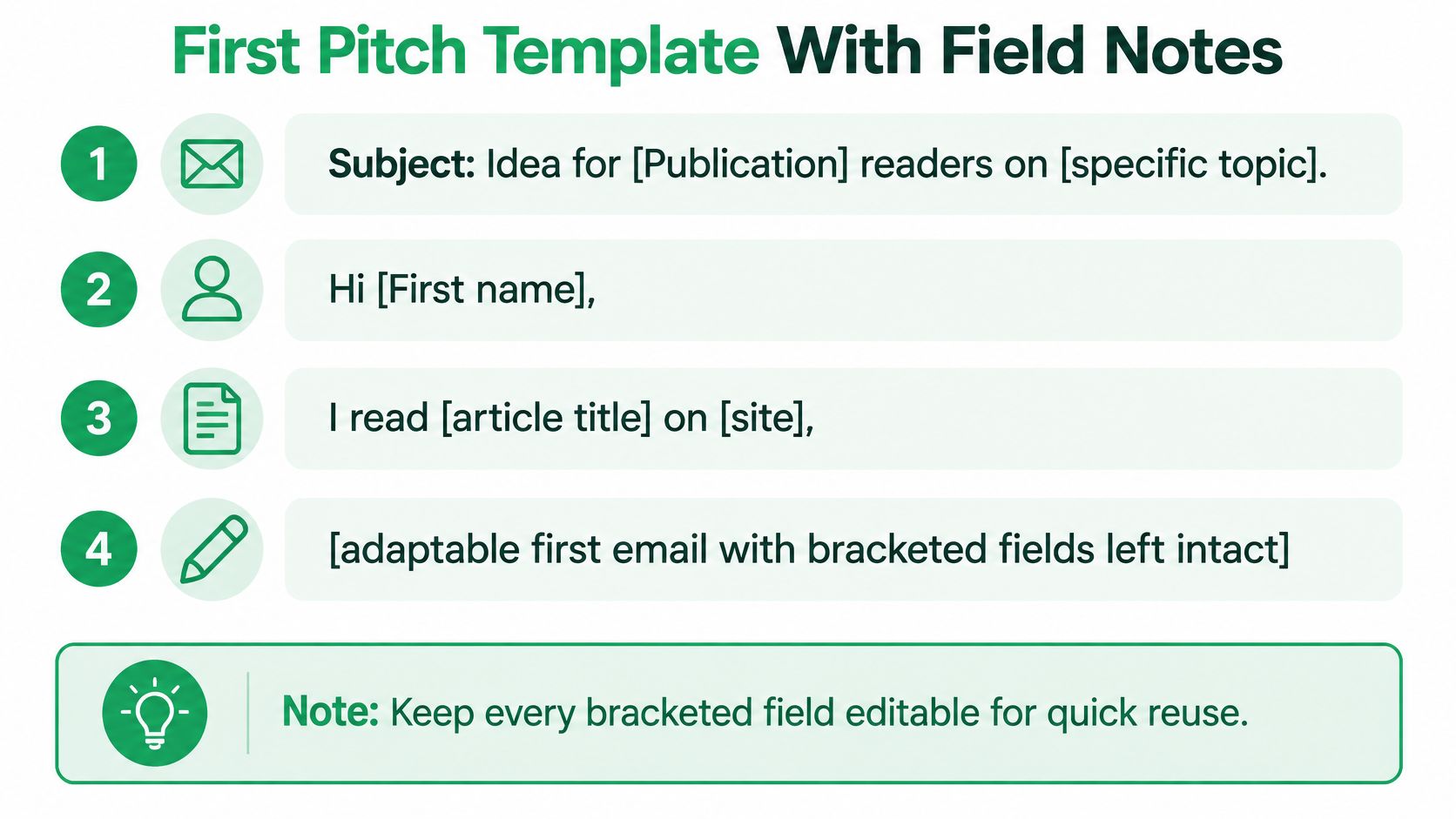
The Template
Subject: Idea for [Publication] readers on [specific topic]
Hi [First name],
I read [article title] on [site], especially the point about [one concrete detail]. Your readers who [audience job] still lack a practical piece on [topic].
I can write 1,000 to 1,500 original words covering [two or three subpoints], with examples from [relevant experience], and I'll follow your edit, links, and disclosure rules. I'm [name, role, one credential].
Would this fit an upcoming slot, or is a neighboring angle more useful? If guest posts aren't a fit, reply no and I won't email again.
[Name, organization, postal address, URL]
Field Notes, Line by Line
The subject names the publication, not "Guest post request." Editors see that generic line dozens of times a week, and it tells them nothing about fit. Naming the publication and the topic does the sorting work for them.
The first sentence proves a read. A name alone isn't enough, so the concrete detail field forces you to open the article and find one point you can reference accurately. If you can't fill that field, you haven't read enough of the site to pitch it.
There's one topic only. Two or three topic options feel generous but they shift the decision burden onto the editor and signal that you'll write anything. One topic, with two or three subpoints, shows you've thought about what their readers need. The offer to accept a neighboring angle gives the editor a low-effort way to redirect you without rejecting you.
No attachment. No draft pasted in. Unsolicited files trigger spam filters and suspicion, and a full draft in the body makes the email unreadable on a phone. No anchor text and no do-follow promise appear anywhere in this email. Those conversations belong after editorial interest, when the publisher's own policy can govern them.
The ask is a yes or a redirect, which is easier to answer than a request for a placement. You're asking whether the topic fits, not demanding a slot, a date, and a link in one move.
Swap the credential for a relevant byline if you have one. A published piece in a comparable publication proves more than a job title. If you're an agency, add one clause: "I'm writing for [client], and you can approve the domain and angle before a draft." That single clause converts the pitch into the right category without rewriting the email.
Keep the whole message inside 120 to 170 words so the ask stays visible without scrolling on a phone. If your filled version runs long, cut adjectives from the credential line first, not the proof of reading.
The short walkthrough below shows the same field logic applied in sequence.
Follow-Up Acceptance and Breakup Templates
Every later email in the set has one job and one timing rule. Send them in order, in the same thread, and stop the moment the editor responds in any direction.
Follow-Up 1
Send this on day 4 to 7, replying in the original thread so the editor sees your first pitch below it.
Hi [Name], floating this up in case [topic] is useful for [Publication]. A fresh angle I didn't mention: [one data point or example]. Happy to adjust to your guidelines.
The fresh angle is the whole point. A follow-up that only says "bumping this" gives the editor no new reason to act. One new data point, example, or subtopic does. Keep it to 60 to 90 words including your signature.
Follow-Up 2
Send this 7 to 10 days after follow-up 1. It's a close-the-loop note of 40 to 70 words with no new pitch.
Hi [Name], closing the loop on my note about [topic] for [Publication]. A quick yes or no is plenty, and if the timing's wrong I can try a different angle later. Thanks for reading.
Don't add a third nudge. Two follow-ups plus a breakup is the full sequence. Beyond that you're spending reputation, not earning replies.
Acceptance Reply
Use this only after the editor shows interest and asks for details.
Subject: Re: [topic]
Thanks, [First name]. Working title: [title]. Outline: [100 words, pasted as text]. Two byline samples: [link], [link]. Turnaround: about one to two weeks after your go-ahead. Before I draft, could you confirm your contributor guidelines, whether links are editorial or paid, and who approves anchor text?
Paste the outline as plain text rather than attaching a file. The three closing questions aren't filler. They're the qualification step that tells you whether this acceptance is one you can use, and they cost the editor one short reply.
Sponsored Disclosure Note
Send this as soon as a fee, client mention, or affiliate relationship becomes likely, before any draft changes hands.
Subject: [Publication] sponsored post on [topic]
Before I send a draft, I should say that [client] may be mentioned as a labeled sponsor. The publication controls placement and rel attributes, and any sponsored or affiliate relationship will be disclosed in the article. What's your paid-post policy and fee?
This matches the standard set out in a guest blogging guide on opportunities and guidelines, which notes that paid or affiliate relationships should be disclosed clearly and prominently, including a statement that a post was sponsored. Don't change the offer to a paid link in a follow-up if the first email was editorial. If the terms change, say so plainly in a note like this one.
Breakup and Opt-Out Confirmation
The breakup goes out after two unanswered follow-ups. Say you'll close the file, thank them for their time, and leave the door open for a later pitch on a different topic. Keep it to 40 to 60 words. You're ending this thread, not the relationship.
The opt-out confirmation is one or two sentences: confirm you've removed them and that no further email will follow. Sending it triggers an immediate entry on the suppression list shared across staff, agencies, and sending tools. Stop the sequence immediately on any no, unsubscribe, or hostile reply. There's no version of one more email that's acceptable after that point.
How Each Email Connects in the Thread
A thread isn't a pile of separate messages. It's one tracker record with one row per publisher, and every email you send updates that row. Without the tracker, two teammates pitch the same editor, an agency can't show a client which conversation is real, and a publisher who opted out in March gets pitched again in May.
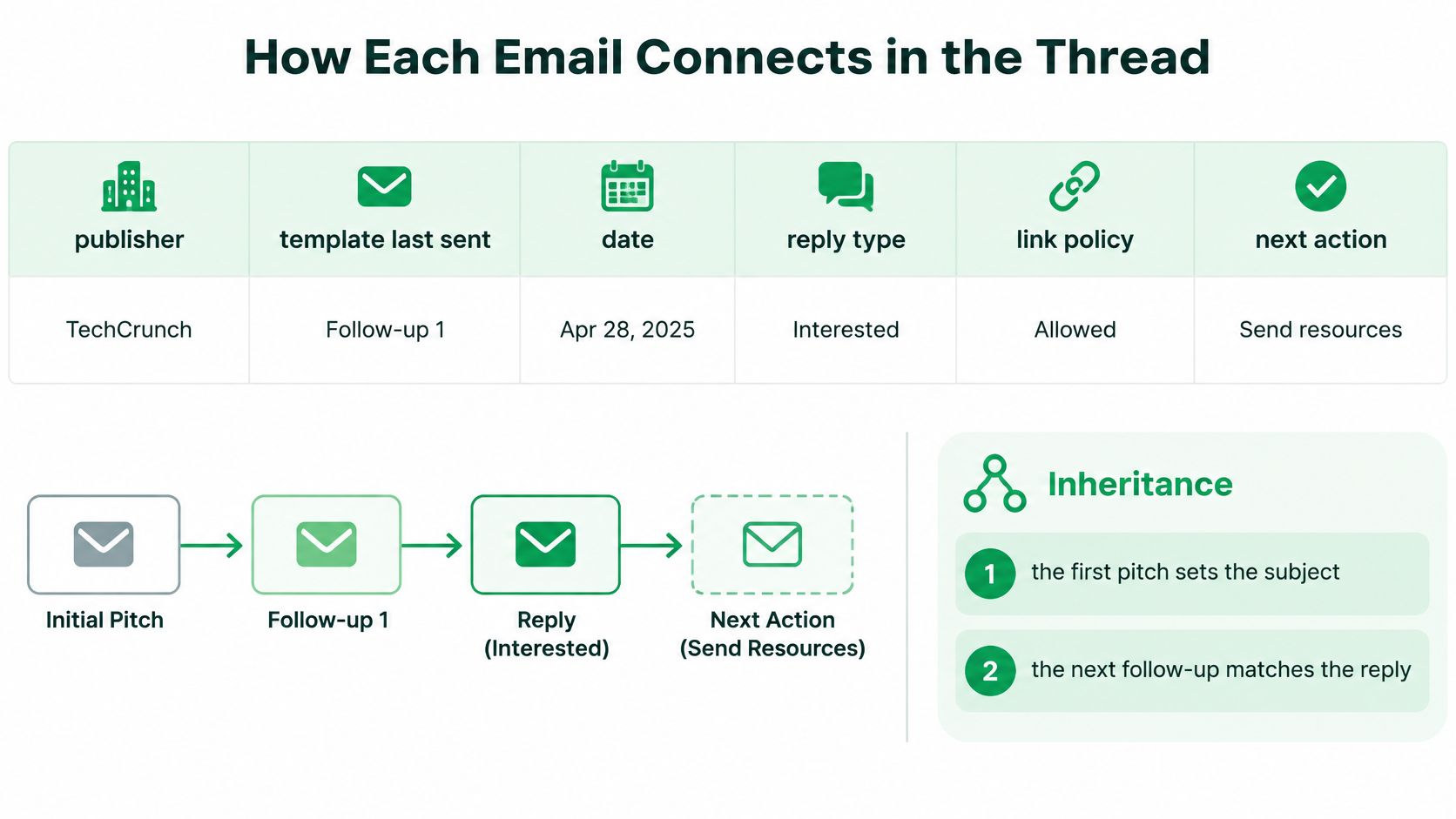
The Six Tracker Columns
Every row carries the same six fields:
- Publisher: The publication and the named editor, so a second sender can see the thread already exists.
- Template last sent: First pitch, follow-up 1, acceptance reply, and so on. This field prevents sending follow-up 1 twice.
- Date: The send date of the last message, which drives the timing of the next one.
- Reply type: Silence, interest, redirect, decline, or opt-out. Interest and redirect lead to different next emails.
- Link policy: Editorial, paid, sponsored labeling required, or not yet confirmed.
- Next action: The specific email or task that happens next, with an owner.
Inheritance Rules
The first pitch sets the subject, topic, and publication, and every later email reuses them. That's what makes the thread readable for an editor who opens your follow-up first. Follow-up 1 may add one proof point only. It doesn't get to swap in a new topic, because a new topic is a new pitch and belongs in a later, separate approach.
If an editor redirects the angle at acceptance, update the outline instead of arguing for the original. Record the new angle in the row so the draft, the samples you send, and any later check-in all reference the version the editor approved. Writers lose placements by drafting the piece they pitched rather than the piece the editor asked for.
Escalation and Status Rules
Escalation: An acceptance that reveals a fee, a required client URL, or an affiliate relationship moves the thread to the sponsored note before any draft is written. The tracker should show that category change explicitly, because the disclosure obligation starts at that moment, not at publication.
Link policy: The editorial pitch fixes the link policy for the thread. A later email can't upgrade it to a do-follow or paid placement. If the policy field in the tracker says editorial, every subsequent message stays consistent with that.
Guidelines: If an editor sends contributor guidelines, they replace your defaults. Their word count, image rules, and link policy go into the row and govern the draft, even when they differ from your template's ranges.
Status: Move a row to writing only when topic, audience, and link rules are all filled in. Move it to dead when the thread closes, whether that's a breakup with no reply, a decline, or an opt-out. A row sitting in limbo with no next action is how duplicate pitches happen, so every open row needs an owner and a date.
An agency can open the tracker in front of a client and show, row by row, which conversations are live, which are waiting on the editor, and which are closed for good.
Score the Reply Before You Write
A reply is not a placement. Before you write a single paragraph, run the reply through four pass-fail tests and only draft when all four hold.
The Four Tests
- Outside contributors accepted: The site publishes external writers, confirmed by the editor rather than assumed from a byline you spotted.
- Audience fit: The topic matches an audience you'd send a customer to. If you wouldn't want your own buyers reading this site, the placement has no value regardless of its metrics.
- Current guidelines stated: You have the editor's actual requirements for length, format, images, and review process, not a guidelines page from two redesigns ago.
- Link terms clear: You know whether links are editorial or paid, and who approves anchor text.
Three of these tests are answered by the questions already built into the acceptance reply: contributor guidelines, whether links are editorial or paid, and who approves anchors. The fourth, topic and audience fit, is your own check. No editor will do it for you.
Why Reply Counts Mislead
The scoring step exists because raw reply volume flatters bad campaigns. The HireEZ 2025 email outreach benchmark report, covering more than 2.7 million emails, reported a 15.2% average reply rate, yet only 41.8% of replies showed genuine intent to engage. Count intent, not replies. A thread full of polite deflections and out-of-office messages is not a pipeline.
The same caution applies to personalization. Published outreach benchmarks generally show personalized emails drawing more replies than generic ones, but that pattern is a correlation, not proof that arbitrary personalization causes success. A sender who researches publishers carefully will usually personalize more and target better, so the reply lift may belong to the targeting. Treat any reply figure as a rough sanity check rather than a quota your team has to hit, because reply rate alone says nothing about publisher quality, editorial acceptance, or campaign value.
Fail the reply if the editor wants a guaranteed anchor, a private-network placement, or payment without disclosure. Each of those terms converts your article into someone else's undisclosed advertisement, and the reputational cost lands on you when it's discovered.
Run a Small Test, Then Decide
Run a test of 20 to 30 personalized pitches in one niche. Log every acceptance against the four tests, and scale only after the qualified accept rate holds across that batch. If accepts keep failing the link-terms test, your targeting is wrong, and sending more volume won't fix it.
This is also the honest point to assess capacity. Scoring replies, writing original drafts, and verifying live URLs every week is real operational work. A specialist provider can build that work around the principle that editors come first, with valuable contributions rather than link drops, using white-hat methods only. A guest posting service that includes content written by subject-matter experts, domain and topic approval, and transparent reporting with live links gives a team clear scope and pricing before any work starts, so the handoff cost can be weighed against running the tracker, the templates, and the verification in-house.
If your team can't research publishers, write to their guidelines, and check placements every week, hand the campaign to a specialist rather than blasting the template at a bigger list. A guest posting email template earns its keep only when the replies it generates survive scoring.
If scoring replies and verifying placements is more operational work than your team can run every week, Linkbuilding.services handles publisher research, outreach, and content written by subject-matter experts, with domain and topic approval before anything is pitched and transparent reporting with live links once it publishes. You'll get clear scope and pricing before any work starts, so visit us to talk through your niche, your target pages, and the publishers worth approaching first.