Guest Posts vs Niche Edits: Cost, Risk and Which to Choose
Guest posts vs niche edits compared on process, control, cost and risk. Learn which format fits your SEO campaign, budget and link goals in 2026.
The popular advice on guest posts vs niche edits is too neat: use guest posts for safety and niche edits for speed. Neither recommendation tells you whether the publisher has readers, whether the placement helps them, or whether a commercial link is appropriately disclosed and qualified. Those are buying decisions, not details to check after publication.
A better comparison separates disclosed paid placements from editorially earned links, then evaluates the work each format requires. The right choice is the placement that fits your audience, target page and editorial context, not the one with the most reassuring label.
How Guest Posts and Niche Edits Differ at a Glance
Placement type isn't link quality. A guest post creates a new article on another publisher's site. A niche edit adds a link to an article that already exists. The same publisher can offer both, so the format describes what you're buying, not whether that publisher deserves your budget.
Guest posts and niche edits compared on core criteria
| Criterion | Guest post | Niche edit |
|---|---|---|
| Where the link sits | New article the publisher hosts | Inserted into an existing article |
| Page history at go-live | New URL with no ranking or link history | Uses an existing article with its age, traffic and existing links |
| Who writes the surrounding copy | You supply a full article, reviewed before publication | The publisher's paragraph; you propose a sentence and an anchor |
| Editorial fit risk | Thin or link-first article if the brief is weak | Awkward or off-topic paragraph around the link |
| Time to a live link | Writing, editing and scheduling before publication | Usually shorter once the publisher agrees |
| Repeatability across sites | Easier to scale across many publishers | Limited inventory; fewer sites sell |
| Link attribute to expect | rel="sponsored" for paid placements; rel="nofollow" where guest-post links need qualification | rel="sponsored" for paid placements; inspect the attributes before buying |
The page-history distinction needs care. An existing article gives you something concrete to inspect: its subject, search visibility and existing references. It doesn't guarantee that your inserted link will receive ranking credit or that the page will keep its traffic.
A new article offers a different opportunity. You can develop a useful argument around the destination page rather than squeeze a recommendation into existing copy. But you must assess the proposed content before there's a live URL to evaluate.
Popularity isn't a purchasing rule
In a 2023 survey cited by Search Logistics, guest posting was the main link-building strategy for 16% of respondents, compared with 4.6% for niche edits. That establishes a difference in reported adoption, not proof that guest posts deliver better returns.
Buying principle: Judge the publisher first, the article second and the placement format third.
For an agency, repeatability may matter because delivery spans unrelated client niches. For a SaaS team, a narrowly relevant article may matter more than broad inventory. Make the comparison on process, control, total cost, acquisition risk and editorial fit, rather than popularity alone.
How Each Placement Gets Built, Step by Step
The operational difference is where you spend effort. Guest posts require content development; niche edits require finding an existing passage that genuinely deserves the addition.
The workflows below show where approvals and verification belong.
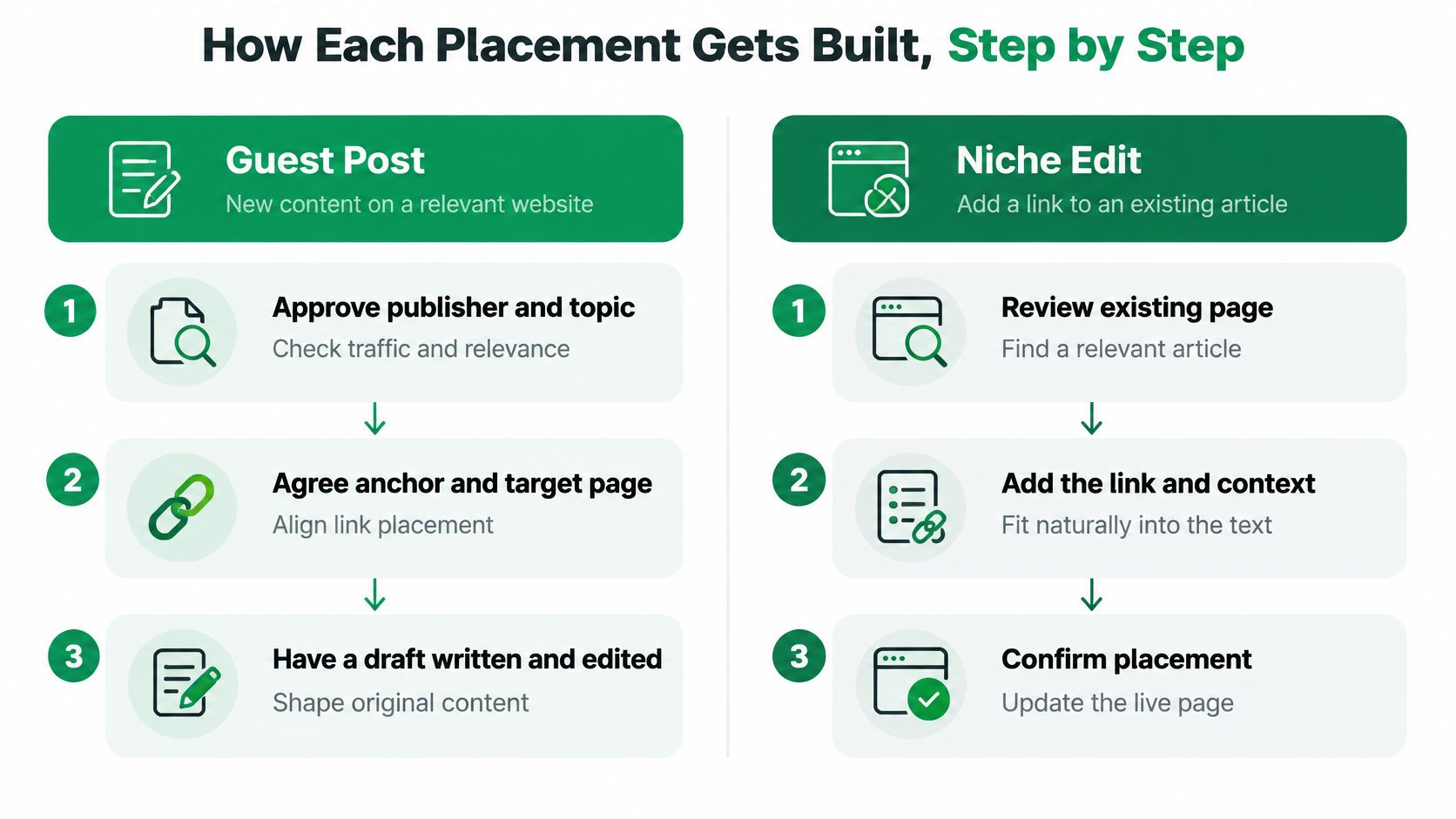
Guest-post workflow
Approve the publisher and topic. Check organic visibility, audience relevance and the publication's existing coverage using Ahrefs or Semrush alongside a manual review. The common slip is approving a domain score without checking what people read.
Agree on the anchor and destination. Specify the target URL and proposed wording before drafting. Otherwise, the writer may build an argument that doesn't support the page you're linking to.
Commission a subject-matter expert. Give the writer an approved brief, reader profile and evidence requirements. A weak brief produces generic copy with a commercial reference attached, rather than a contribution worth publishing.
Complete editorial review. Have the editor check originality, independence, disclosure and link qualification. Don't assume an approved draft will automatically publish with the correct attribute.
Publish and collect the live URL. Compare the published version with the approved copy. Publishers can change an anchor, move a reference or remove a disclosure during production.
Verify the placement and indexing. Inspect the rendered link and HTML attribute, then check whether the page is discoverable in search. If you control the publishing property, use Search Console's URL Inspection tool; don't promise indexing for someone else's site.
Niche-edit workflow
Identify suitable existing articles. Look for pages with relevant coverage and evidence of search visibility. The common mistake is choosing an old URL simply because it's old.
Read the paragraph and its references. Check whether your destination adds information the reader needs. Reject insertions that require an unrelated sentence or sit among unexplained commercial links.
Agree on the insertion and price. Record the proposed context, anchor, attribute and commercial disclosure. A vague agreement to add a contextual link leaves too much unresolved.
Have the publisher make the edit. Request the live URL and inspect the updated passage. Watch for an anchor changed without notice or wording that overstates your product.
Confirm the link remains correct. Check the destination, attribute and surrounding copy after publication. Save the agreed and delivered versions in your tracker.
Monitor subsequent performance. Track referral visits and target-page rankings over the following weeks. Treat ranking movements as observations, not proof that the insertion caused them.
Both workflows share one delivery gate: don't report a placement as complete until the link is live, correctly qualified and in the agreed context.
Editorial Control Over Content, Anchors and Timing
Control means more than selecting clickable words. It means deciding what the reader understands before reaching the link, what claim the link supports and whether the destination fulfils that expectation.
With a guest post, you can propose the topic, angle, author and anchor, then revise the draft before publication. You can't override the publisher's editorial calendar or site-wide rules. A publisher willing to publish anything unchanged isn't necessarily offering better control; it may be providing less editorial scrutiny.
A pricing-comparison example
Say a SaaS company wants readers to visit its pricing-comparison page. A guest post could explain how buyers should compare billing models, usage limits and implementation costs, then reference the comparison where those details become useful.
The link has a job within the argument. It isn't merely an exact-match phrase placed in the introduction.
A niche edit could work inside an existing review article that already discusses the same software category and purchasing questions. It wouldn't fit a general productivity article just because both pages mention software. The buyer should be able to explain why that particular paragraph needs the destination.
Control over the surrounding words determines whether the anchor reads as a useful recommendation or an inserted advertisement.
Use anchor text examples to evaluate how wording changes reader expectations. A branded reference, descriptive phrase and commercial keyword can point to the same destination while making very different promises.
Timing and post-publication rights
A niche edit can have a shorter production path because there's no full article to commission. That advantage starts after approval, not when prospecting begins. Finding an appropriate existing page may take more work than securing permission to contribute something new.
Guest-post timing includes drafting, revisions and scheduling. Build those dependencies into the campaign rather than treating every delayed publication as a delivery failure.
Resolve these questions in writing before authorising either format:
- Final-copy review: Can you inspect the draft or proposed insertion before it goes live?
- Anchor changes: Can the publisher alter the wording after publication, and will you receive notice?
- Future edits: What happens if the article is rewritten, consolidated or removed?
Don't confuse a promise of permanence with enforceable editorial control. Document the remedy you have.
What Each Format Costs Once Labor Is Counted
The 2022–2024 Ahrefs outreach benchmark summarised by SEOBRO reported average paid placement prices of $77.80 for guest posts and $361.44 for niche edits; it also reported that 25.5% of 180 sites responded to guest-post pitches, while 12.6% of 450 sites approached for niche edits were willing to sell.
Paid price and response rate by format
| Format | Average paid price | Outreach response rate |
|---|---|---|
| Guest post | $77.80 | 25.5% of 180 sites responded |
| Niche edit | $361.44 | 12.6% of 450 sites willing to sell |
| Labor for research, writing and verification | Not included; calculate from recorded hours and internal rates | Not measured as an outreach response rate |
The table reproduces that historical benchmark. It isn't a current price list, and its outreach measures aren't identical: responding to a pitch isn't the same as agreeing to sell. Don't turn either percentage into a forecast of your campaign's successful placements.
The visual separates publisher fees from the additional work required to deliver a usable placement.
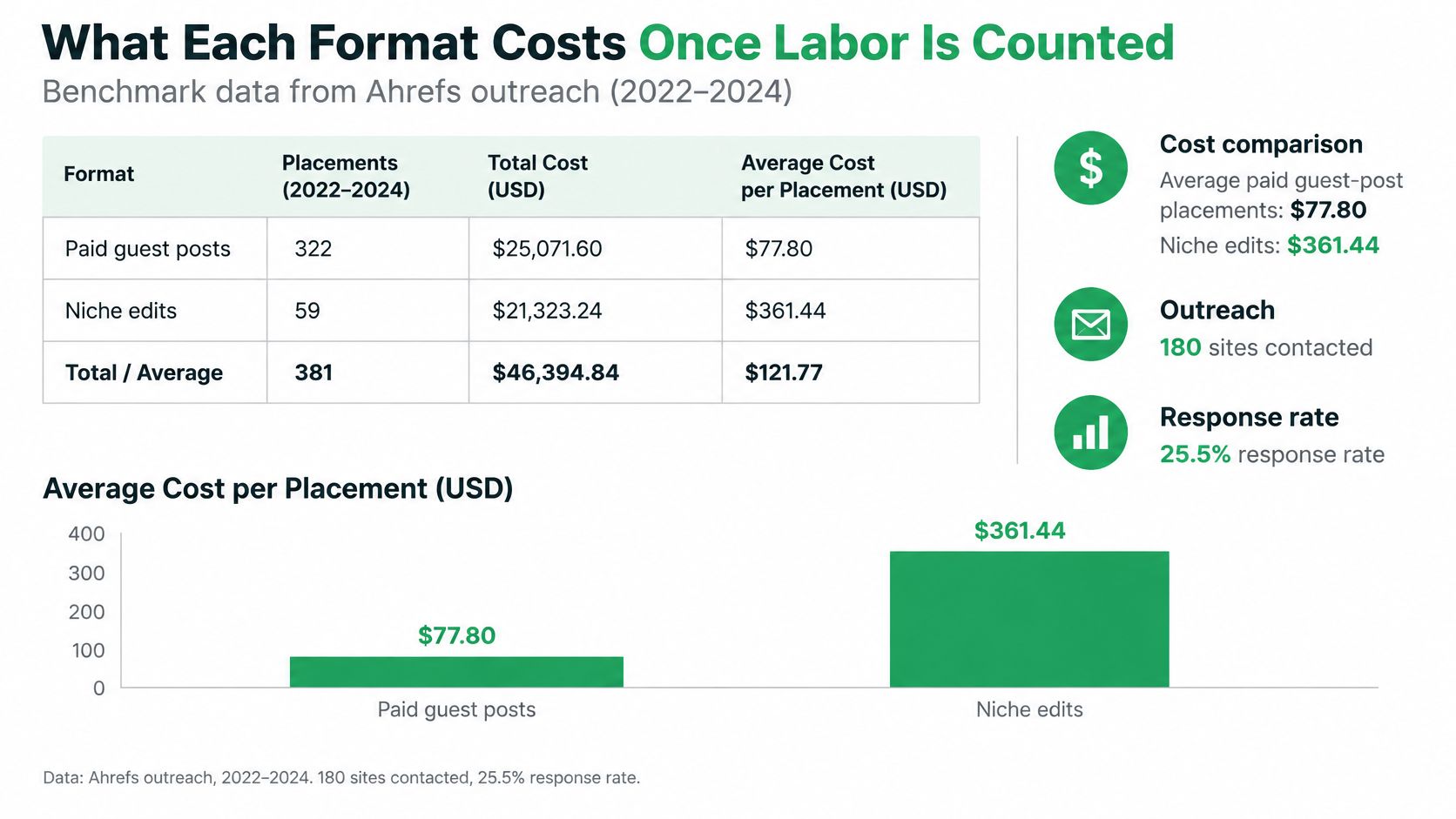
Count the work that the invoice omits
Guest-post production requires research, writing, editing and approval. The resulting URL also needs to become discoverable and attract readers. A low publisher fee doesn't eliminate those responsibilities.
Niche edits avoid commissioning a full article, but they don't eliminate prospecting. You still need to locate an appropriate page, inspect its context, negotiate permission and verify the finished insertion. The benchmark's lower willingness-to-sell figure makes availability a material purchasing consideration, although it doesn't measure your team's labor directly.
Record costs under consistent categories:
- Acquisition: Prospect research, outreach, follow-ups and negotiation.
- Production: Expert writing, editorial review and insertion copy.
- Quality assurance: Attribute checks, destination checks and placement monitoring.
- Remediation: Time spent correcting or replacing failed deliveries.
Compare cost per usable placement
For an internal evaluation, set a review checkpoint, such as 90 days after publication. That's a proposed accounting window, not a claim about how long SEO results take.
Calculate total placement spending plus labor cost, divided by the placements still live, indexed and compliant with your agreed criteria. Keep referral outcomes beside that figure rather than assuming every usable placement has equal business value.
The counterintuitive conclusion is that a cheaper guest-post invoice can produce a more expensive finished asset. Equally, paying more for an existing article doesn't make it a better investment. Compare complete delivery costs and observable usefulness, not publisher fees alone.
How Google Judges Paid and Earned Links
A guest-post label doesn't make a paid link safe, and an established article doesn't make an inserted link editorially earned. Google evaluates the acquisition and purpose of the link, not the service category on your invoice.
Google's spam policies identify paid links used to manipulate rankings and optimized anchor text in articles, guest posts and press releases as link-spam examples. The decisive questions are whether compensation influenced the placement, whether the link passes ranking credit and whether it exists primarily to manipulate search results.
Qualification isn't optional paperwork
For a paid placement, specify rel="sponsored". Google's guidance has also recommended rel="nofollow" for guest-post links requiring qualification. Don't treat a visible sponsorship statement as a substitute for the HTML attribute: readers and search systems receive different signals.
An editorially earned link is different because the publisher independently chooses the reference for its readers. Paying a writer to produce an informative article doesn't, by itself, settle whether the subsequent publisher placement is earned or commercially arranged.
The distinction also matters when evaluating a do-follow backlink. A promise that a paid link will pass ranking credit isn't a compliance benefit. Proper disclosure and qualification don't convert a purchased placement into an earned endorsement.
Audit the acquisition pattern
Review recent links and publishers that link to you repeatedly. For each placement, record the destination, anchor, publisher, surrounding passage, commercial arrangement and live attribute. Where a link violates the rules, seek removal or qualification rather than leaving the issue hidden in a delivery report.
Look for patterns that deserve investigation:
- Repeated commercial anchors: Similar sales-oriented wording across unrelated publishers.
- Irrelevant hosts: Articles whose readers have no plausible need for the destination.
- Thin contributions: Pages that offer little beyond the inserted recommendation.
- Unexplained delivery spikes: Sudden batches that bypass editorial approval or publisher checks.
These are audit signals, not a formula that proves a penalty will occur. Don't assume every problematic link triggers a direct sanction, but don't assume the absence of one establishes lasting ranking value.
Audit priority: Separate paid placements from earned references before calculating what the campaign achieved.
At Linkbuilding.services, we vet each publisher on domain rating, referring domains, organic traffic and topical relevance before sending a pitch. We avoid dead sites, private blog networks and domains without an audience, focusing on publishers that rank for keywords and earn traffic from Google.
Those checks assess publisher suitability. They don't replace disclosure or qualification, and an attractive authority score can't excuse an undisclosed commercial relationship.
Matching Each Format to Your Campaign Goal
Better format by campaign goal
| Campaign goal | Better fit | Why |
|---|---|---|
| Own a topic with expert depth | Guest post | A new page can carry original research and commentary |
| Push one ranking commercial page | Niche edit | Contextual fit inside an article that already ranks |
| Spread links across many niches on a budget | Guest post | Easier to repeat across publishers |
| Win referral traffic and brand discovery | Guest post | The publisher's audience can be matched to your buyers |
| Support a low-traffic page | Neither by default | A niche edit only makes sense if the host article earns real traffic |
These are starting preferences, not promises of ranking improvement. For paid placements, interpret the commercial-page recommendation as an opportunity for relevant exposure and referrals, not permission to buy ranking credit.
The formats serve different editorial situations, illustrated below.
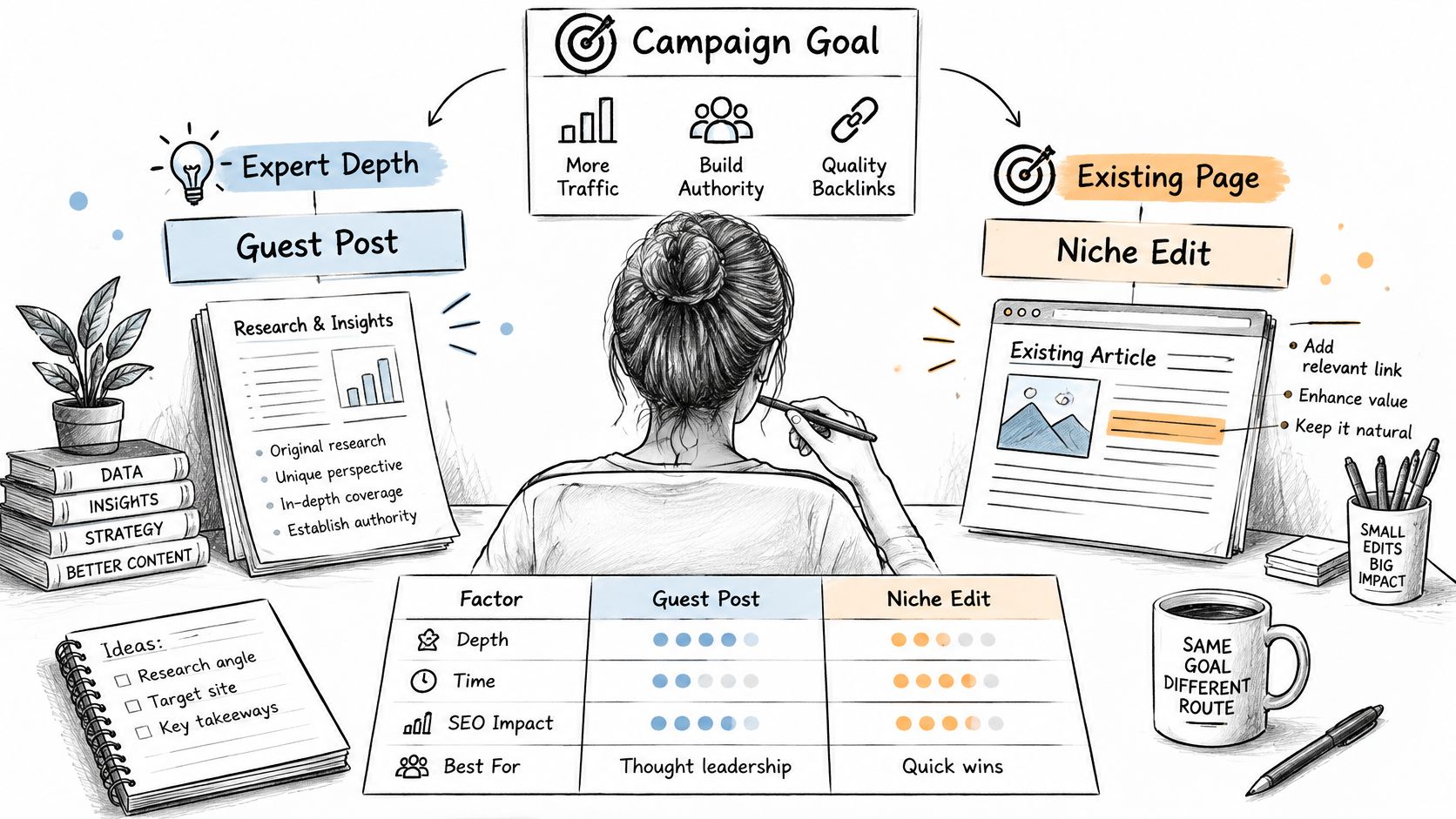
Use audience evidence to resolve close calls
Ask what remains valuable if the link contributes nothing to rankings. Google's spam-update guidance explains that previously gained ranking benefits can be lost when its systems remove the effects of link spam. That makes independent audience value a practical investment test, not just an editorial preference.
Inspect the host article's search queries, relevance to the buyer's problem and plausible path to the destination. After publication, measure referral sessions, engagement and meaningful actions where your analytics setup allows. Don't substitute a domain-level traffic estimate for evidence about the actual article.
For agencies serving varied clients, white-label guest posts can provide a repeatable production process. For a SaaS or B2B team focused on a pricing-comparison page, a relevant review article may offer a more precise audience match. Ecommerce teams should apply the same test to category guides and purchasing resources rather than pursuing unrelated mentions.
This video offers another way to consider the format decision.
Match delivery to the intended outcome
Our niche-edits service adds contextual backlinks to existing articles on sites that rank and bring in search traffic, with minimum traffic and authority requirements. Our guest-posting service includes subject-matter expert writing, domain and topic approval, and transparent reporting with live links.
If your goal is to improve Google search rankings, distinguish that objective from the results a disclosed paid placement can reasonably be evaluated on. Neither format repairs an unhelpful destination page.
The strongest tie-breaker is simple: would the article and its recommendation still deserve to exist without a ranking benefit? If not, reconsider the opportunity rather than changing its label.
Choose the Format Before You Brief a Publisher
Choose a niche edit when a specific target page fits naturally within an existing article with a relevant audience, and your budget can absorb the acquisition cost. Choose a guest post when you need room for original expertise, a repeatable publishing process or a fuller introduction to your brand.
The decision should produce a concrete brief, not just a purchase category. A request for niche edits without approved host-page criteria invites irrelevant insertions. A request for guest posts without a reader problem invites articles written only to accommodate links.
Pre-brief checklist
Confirm the destination and audience. Name the target page, the reader it serves and the action you'd like that reader to take. Fix a weak destination before commissioning outside exposure.
Approve publisher suitability. Check traffic, rankings and topical alignment against the intended audience. Specify unacceptable site types so prospectors don't fill the shortlist with superficially impressive domains.
Agree on wording and attributes. Record the proposed anchor, target URL and qualification, including
rel="sponsored"for paid placements. Give the editor enough context to assess the recommendation rather than merely approve a phrase.Confirm commercial disclosure. State how the relationship will be communicated to readers. Don't leave the decision to whoever uploads the article.
Set maintenance terms. Establish what happens if the page changes, the link disappears or the destination needs updating. Distinguish an agreed correction process from an unsupported guarantee of permanence.
Turn the choice into an approved plan
We provide clear scope and pricing before work starts. Our third process step is creating a 90-day roadmap covering target pages, the anchor plan, link velocity, publisher criteria and content angles, with pre-approval built in.
Use that planning discipline to prevent disconnected purchasing decisions. The roadmap should tell the writer, prospector and editor what success looks like before anyone negotiates a placement.
Your next action is to put scope and pricing in writing, then approve the roadmap before the first pitch goes out. That's more useful than declaring either format the universal winner.
Linkbuilding.services offers managed guest posting, contextual niche edits and white-label delivery, including publisher research, content production, placement verification and reporting. Visit to discuss your target pages and budget, then establish which format fits your audience, editorial requirements and campaign goals before outreach begins.