Guest Blogging and SEO: What Links Still Count in 2026
Learn how guest blogging and SEO work together in 2026: which links pass ranking credit, the risks to avoid, and how to measure results.
If a guest post brings qualified buyers but no ranking credit, did it fail? And if another placement delivers a followed backlink that Google ignores, did it succeed?
Those questions expose the weakness in judging guest blogging and SEO by backlink totals alone. A guest post is an article you contribute to another publisher, but its value can take different forms: readers who discover your business, an editorial link that may support search visibility, or a manufactured link that creates policy risk. The useful question is not whether you got a link. It's whether the placement deserves readers, how the link is qualified, and what you can measure.
Which Guest Post Links Count for SEO
A guest post link can support SEO when it's editorially earned, relevant, and qualified correctly. None of those conditions guarantees rankings. They establish whether you're pursuing a legitimate editorial reference rather than buying a ranking signal.
Start by separating the common arrangements.
Guest post link types, markup and risk
| Link type | Markup | Ranking credit | Policy risk |
|---|---|---|---|
| Editorial link, no payment | None, plain link | Can pass ranking credit when relevant | Low when the post serves readers |
| Paid placement marked sponsored | rel="sponsored" | Not a dependable source of ranking credit | Low when properly qualified and disclosed |
| Paid placement marked nofollow | rel="nofollow" | Ranking credit not promised | Low when properly qualified and disclosed |
| Paid placement, unmarked, keyword anchor | None, plain link | Can appear eligible to pass credit, but may be discounted | High; Google classes paid links intended to manipulate rankings as link spam |
The first row describes an editor choosing a contribution because it helps the publication's audience. The link belongs because the destination supplies something useful, such as original evidence, a detailed explanation, or a relevant resource. An unpaid article isn't automatically legitimate, however. A coordinated campaign built primarily to manipulate rankings can still be problematic.
The sponsored rows describe a commercial relationship. Qualification tells search engines not to treat an advertisement as an ordinary editorial endorsement. Disclosure for readers and link markup serve different purposes, so a visible sponsorship label doesn't replace the appropriate attribute.
The final row combines payment with an attempt to obtain ranking credit. The danger isn't that its HTML looks unusual. It may look exactly like an ordinary editorial link, which is why the commercial arrangement matters.
What the markup and anchor actually do
Google's crawlable-link guidance recommends standard HTML <a href="..."> links and concise, descriptive anchor text; its guidance also explains qualifying sponsored links with rel="sponsored" or rel="nofollow".
Think of markup as the relationship label and anchor text as the destination label. One helps qualify why the reference exists. The other tells a reader what they'll find after clicking.
A do-follow backlink is commonly understood as a link without a qualifying attribute that restricts ordinary treatment. It isn't a special certification of quality, and it doesn't force Google to award ranking credit.
Say a payroll article references a guide to calculating overtime. An anchor such as overtime calculation guide describes the destination. Forcing an unrelated product keyword into that sentence makes the article less useful, even before you consider campaign patterns.
Check the offer before accepting it
- Editorial purpose: Would the editor include this destination if ranking credit weren't part of the discussion?
- Commercial qualification: If money or another commercial benefit changes hands, will the publisher qualify the link appropriately?
- Descriptive wording: Does the anchor explain the destination naturally, rather than repeat a campaign keyword mechanically?
Practical rule: Buy distribution when you need distribution. Don't mistake a paid publishing agreement for an earned editorial endorsement.
A sponsored or nofollow placement can still introduce your business to readers. Its commercial value doesn't require a promise of ranking credit.
What Guest Posts Deliver Beyond Rankings
A sponsored article that produces interested readers can be more useful to a business than a followed link nobody encounters. That isn't a consolation prize. It's a different outcome, and it deserves its own evaluation.
Referral visits happen when readers click through from the publisher. Brand exposure happens when they encounter your name, even without clicking. A useful bylined contribution can also demonstrate expertise to people deciding whose advice to trust. These are audience outcomes, not automatic Google ranking benefits.
Link scarcity helps explain why useful publishing matters. Industry findings summarized by BlazeHive's blogging statistics found that 94% of approximately 912 million blog posts had no external links. Publishing something on your own website doesn't mean other people will discover or cite it.
A software example without a ranking promise
Say a B2B software company contributes an article about preparing customer records for a system migration. An industry publication accepts it because its readers struggle with duplicate records and inconsistent fields.
The article includes a practical cleanup worksheet. Readers can apply the advice without booking a demonstration, while those who need the worksheet can visit the company's website. Some may later search for the company by name when their migration project becomes urgent.
That sequence has plausible business value even if the original placement carries no ranking credit. The author has answered a real question at the point when a potential buyer needs help.
Useful exposure has somewhere to go
The destination should continue the article's work. Sending a reader from a technical tutorial to a generic homepage creates unnecessary friction; sending them to the promised worksheet gives them a reason to stay.
- For immediate interest: Offer the resource the paragraph describes.
- For later consideration: Make your company name and expertise clear without turning the contribution into a sales pitch.
- For further citations: Include explanations or resources that another writer could genuinely use.
Secondary mentions and natural links may follow, but they're possibilities, not deliverables you can promise.
Judge the contribution by what a reader gains before judging what a backlink might pass.
That test keeps the article useful even when search engines assign its link little or no direct ranking value.
What Google Enforced and Safer Practice
The historical turning point wasn't a ban on writing for other publications. As Search Engine Land's account of the guest-blogging crackdown explains, Matt Cutts warned about spammy guest blogging in January 2014, and Google confirmed action against a major guest-blogging network on March 18, 2014.
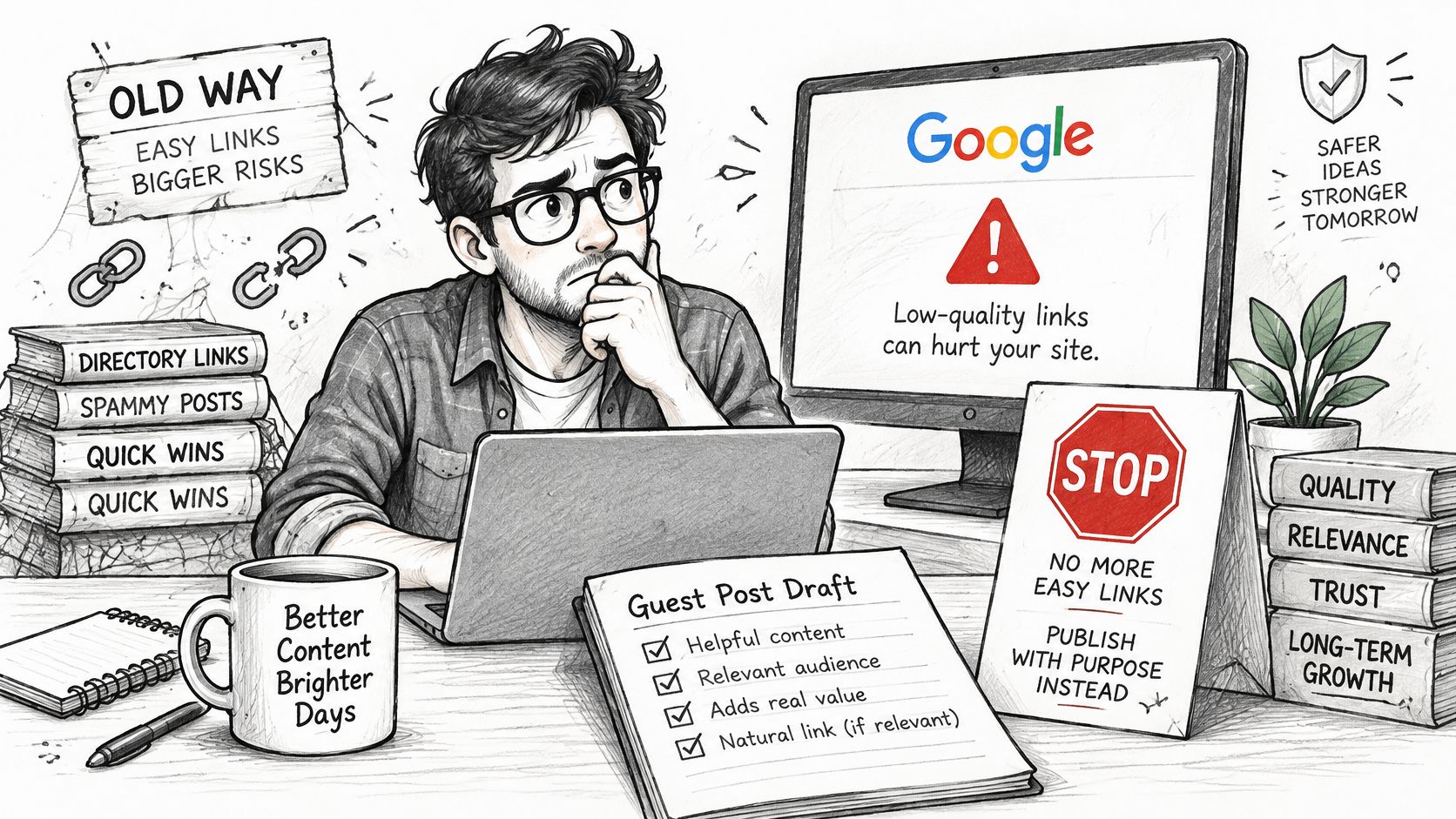
The distinction was between legitimate contributions and publishing designed primarily to manufacture links. Repeated placements, weak publishers, commercially motivated links, and articles written chiefly to influence rankings formed the problematic pattern.
The choice is between useful editorial work and placement-first shortcuts.
Separate a wasted link from a policy problem
Google's link-spam policy classifies buying or selling links intended to manipulate rankings as link spam, including paid guest-post links that pass ranking credit. It describes algorithmic handling of spam and the possibility of manual action for policy violations.
These outcomes shouldn't be bundled together:
- Commercial exposure: Readers discover the business, regardless of direct ranking credit.
- Ignored links: The campaign records placements, but Google discounts the intended ranking signals.
- Policy risk: The arrangement violates spam rules and may expose the site to enforcement.
A discounted link isn't evidence that a campaign worked safely. It may mean the purchased signal didn't achieve what the buyer expected.
Say a SaaS team buys a batch of articles across a publisher network. Every article uses the same product keyword as its anchor, none qualifies the paid relationship, and the articles attract little genuine readership. The problem is the combined publishing model, not merely an awkward phrase in an otherwise valuable article.
Replace the mechanism, not just the wording
| Risky practice | Safer practice |
|---|---|
| Private blog networks | Independently valuable editorial publications |
| Repeated exact-match anchors | Descriptive wording chosen for each context |
| Payment followed by automatic publication | An editor who reviews and can reject the draft |
| Unqualified paid links | Properly qualified commercial links |
| Sites maintained only to sell placements | Publishers serving an identifiable audience |
Changing anchors alone won't make an artificial network editorially independent. Likewise, improving the article doesn't erase an undisclosed commercial link arrangement.
At Linkbuilding.services, we avoid dead sites, PBNs, and domains without an audience. We focus on publishers that rank for keywords and earn traffic from Google, and our team believes editors come first, with valuable contributions rather than link drops.
For additional context on the guest-blogging debate, watch the following discussion.
A good guest contribution resembles a referral letter from a trusted colleague: it has a reason to reach a particular person. A link farm resembles flyers pushed under every door. Let editorial usefulness determine the placement, rather than starting with a quota and finding somewhere to deposit the links.
How to Vet a Placement Before You Pitch
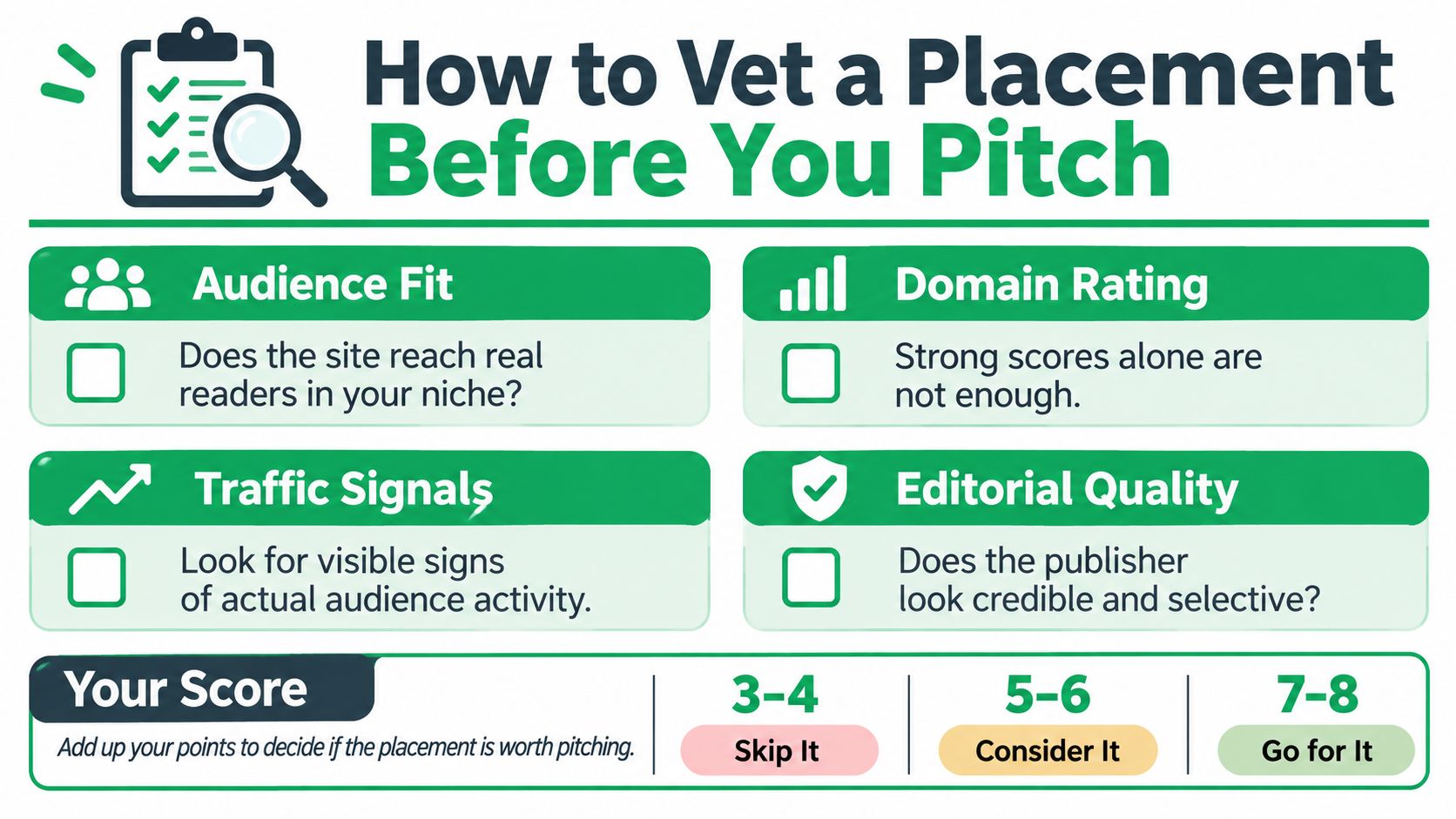
Use a publisher scorecard before you invest in outreach or drafting. A strong domain rating can justify further investigation, but it can't establish audience fit, editorial independence, or whether your proposed article belongs there.
Placement vetting scorecard
| Criterion | Strong signal | Red flag |
|---|---|---|
| Topical relevance | Publisher covers your niche for its own readers | Generic site that accepts any topic |
| Audience | Organic traffic and relevant keyword rankings | No traffic, or apparent activity supported only by link metrics |
| Editorial independence | Editor reviews and can reject your draft | Pay-and-publish with no edit |
| Link placement | Link sits in body text that fits the paragraph | Keyword-led link in a footer, sidebar, or author box |
| Publisher pattern | Host domains are varied and independent | Same network hosting many of your placements |
| Domain rating | Checked alongside traffic and relevance | Used alone as the decision |
An author bio isn't suspicious on its own. The red flag is a keyword-focused placement chosen for manipulation rather than a useful author reference. Likewise, a contextual body link isn't automatically trustworthy just because it sits inside a paragraph.
Ahrefs' SEO statistics summarize a positive correlation between unique referring domains and search traffic while explicitly cautioning that correlation doesn't establish causation. Use that finding to investigate independent publishers, not to assume every additional domain will improve rankings.
Inspect the publisher in a practical order
- Check search visibility. In Ahrefs or Semrush, inspect organic traffic estimates, ranking keywords, and the pages attracting visits. Relevant rankings are more informative than an unrelated traffic peak.
- Read existing contributions. Look for specific advice, credible authorship, coherent subject coverage, and links that support the surrounding text.
- Confirm editorial control. Establish who reviews the draft, whether revisions are expected, and whether the editor can decline an unsuitable reference.
Traffic estimates aren't audited readership figures. Treat them as screening evidence and compare them with what you can see on the site.
Use this checklist to keep audience quality and editorial judgment visible during review.
Record a decision, not just a score
For each candidate, record topic fit, relevant ranking pages, traffic evidence, referring domains, editorial contact, proposed destination, link context, commercial terms, and approval status. Include a short rejection reason so another team member doesn't reopen an unsuitable prospect.
At Linkbuilding.services, we vet each publisher on domain rating, referring domains, organic traffic, and topical relevance before pitching. Those checks apply to publisher selection, not just to a report assembled after publication.
The same contextual test matters when comparing guest articles with niche edit links: the destination should help someone reading that particular passage. Reject an off-topic placement even when its headline metric looks attractive.
Metrics That Show Real Authority Growth
A rising backlink count can conceal repeated links from the same publisher, irrelevant placements, or references that disappear after publication. Counting delivery is useful operationally, but it isn't the same as measuring authority or business results.
Ahrefs' analysis of leading blogs reported that the correlation between total backlinks and organic traffic declined from 0.27 to 0.21 compared with its earlier study. That doesn't mean links stopped mattering. It means aggregate counts explain less than a simple more-links-equals-more-traffic story suggests.
Build a baseline before publication, then track the destination pages and placements together.
| Metric | What to record | What it helps you assess |
|---|---|---|
| New referring domains | Newly discovered independent linking domains | Breadth beyond repeat placements |
| Target-page rankings | Positions for a defined query set | Movement on the pages you intended to support |
| Qualified organic sessions | Search visits to relevant landing pages and meaningful actions | Whether visibility attracts the intended audience |
| Anchor diversity | Anchor wording across the campaign | Forced repetition or disproportionate keyword targeting |
| Link persistence | Live page, destination, attributes, and link presence | Whether delivered placements remain intact |
Read the signals together
New referring domains describe reach across publishers, not guaranteed quality. Check whether those domains remain relevant and independent rather than treating every new hostname as progress.
Target-page rankings are more useful than a sitewide average that mixes unrelated pages. Use a consistent query set in your rank tracker and annotate major page changes, because rewritten content or internal linking can affect the same results.
Qualified organic sessions require a business definition. In Google Analytics, examine whether visitors reach relevant pages and complete meaningful events, such as a qualified enquiry or product evaluation, rather than celebrating sessions alone.
Measurement caution: A ranking improvement after a guest post isn't proof that the guest post caused it.
Establish a review rhythm
- Monthly placement review: Check new referring domains, live links, destination URLs, and attributes.
- Longer performance review: Evaluate rankings and qualified organic sessions over several months rather than reacting to daily fluctuations.
- Pattern review: Investigate repeated exact-match anchors, disappearing placements, and unexpected concentrations of publishers.
Keep referral visits and assisted conversions in a separate distribution view so they don't get confused with organic-search gains.
A broader publisher footprint with stable, useful references is encouraging. A sudden concentration of keyword anchors without relevant audience or performance improvements calls for investigation, not another order of identical placements.
Set Your Guest Blogging Rules Before You Pitch
Write the operating rules before outreach begins. Otherwise, the easiest available placement can replace the campaign's actual goal.
Build an auditable starting plan
- Choose destination pages and purposes. Identify whether each page should support product evaluation, category discovery, or an informational task. Fix an unsuitable destination before seeking references to it.
- Document acceptable arrangements. Specify permitted link types, commercial qualification, repeat-publisher limits, and editorial expectations. Use an anchor text example to distinguish a useful description from a forced keyword.
- Approve a defensible shortlist. Apply the scorecard and reject candidates that fail the audience check, even if they're easy to secure.
- Set measurement ownership. Name who records baseline performance, verifies publication, and reviews results each month.
- Keep commercial records. Save payments, agreements, publisher correspondence, and qualification requirements with each placement.
Make delivery inspectable
A team without internal outreach capacity can use a managed provider, but delegation shouldn't remove oversight. Publisher visibility before pitching, live placement reporting, defined scope, and white-hat methods should remain part of the working arrangement.
At Linkbuilding.services, we provide clear scope and pricing before work starts and use white-hat methods only. We don't guarantee specific rankings, traffic amounts, or revenue outcomes.
Evaluate results over time and preserve the distinction between verified delivery and demonstrated performance. No provider can responsibly turn an editorial placement into a guaranteed search outcome.
Linkbuilding.services offers managed guest posting with subject-matter content, domain and topic approval, and transparent reporting with live links. Visit Linkbuilding.services to discuss your target pages, publisher criteria, and measurement goals before starting outreach.