Niche Edit Links: How They Work and How to Vet Them
Learn what niche edit links are, how to choose publishers, run compliant placements, and measure durability so your backlinks keep working over time.
A niche edit is a contextual backlink added to an existing article on a site that already ranks and earns search traffic, rather than a link inside a newly written guest post. That sounds simple. It's also where most buying advice stops too early.
You'll see offers scored by how many niche edit links were placed. You're rarely told how many are still live, still relevant, and still on the page you thought you bought into months later.
Why Niche Edit Links Deserve a Closer Look
Counting placed links is the wrong scorecard. A link that goes live on Monday, disappears during a site cleanup, or ends up surrounded by unrelated commercial links hasn't done much for you. It looked good in a delivery report. That's not the same as value.
If you're an SEO lead, agency owner, or in-house marketer, you probably don't need more theory. You need stronger support for specific target pages. You also have limited outreach capacity, a budget to protect, and a manager or client who'll ask what changed.
That creates a practical tension. Niche edits can be faster than writing and placing a new article from scratch. They're also easier to buy badly, because you're depending on someone else's existing page, editorial standards, and willingness to keep the placement intact.
The durability question: don't ask only whether a link can be placed. Ask whether it'll still be live, indexed, and topically sensible after 6, 12, and 24 months.
That's the lens to use from the start. You'll define what you're buying. You'll screen publishers before anyone pitches them. You'll follow a documented placement process. You'll weigh policy risk carefully. Then you'll keep checking after publication, instead of treating a live URL as the finish line.
What You'll Be Able to Decide
By the end, you should be able to look at any niche edit offer and spot the gaps. Is the host page read? Does the proposed paragraph help a human reader? Is a paid placement qualified correctly? What happens if the article is deleted?
You don't need perfect certainty before you spend. You do need a repeatable way to say yes, no, or not at that price. That's a much better position than buying a volume number and hoping the links behave.
Defining Niche Edit Links and Their Benefits
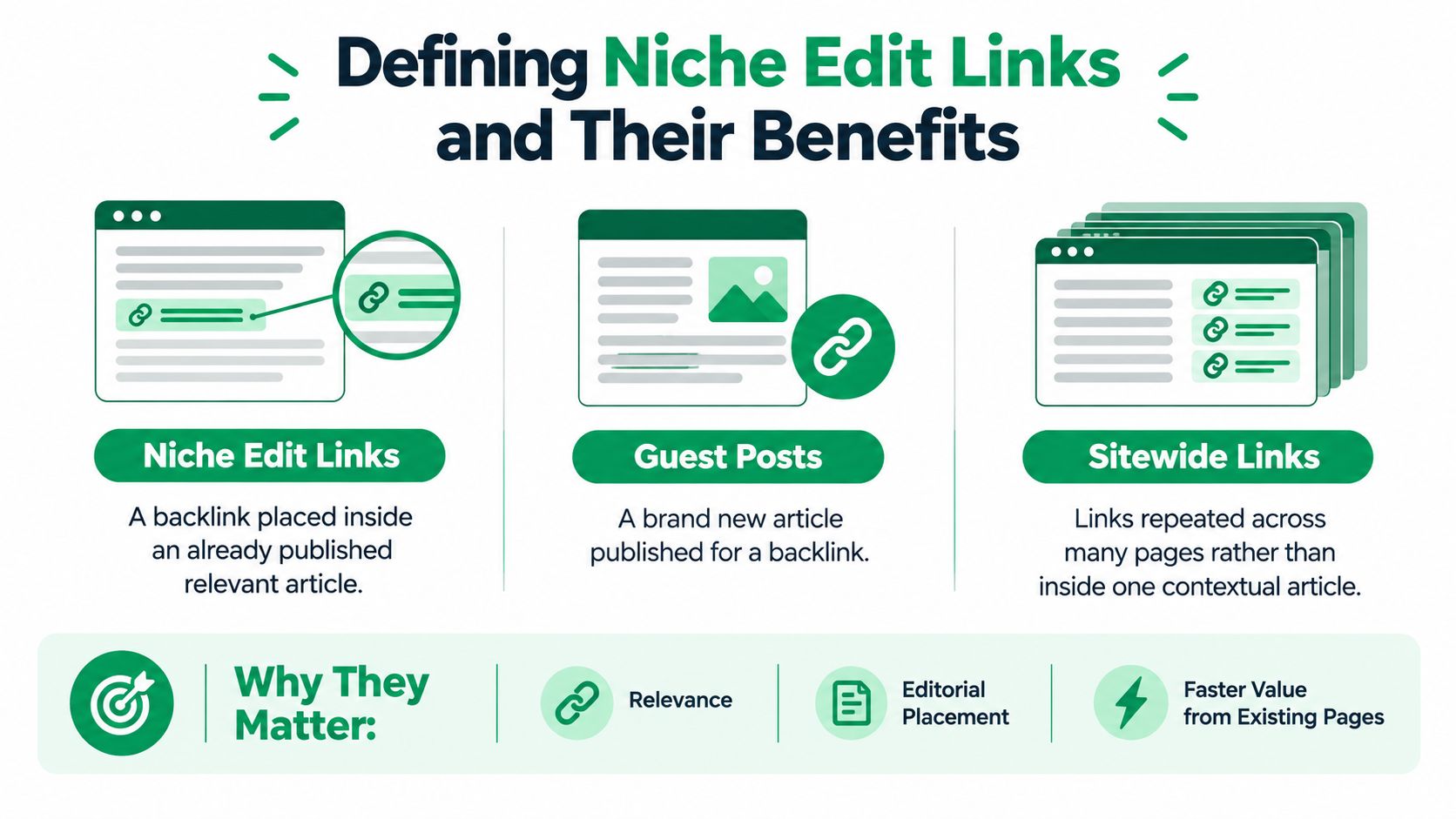
A niche edit, also called a link insertion or curated link, is a backlink added into an article that's already published. An editor updates a relevant paragraph, adds a useful sentence or reference, and links to your target page in context.
A guest post works differently. You create a new article, pitch it, get it approved, and wait for that new page to be indexed and found. Both tactics can earn you a backlink. They carry different levels of control, speed, and dependence on the host page.
A Simple Analogy That Helps
Think of a library book that readers already borrow. A niche edit adds one relevant reference to a page in that book. A guest post prints a new book so it can carry your reference.
The existing book has an audience already. That's the appeal. But you're also borrowing someone else's shelf space. If the book is withdrawn, heavily edited, or never really read, your reference doesn't help much.
Readers often confuse existing with valuable. They're not synonyms. An old article can be indexed and still be thin, off topic, or ignored. The benefit comes from an existing article that's relevant, crawlable, and visited.
Why the Surrounding Page Matters So Much
A backlink doesn't sit alone. It sits inside a paragraph, on a page, inside a site full of internal links, navigation, and older content. That network context shapes how the placement should be interpreted.
A Stanford study of the web link graph found that 79.1% of links in its dataset were intra-host links connecting pages on the same host, while only 20.9% were inter-host links connecting different hosts. At domain level, 83.9% were intra-domain. In plain terms, most links on the web are a site linking to itself. Your niche edit is one of the smaller set that crosses to another site.
That doesn't automatically make it powerful. It makes context more important, not less. You should assess the linking page's role on its site, its topical fit, and whether search engines can crawl and understand it. A link count alone tells you very little.
The Practical Benefits When It's Done Well
Used selectively, niche edits offer three clear advantages.
- An existing audience: the article is already being found and read, so you're not waiting for a brand new page to gain traction.
- Topical context: the surrounding sentences can explain why your resource belongs there, which helps human readers first.
- Focused support: you can point to a specific product, guide, or service page that needs relevant references.
There's a trade-off you shouldn't ignore. You control less than you do with a guest post. You don't own the article, its future edits, or its outbound link profile. That lack of control must be priced into the decision.
The comparison below sets the three link types side by side, so you can see where a niche edit fits and where it doesn't.
Choosing Publishers Worth Pitching
Don't start with a domain score and work backwards. Start with a reader. Would a real person land on this article, trust it, and find your link useful? If the answer's shaky, a strong metric won't save the placement.
Authority scores are useful as a first filter. They're misleading as a final answer. A domain can carry a high rating from its history while the specific article gets no meaningful traffic, ranks for nothing relevant, or sits on a site that no longer serves a clear audience.
Publisher Criteria and What Each Signals
| Criterion | What It Signals |
|---|---|
| Domain rating | A rough view of backlink strength, useful for screening but not proof of readership |
| Referring domains | Whether other sites link to the publisher, and whether that profile looks broad or manufactured |
| Organic traffic | Whether real search visitors reach the site, which supports referral and discovery value |
| Keyword rankings | Whether the publisher competes for topics near yours, rather than ranking by accident |
| Topical relevance | Whether the site, section, and exact article match your target page closely enough for readers |
| Audience fit | Whether the publisher's readers resemble the people you want to reach |
We use Ahrefs, Semrush, and our own research to find publishers that match a client's niche and audience. Each publisher is vetted on domain rating, referring domains, organic traffic, and topical relevance before any pitch is sent. That order matters. Research first, outreach second.
We also avoid dead sites, PBNs, and domains with no audience, focusing instead on publishers that rank for keywords and earn traffic from Google. A private blog network might accept your link quickly. Speed isn't a quality signal.
Real sites with traffic beat metric games. Every time.
A Filter You Can Apply Today
Take any candidate list and run it in this sequence.
- Remove the irrelevant: cut sites and articles that don't match your topic, even if the metrics look attractive.
- Check for life: confirm the site ranks, earns organic traffic, and publishes for a recognizable audience.
- Inspect the exact page: read the article, find the paragraph where your link would sit, and check the other outbound links.
- Question the pattern: look for unrelated commercial links, thin updates, or a page that seems built to sell placements.
That last step catches a common mistake. Buyers vet the domain and forget the page. Your link won't live on a domain in the abstract. It'll live in one article, next to specific words, among specific neighbors.
If a publisher can't pass the page-level test, don't pitch it. You'll save outreach time, and you'll avoid paying to fix a weak decision later.
Placement Process from Pitch to Live Link
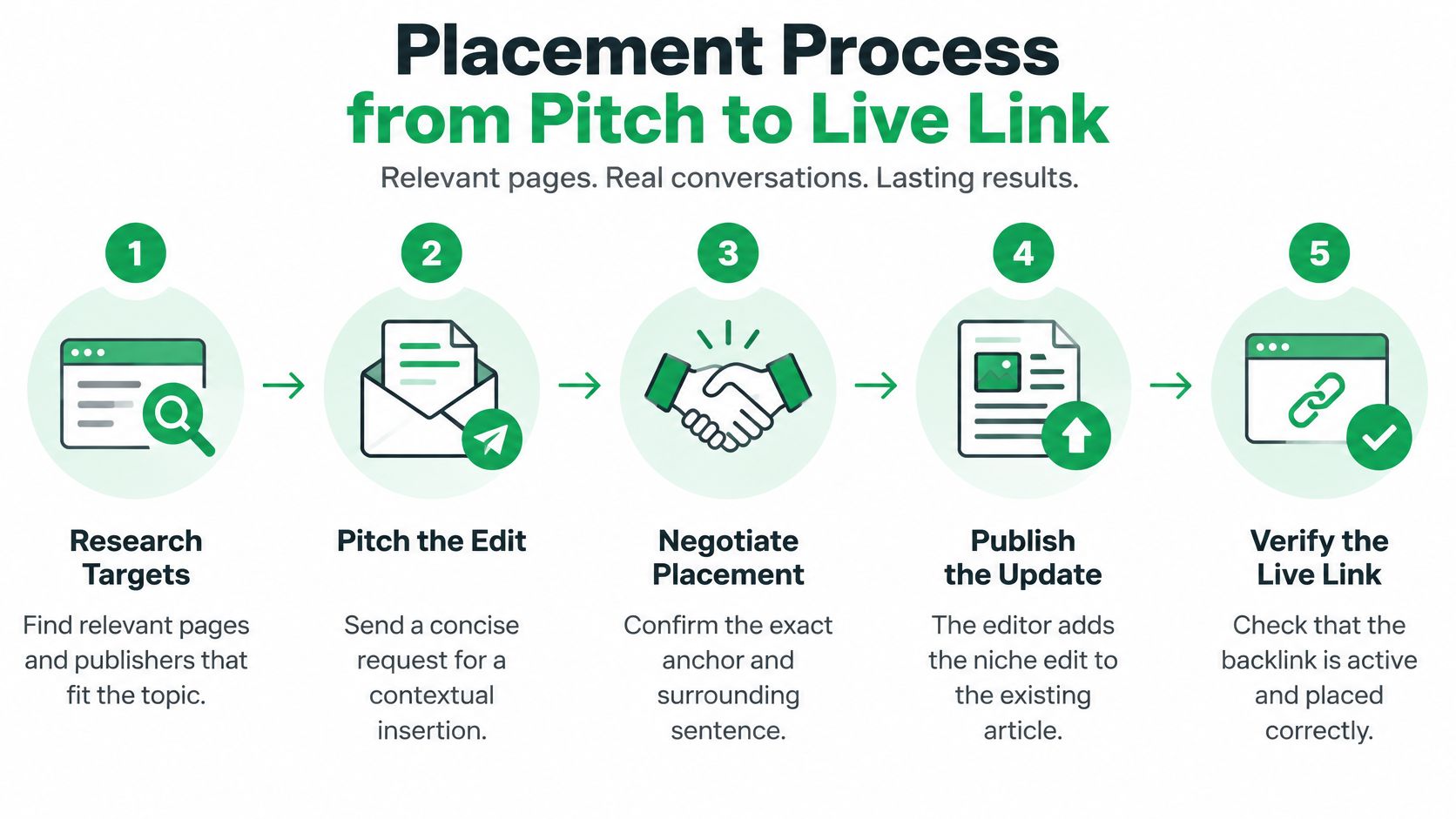
A clean placement runs like a kitchen handoff: prep, order, cook, plate, check the dish before it leaves. If a provider jumps straight to bulk pitching, they are serving food before anyone wrote the ticket. You should be able to see the sequence, the approval points, and the records that remain after the link goes live.
The visual below shows five moves from research to verification.
Step 1 Map the Opportunity Before Outreach
The first step is researching the client's niche and analyzing market, competitors, and current assets to map opportunities. That work delivers an opportunity map with link requirements and risk checks. You decide what kinds of pages need support before anyone contacts an editor.
Target pages also get prioritized here. A commercial page, a detailed guide, and a homepage need different references, anchors, and publisher types.
Step 2 Fix Scope, Price, and Page Targets
Clear scope and pricing should be in place before any work starts. Use the opportunity map to assign effort: which URLs matter most, what each page can reasonably earn, and where a paid placement would create more risk than value. This step feels slower on day one and usually cheaper by month three.
Step 3 Build the 90-Day Roadmap and Get Pre-Approval
The third step is creating a 90-day roadmap covering target pages, anchor plan, link velocity, publisher criteria, and content angles, with pre-approval built in. You see the direction before placements go live. That gives you a chance to reject a domain, topic, or anchor that exceeds your risk tolerance.
Step 4 Pitch the Editor With a Useful Change
Linkbuilding.services uses white-hat link building methods only, and the team believes editors come first, with valuable contributions rather than link drops. From the editor's side, your request is an interruption unless it improves their article. A good pitch names the exact paragraph, explains the gap, and offers a sentence or resource readers can use.
Watch how that editorial thinking changes the outreach conversation in the walkthrough below.
Step 5 Record the Terms, Then Verify Like a Skeptic
If a placement is paid, keep publisher payment and approval records. Record the target URL, agreed anchor, surrounding text, live date, and qualification status. Paid advertising or sponsorship links should carry the correct rel attribute, because separating editorially earned links from compensated placements keeps reporting honest and makes later audits easier.
After publication, open the page yourself. Confirm the link points to the right target, the anchor matches what was approved, and the surrounding paragraph still makes sense. Your report should give you the live URL, plus the baseline record needed to check whether that placement is still live and relevant after 6, 12, and 24 months.
Weighing Search Engine Risks Against Gains
Relevant editorial links can support organic visibility. That's the honest gain. Results typically develop over several months rather than appearing immediately, and no single niche edit should be sold as a ranking switch.
The risk side is just as concrete. Search engines don't only count links now. They look at purpose, patterns across sites, and transactional behavior.
On December 14, 2022, Google announced a link spam update powered by SpamBrain, described in Google's December 2022 link spam update announcement as able to detect sites buying links and sites created primarily to pass outgoing links. Google warned that rankings could change when spammy links were neutralized and that ranking credit passed by unnatural links could be lost.
Read that carefully. A placement intended primarily to manipulate rankings may not trigger a dramatic penalty story. It may be ignored. You've still spent the money, and you've added a pattern to your profile that you now have to explain.
The Qualification Trade-Off
Google's spam policy treats buying or selling links for ranking purposes as link spam. Paid links used as advertising or sponsorship should be qualified. That creates a choice you can't wish away.
A properly qualified paid link is safer for advertising and referral goals. Its PageRank contribution isn't the main benefit you should expect. An unqualified paid contextual link may be capable of passing ranking signals, but it carries policy exposure.
If a placement would make little sense without its ranking benefit, treat it as high risk.
That rule is deliberately plain. Would the editor add the reference because it helps readers? Would you still want the mention for referral traffic, brand discovery, or a relevant audience? If the answer's no, you're mostly buying a ranking signal. That's exactly the purpose search engines aim to discount.
Don't let the word contextual calm you down. A link can sit inside a paragraph and still be a paid manipulation attempt. Context improves usefulness. It doesn't erase the commercial nature of the placement.
Your decision depends on your goal and risk appetite. If you need defensible advertising and referrals, qualification is the safer route. If you're chasing ranking credit from paid unqualified links, name that risk internally before you buy. Don't discover it during an audit.
Quality Checks and Measuring Long-Term Durability
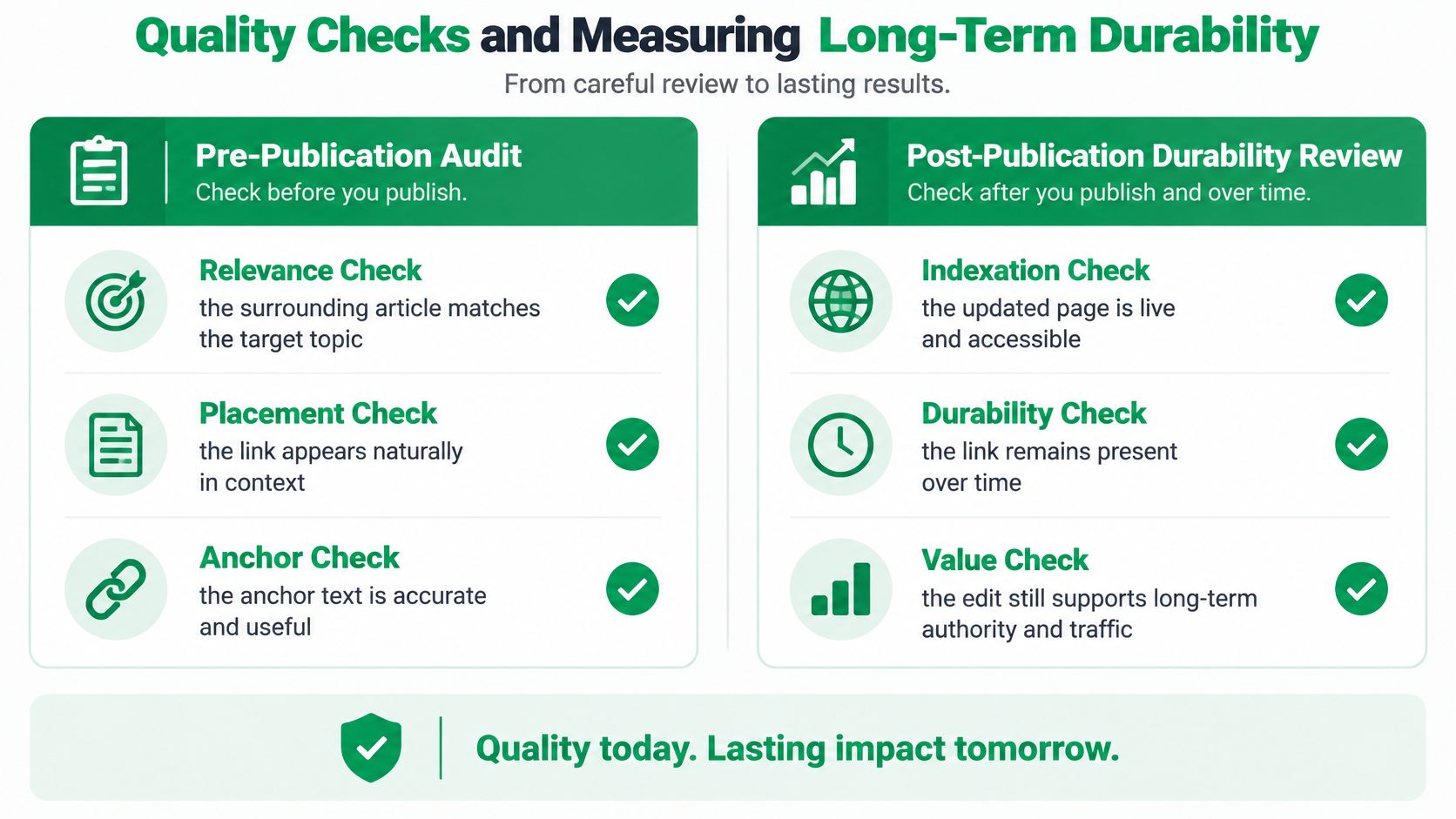
Publication day is a checkpoint, not proof of lasting value. You need two sets of checks. The first asks whether the placement should go live. The second asks whether it still deserves to be counted months later.
The checklist below combines those pre-publication and durability reviews in one view.
Checks Before and at Publication
Read the surrounding paragraph out loud. It should be topically relevant, accurate, and useful without your link. If the sentence was bent into shape only to hold an anchor, readers will feel it.
Then audit your anchors across the campaign, not one link at a time. Avoid repeated exact-match anchors and heavy concentration on commercial phrases. Watch for clusters of links from unrelated sites arriving in a pattern that looks coordinated rather than editorial.
- Relevance check: the article, section, and paragraph match your target topic.
- Placement check: the link appears naturally and points to the approved page.
- Anchor check: the wording is accurate, varied, and useful for readers.
- Indexation check: the updated page is live and accessible.
Google's documentation on unnatural links, covered in its manual actions guidance within the spam policies, recommends removing artificial links or preventing them from passing PageRank with an appropriate rel attribute. Keep that remedy in mind before you need it. Your records should show which placements were compensated and how each one was qualified.
Measure Survival at 6, 12, and 24 Months
Even established pages disappear. A 2024 Pew Research Center finding, discussed in the Internet Archive's account of recovering the dead web, showed 38% of webpages that existed in 2013 were no longer accessible a decade later. Ahrefs separately reported 66.5% of links pointing to sites over a nine-year period were dead in its sample.
So track durability directly. Report survival rate, replacement rate, topical drift, referral clicks, and routine link-status checks alongside authority metrics. Ask whether the publisher still earns organic traffic, whether your target page remains indexed, and whether redirects preserve the intended destination.
If an article is deleted, document when it happened and whether a replacement is owed. If it's edited and drifts off topic, decide whether the link still belongs there. If it redirects, confirm the final page is the one you intended to reference.
Our team believes reporting should be clean and verifiable. That belief becomes practical here. You can't run a 24-month durability review from vague delivery notes and screenshots. You need live URLs, dates, anchors, qualification status, and a history of checks.
Next Steps for Your Niche Edit Campaign
You now have a sequence you can repeat. Define the link type correctly. Choose publishers on relevance, traffic, and a real audience. Run a documented placement with qualification where needed. Verify the link at publication, then again at 6, 12, and 24 months.
Our niche edits service adds contextual backlinks to existing articles on sites that rank and bring in search traffic, with minimum traffic and authority requirements. We research the market and competitors for each niche and produce an opportunity map with link requirements and risk checks. You can review that thinking before outreach begins, rather than after money has moved.
We also provide clear scope and pricing before any work starts. Reporting includes live links so you can verify each placement yourself. For context on scale, we've placed over 2,500 links, work with over 30,000 publishers, and serve over 40 niches. Scale only helps if the filters stay strict.
If you're comparing providers, use the same questions with each one. Which exact pages are being proposed? How were they vetted? Which placements are compensated, and how are they qualified? What will the durability report show after the first checks?
You can start by exploring our link building resources and campaign hub and bringing your target pages to a scoping conversation. Ask for an opportunity map built around those pages. Review the publisher criteria, anchor plan, and risk checks before you commit to volume.
That first conversation should feel specific. If the answer is only a package size and a delivery count, you haven't heard enough. Push for the pages, the reasoning, and the follow-up schedule. That's where a niche edit campaign earns its budget.
If you're ready to judge niche edits by durability rather than delivery volume, Linkbuilding.services can research your niche, map the opportunities and risks, and share a clear scope before any placement work begins. Bring your target pages, review the proposed publishers and qualification approach, and verify every live link for yourself.
Crafted with the Outrank app