White Label SEO: How Agency Fulfillment Works in 2026
White label SEO explained: how agencies outsource link building, quality control, reporting and provider choice in 2026.
The SEO-outsourcing-services market reached $6.5 billion in 2024 and is projected to reach $16.44 billion by 2033, according to the SEO services industry statistics compiled by SEOSandwitch. That growth explains why white-label SEO has become a normal way for agencies to sell link building, content, and audits without hiring every specialist in house. It also raises the harder question most guides skip. When you resell someone else's work, how do you prove what was placed, how it was qualified, and whether it's still there?
What White-Label SEO Covers and Who Does the Work
White-label SEO is a delivery model, not a tactic. A fulfillment provider performs services such as technical audits, content optimization, keyword research, and link acquisition, while your agency presents the finished work under its own brand. The end client sees your proposals, your invoices, and your reports. The supplier stays invisible by design.
Think of your agency as a general contractor. You own the homeowner relationship and subcontract the electrical work to a specialist crew. The homeowner judges one company, even though two teams did the job.
The Three Roles
- The client buys the outcome, approves budgets, and judges results against its own goals.
- The reseller agency owns the relationship, strategy, and pricing, and takes responsibility for anything delivered under its name.
- The fulfillment team researches publishers and keywords, writes or commissions content, places links, and verifies what went live.
Separating client ownership from production is the whole point. It lets an agency add specialist capacity in outreach, writing, or technical work without carrying a full in house team for every function, and it keeps recurring work coordinated across research, placement, verification, and reporting without hiring ahead of demand.
Who Does What in a White-Label SEO Engagement
| Task | Reseller agency | Fulfillment provider | What the client sees |
|---|---|---|---|
| Client strategy and pitch | Owns the plan and pricing | Advises on feasibility | Agency-branded strategy |
| Publisher research and outreach | Approves the shortlist | Runs research and outreach | Agency-branded progress reports |
| Content writing | Reviews the brief and draft | Writes and edits the article | A live article on the publisher site |
| Placement verification | Spot-checks the sample | Verifies live URL and link attribute | Live URL in the report |
| Reporting | Presents results to the client | Produces the data and audit trail | Agency-branded dashboard |
Two partnership shapes sit behind that table. In an execution model, your strategist sets priorities and the provider delivers tasks. In a growth model, the provider helps build the strategy because you don't have that lead in house. Both work, but they fail differently, so name which one you're buying.
Practical rule: If you can't say who approves a publisher before outreach starts, you don't have a white-label process yet. You have a purchase order and hope.
Before you sign anything, answer three questions in writing. Who does outreach? Who approves each placement? Who owns the reporting? Every later dispute about quality, timing, or credit traces back to one of those three, so I wouldn't let a first order move until all three have a named owner.
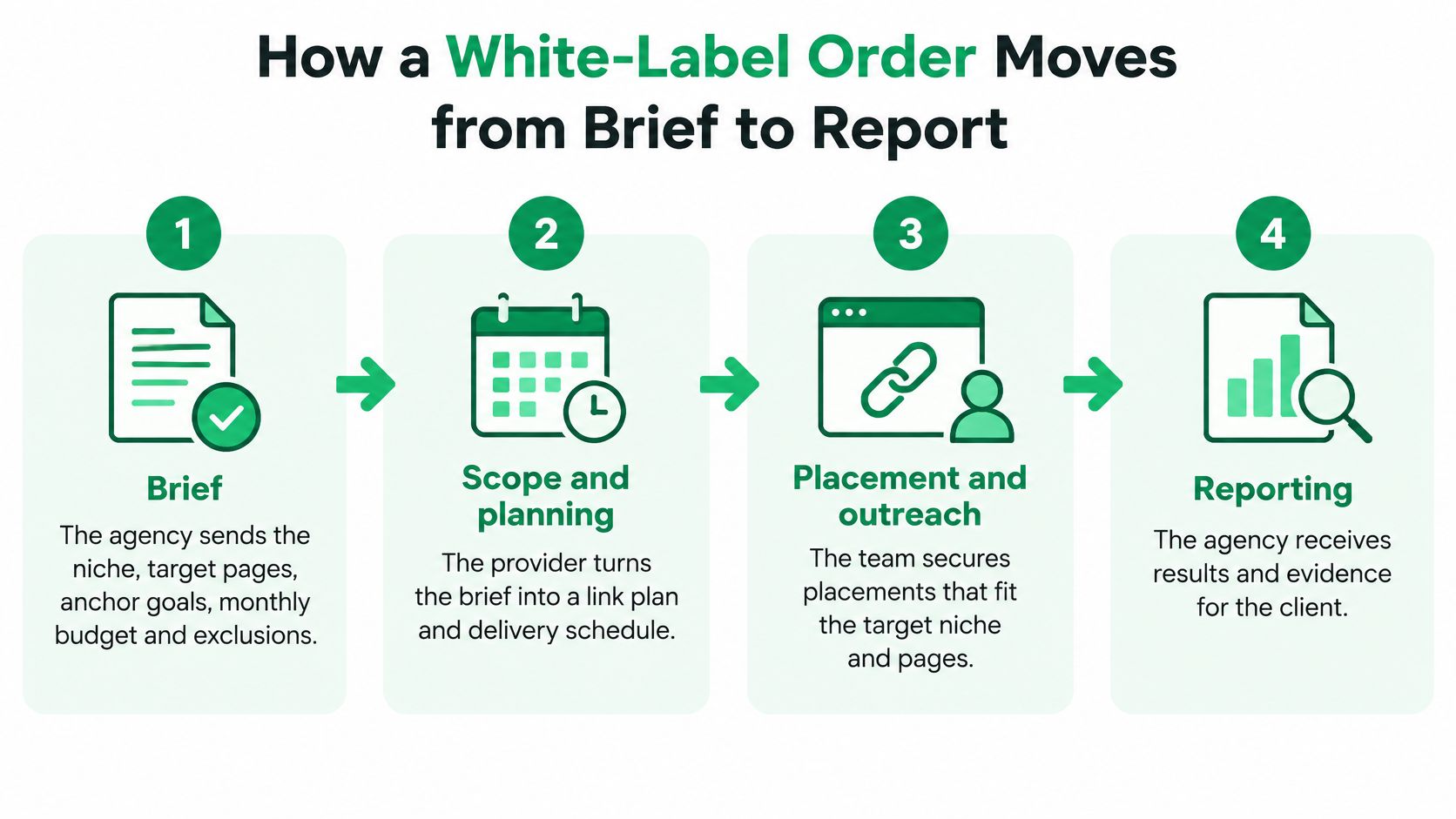
How a White-Label Order Moves from Brief to Report
A clean order follows the same sequence whether you're buying five links or fifty. The steps look boring, and that's the point. Boring is auditable.
The flow below compresses the journey into four stages before we break it into working steps.
The Seven Working Steps
- Brief. You send the niche, target pages, anchor goals, monthly budget, and exclusions such as competitor sites or topics the client won't touch. A vague brief produces vague publishers, so include pages you do not want linked as well as pages you do.
- Scope and pricing. The provider confirms scope, volume, dates, and price in writing before any work starts. We provide clear scope and pricing before any work starts, because fees that surface after the first batch are how reseller margins disappear.
- Opportunity map. The provider lists candidate publishers filtered by traffic, topical relevance, and ranking keywords. You're judging fit here, not just authority scores, so ask why each site earned its place on the list.
- Approval. You approve domains and topics before outreach begins. Skip this and you'll eventually pitch a client on a site they'd have rejected in ten seconds.
- Production and placement. The team negotiates with the publisher, commissions or writes the article, and places the link with the agreed anchor. Good guest blogging outreach is manual and relationship based, which is slower than bulk inventory and much easier to defend.
- Verification. Someone checks the live URL, link attribute, HTTP status, and indexation after publication. Skip this and a link can be removed, moved, or changed to nofollow without anyone noticing until the client asks.
- Report. You receive a dated log of live URLs you can load straight into your own dashboard. The report is a record, not a sales deck, so it should survive being forwarded to a skeptical client unchanged.
What a Finished Batch Looks Like
Every row carries a live URL, a confirmed attribute, and a publication date. Every row the client rejected is logged with a reason, so the next shortlist doesn't repeat the same argument. Replacements for dead or altered placements are recorded against the original row rather than appended as fresh wins.
Delivery coordination matters more than most agencies expect. A shared tracker, a named contact, and a weekly checkpoint keep anchors, target pages, and volume adjustable while the batch is in flight. Without that cadence, you learn about problems at reporting time, which is the most expensive moment to fix them.
One habit separates smooth resellers from frustrated ones. They treat step four, approval, as a client service rather than a delay. Showing a client the shortlist before pitching builds trust you can't retrofit after a placement they hate goes live.
Quality Controls That Keep Resold Links Working
An authority score is the weakest buying signal in this market, yet it's the one most price lists lead with. The stronger control is a quality system built around relevance, indexability, and link persistence, applied before outreach and again after publication.
Start by looking closely at what a real backlink audit checks beyond the headline metric.
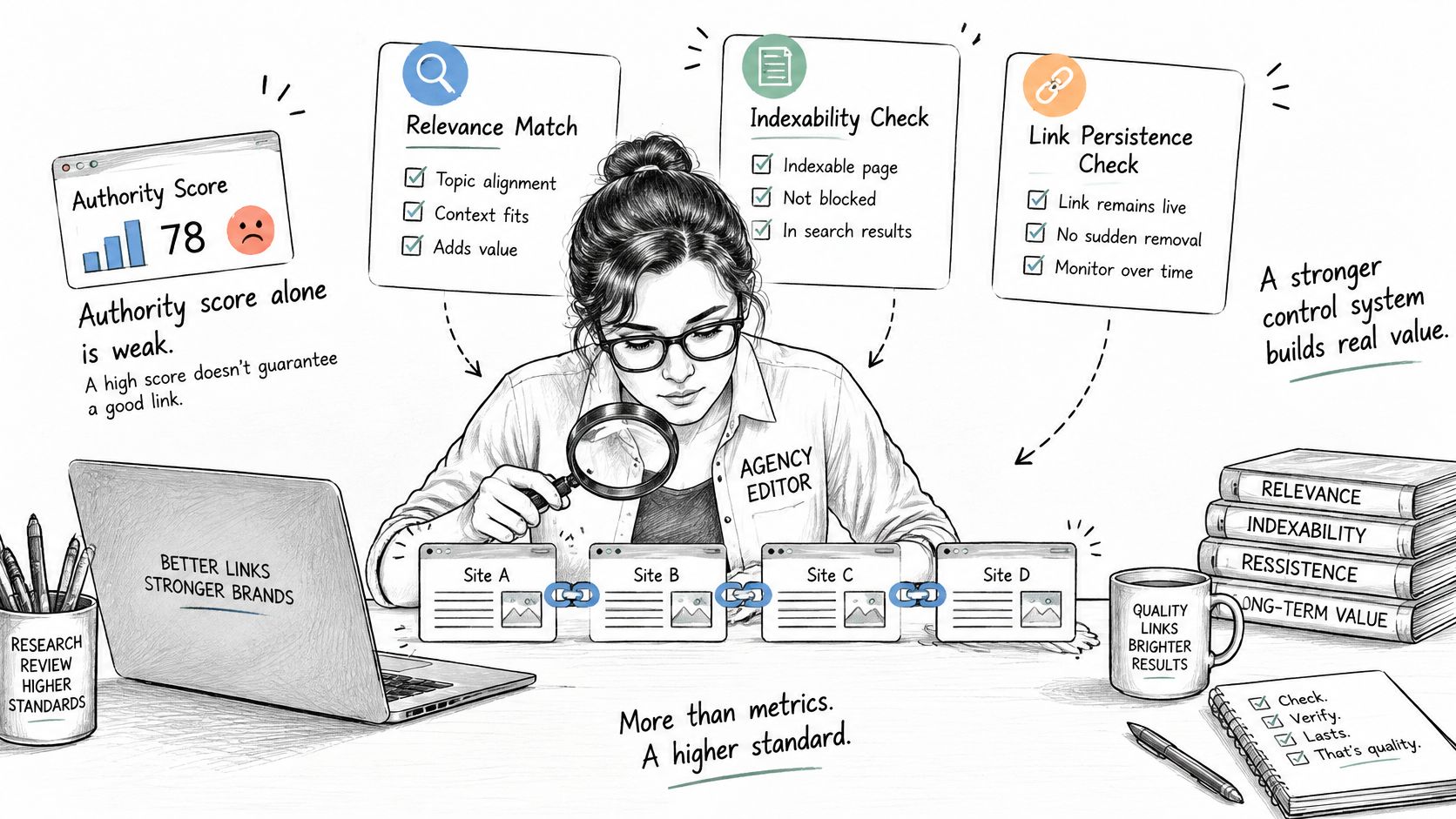
Screening Before Outreach
- Organic traffic and ranking keywords: Confirm the site earns real visibility for terms near the client's topic, not just branded or irrelevant queries.
- Topical match: A payments article belongs on a finance site, not a general lifestyle blog that accepts everything.
- Recent publishing activity: Regular, coherent publishing suggests a maintained site rather than an abandoned shell.
- Audience evidence: Comments, a newsletter, or visible readership signals people arrive.
- Outbound link load: Pages stuffed with sponsored outbound links dilute value and pattern match against link schemes.
We avoid dead sites, PBNs, and domains with no audience, focusing instead on publishers that rank for keywords and earn traffic from Google. That filter costs time up front and saves replacements later.
The stakes aren't theoretical. Google's Search Essentials documentation states that spam-policy violations can cause lower rankings or complete omission from Search, and that after a link-spam update, removing or neutralizing spammy links may eliminate their previous ranking benefit without restoring it. A link that vanishes is a sunk cost, and a link that triggers neutralization is worse than none.
The short walkthrough below is worth watching before you set your own acceptance thresholds.
Control After Publication
Recrawl each placement URL at 30, 90, and 180 days. Confirm it's still live, indexable, contextually relevant, and unchanged in its rel value. Log any change and request a replacement under the contract terms you agreed before the batch started.
Apply the same acceptance criteria across SaaS, ecommerce, B2B, and enterprise campaigns. Consistency is what makes fulfillment scalable and defensible. When a client challenges a placement, you want a checklist it passed, not a judgment call someone made in March.
Paid Placements, Link Attributes and Disclosure Rules
This is the section most white-label guides avoid, and it's the one that carries real risk. A paid placement isn't automatically a problem. It becomes one based on intent and qualification.
Google's guidance on qualified outbound links treats buying or selling links intended to manipulate rankings, including money exchanged for links, advertorials, and guest posts with optimized anchor text, as link spam. Paid advertising or sponsorship links are permitted when qualified with rel="sponsored", which Google prefers, or rel="nofollow", which remains acceptable.
The Subtle Case
A placement can look editorial, sit on a site with genuine traffic, and clear every authority threshold on your scorecard, yet still create exposure if the payment is meant to pass ranking credit. Metrics don't cleanse intent. Understanding how follow and nofollow links differ in treatment is basic literacy for anyone reselling this work.
A supplier who reports only do-follow counts is asking you to carry a risk they won't put in writing.
Placement Types and the Attribute to Report
| Placement type | Commercial relationship | Required link attribute | How to report it |
|---|---|---|---|
| Editorially earned link | None | Standard followed link | Earned link |
| Sponsored post with clear disclosure | Paid | rel=sponsored (preferred) or rel=nofollow | Sponsored placement |
| Advertising or sponsored listing | Paid | rel=sponsored or rel=nofollow | Advertising |
| Paid guest post with optimized anchor meant to pass ranking | Paid | Link-spam risk under Google policy | Do not sell as a ranking link |
The Compliance Routine
- Classify the commercial relationship before you order anything. Earned, sponsored, and advertising are different deliverables with different rules.
- Record the requested anchor and target URL so the order and the outcome can be compared line by line.
- Verify the rendered HTML after publication to confirm the attribute that shipped, not the one promised in an email.
- Keep a screenshot or crawl record for every placement. That file is your evidence if the page changes later.
- Report the placement as earned or sponsored, with the published attribute stated, never collapsed into a do-follow total.
Keep Google policy separate from consumer disclosure law. FTC-style sponsored-content requirements in major markets oblige publishers and advertisers to disclose material connections to readers, which is a different obligation from qualifying a link for a search engine. Both can apply to the same placement, and neither satisfies the other. Check your market's rules with counsel rather than assuming a rel attribute covers you.
We use white-hat link building methods only, and you should still ask us, or any provider, for the attribute record on every placement. A policy statement is a claim. The crawl record is proof.
Reporting Standards Agencies Should Require
Ranking screenshots are the weakest form of evidence you can hand a client. A defensible report is layered, starting with proof of delivery and moving outward to outcomes, with each layer labeled for what it can and can't show.
The checklist below sets out the baseline a reseller should expect before any outcome data enters the conversation.
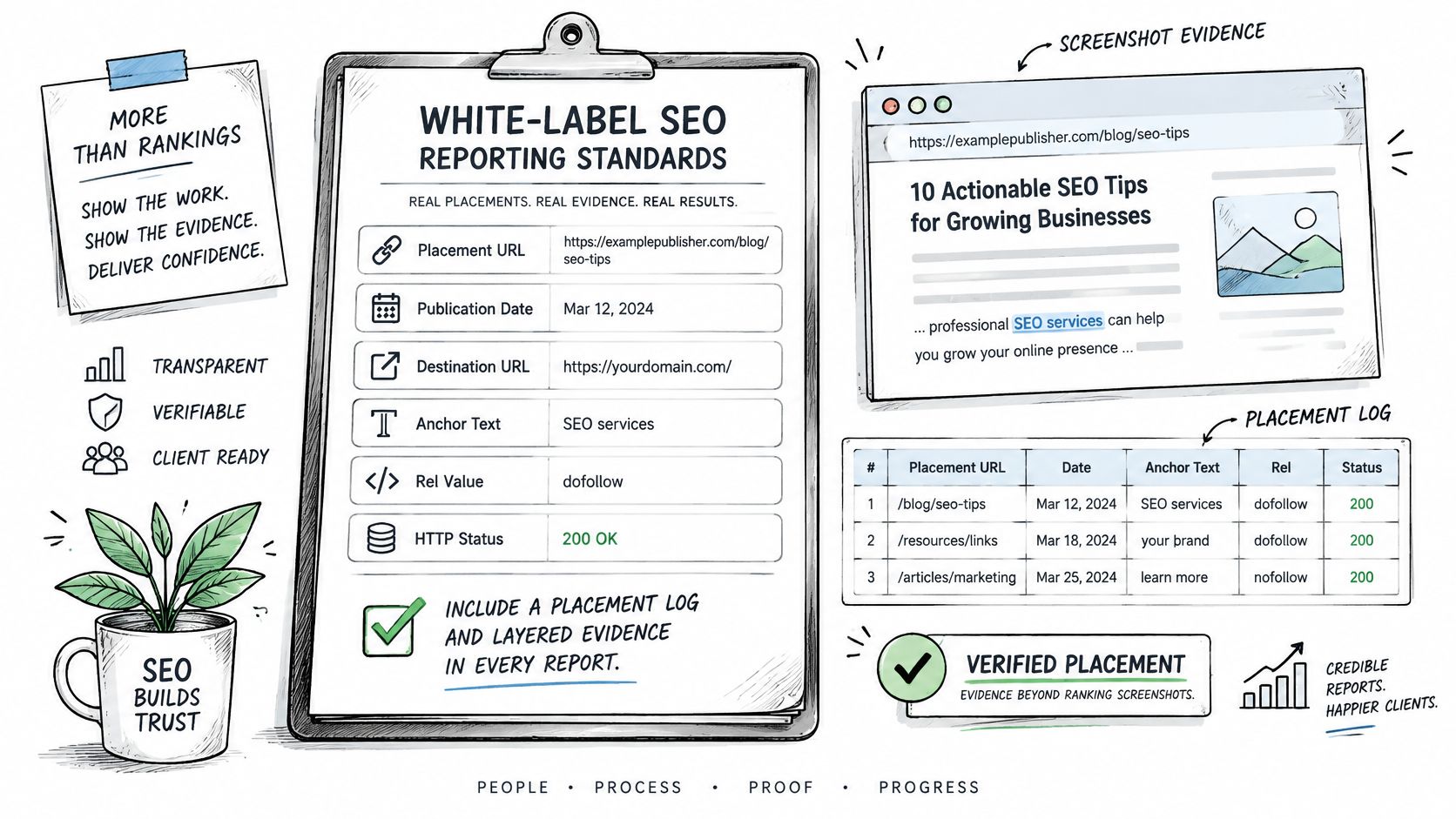
Start With the Placement Log
Every report should open with the log itself: placement URL, publication date, destination URL, anchor text, rel value, HTTP status, indexation status, and the publisher's topical relationship to the client. Our team believes reporting should be clean and verifiable, and we provide live reporting on campaigns so you aren't waiting for a month end export to check a URL.
Then add outcome layers. Look at target-page organic performance in Search Console, branded-search movement, referral analytics, and assisted conversions. Each layer answers a different question, and none of them, alone, proves a link caused anything.
Reporting Across Search and AI Referral Journeys
Visibility no longer ends at the blue links. Digiday's report on the state of AI referral traffic in 2025 cited Similarweb data showing ChatGPT referral traffic rising 52% year over year from September to November 2025, while Gemini referrals rose 388% during the same period. Conductor data cited in the same report found LLM-referred visitors converted to sign-ups at 1.66%, compared with 0.15% from search.
Those figures describe a channel trend. They do not show that one backlink produced an AI citation for your client, and your report shouldn't imply otherwise. Label correlation as correlation, run periodic AI-visibility checks alongside branded-search and referral trends, and track whether placements improve brand mentions, entity clarity, and referral quality over time.
Metrics to Report and What Each One Proves
| Metric | Where it comes from | What it proves | What it does not prove |
|---|---|---|---|
| Placement log | URL, date, anchor, rel value, HTTP status | Exactly what was published and still exists | Any ranking effect |
| Target-page organic clicks | Search Console, page level | Search demand moved to the target page | That the link caused the change |
| Branded search trend | Search Console or analytics | Brand interest is rising or falling | The source of that interest |
| AI referral sessions | Analytics referral source | Visits from AI tools reached the site | That a backlink caused an AI citation |
| Assisted conversions from AI referrals | Analytics conversion paths | Referral visitors contributed to sign-ups | Direct revenue credit for the link |
Structure the client report in that order: placement log first, target-page metrics second, referral and AI-visibility trends third, with a caveat column kept visible. Clients trust reports that admit their own limits far more than dashboards that claim credit for everything that moved.
What White-Label SEO Costs and How Pricing Is Structured
Anchor your expectations in what the market spends. In 2024 research of more than 800 SEO experts, nearly half of marketers reported spending between $5,000 and $10,000 per month on link building, according to uSERP's link building research. Treat that as a spend benchmark, not a price list. It tells you what serious programs budget, not what any single placement should cost.
Three Structures You Will Meet
- Monthly retainer: A set number of placements in an agreed niche, with research, writing, and reporting bundled into one predictable fee. Best for clients with steady targets.
- Per-placement pricing: Each link priced on publisher quality, topical fit, and whether it's editorial or sponsored. Transparent, but totals swing with availability.
- Bundled packages: Technical audits, content optimization, keyword research, and link acquisition under one fee. Convenient, though you should still ask what each component costs inside the bundle.
How those models compare against running the work yourself is worth modeling against typical SEO costs per month before you set your resale margin.
What Actually Drives the Price
Volume is the visible driver, but it isn't the main one. You're paying for publisher screening effort, writing and editing quality, attribute verification, and the reporting depth you need to defend each placement to your client. Cheap placements from unvetted inventory skip exactly those steps, so the low unit price reappears later as replacements, lost links, and uncomfortable client calls.
Cost rule: Price the verification and reporting into your margin from the start. Retrofitting evidence for a placement you already sold is the most expensive way to buy it.
Get scope, pricing, and replacement terms in writing before the first batch. A per-placement quote without a replacement clause isn't cheaper. It's unfinished.
How to Vet a White-Label Provider
Outsourcing link work is already the norm, so the key decision is which provider earns your brand's name on their output. In a 2025 survey of 518 SEO professionals, 56% outsourced at least part of their link-building work, according to CloudDevs research on link building outsourcing.
The checklist below turns that decision into checks you can run on any provider's sample before money moves.
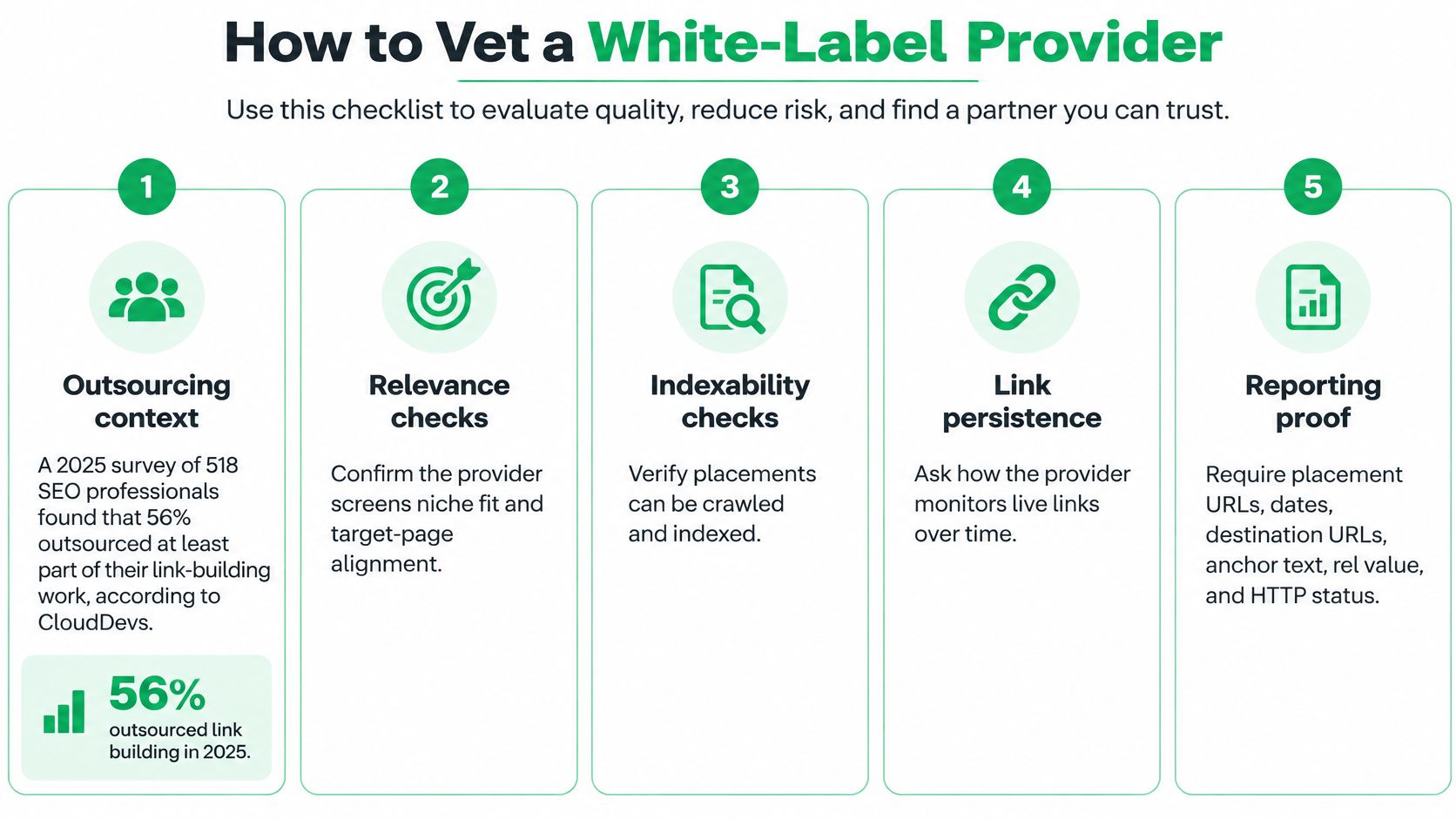
White-Label Provider Scorecard
| Criterion | Question to ask | Good answer | Red flag |
|---|---|---|---|
| Placement sourcing | Where do publishers come from? | Manual outreach to sites with real traffic | Bulk inventory with no vetting |
| Link attribute | How are paid placements qualified? | rel=sponsored or rel=nofollow recorded | Do-follow promised with no disclosure |
| Approval | Can I approve domain and topic first? | Yes, before any pitch | Placement appears without notice |
| Reporting | What does each report contain? | Live URLs, dates, anchors, status codes | Domain rating and link counts only |
| Outcomes | Do you guarantee rankings or traffic? | No, outcomes are not guaranteed | Guaranteed rankings or revenue |
| Scope and fees | Is scope and pricing in writing before work starts? | Yes | Vague or changing fees |
Run the provider's sample publisher list through your own screening checks for traffic, topical fit, publishing activity, and outbound link load. A sample is a provider's best foot forward, so if the sample fails your filters, the paid work won't pass them either.
Credentials are claims until you test them. We offer an NDA before any competitor or strategy specifics are discussed, we've been doing link building since 2016, and the company was built by people who ran SEO for a decade before starting it. Treat all of that the way you'd treat any provider's history, as background to verify through a sample report and a small paid test, not as a substitute for either.
End every vetting call with six direct questions. Who sources publishers? How are paid placements attributed? Can I approve before the pitch? What does each report contain? Are outcomes guaranteed? Is scope written before work starts? Hesitation on any one of them is data.
Pilot One Campaign Before You Scale
Don't scale a white-label relationship on a sales call. Run a bounded pilot, judge it against rules you wrote in advance, and let the evidence decide. I would rather lose two weeks to a pilot than a client to a bad first batch.
The Pilot Sequence
- Pick one niche and one target page with clear organic value, so movement is readable.
- Set a budget sized for a single batch. You're buying information about process quality, not maximum link volume.
- Agree pre-approval rules for domain, topic, anchor, and attribute before outreach starts.
- Review the first batch against your screening checks, the attribute record, and the placement log. Every URL gets opened, not sampled.
- Schedule checkpoints at 30, 90, and 180 days covering target-page clicks, branded search, and AI referral trends.
- Scale only if every placement verifies and the reporting is complete, not because one ranking moved in week three.
Results develop over months, so read the checkpoints as a trend rather than a verdict at each date. A pilot that delivers clean placements and honest reporting with modest early movement is a better scaling candidate than one with a lucky ranking jump and a log full of gaps.
Once a pilot passes, scale becomes an operations question. Our white label service provides agency-ready deliverables you can resell under your client's brand, with bulk ordering, priority delivery, and reports ready for CSV or Looker. We do not guarantee specific rankings, traffic amounts, or revenue outcomes, which is exactly why the pilot exists. It's where you decide, on inspected work, whether the relationship deserves volume.
Do one thing this week. Pick the target page and write your acceptance rules before you talk to any provider. That single document turns every later conversation from persuasion into comparison.
If you're ready to resell link building with pre-approval, verified attributes, and reporting your clients can inspect line by line, visit Linkbuilding.services to scope a pilot campaign. Bring one target page and your acceptance rules, and we'll confirm scope and pricing in writing before any work starts.