What Is White Labeling? How It Works and Why It Matters
What is white labeling? Learn how the model works, who owns the brand, and how it differs from private label and outsourcing.

White labeling is a business arrangement in which one company produces a product or service and another sells it under its own brand. Retailers use private-label goods across many everyday product categories, making this a familiar form of commerce rather than a side trick.
Your team has a client request you cannot staff this month. They want guest posts, a store brand, or a feature your team has never built, and hiring would miss the deadline. The invoice will still carry your logo. That makes white labeling a decision about accountability as much as branding: if the work is late, weak, or oversold, your client is likely to hold your company responsible.
What White Labeling Means in Plain Terms
Say a bakery supplies loaves to four cafés. Each café puts the bread on its own menu, sets its own price, and never introduces the baker. The customer who finds a stale slice calls the café, not the oven down the road. That split is the whole model.
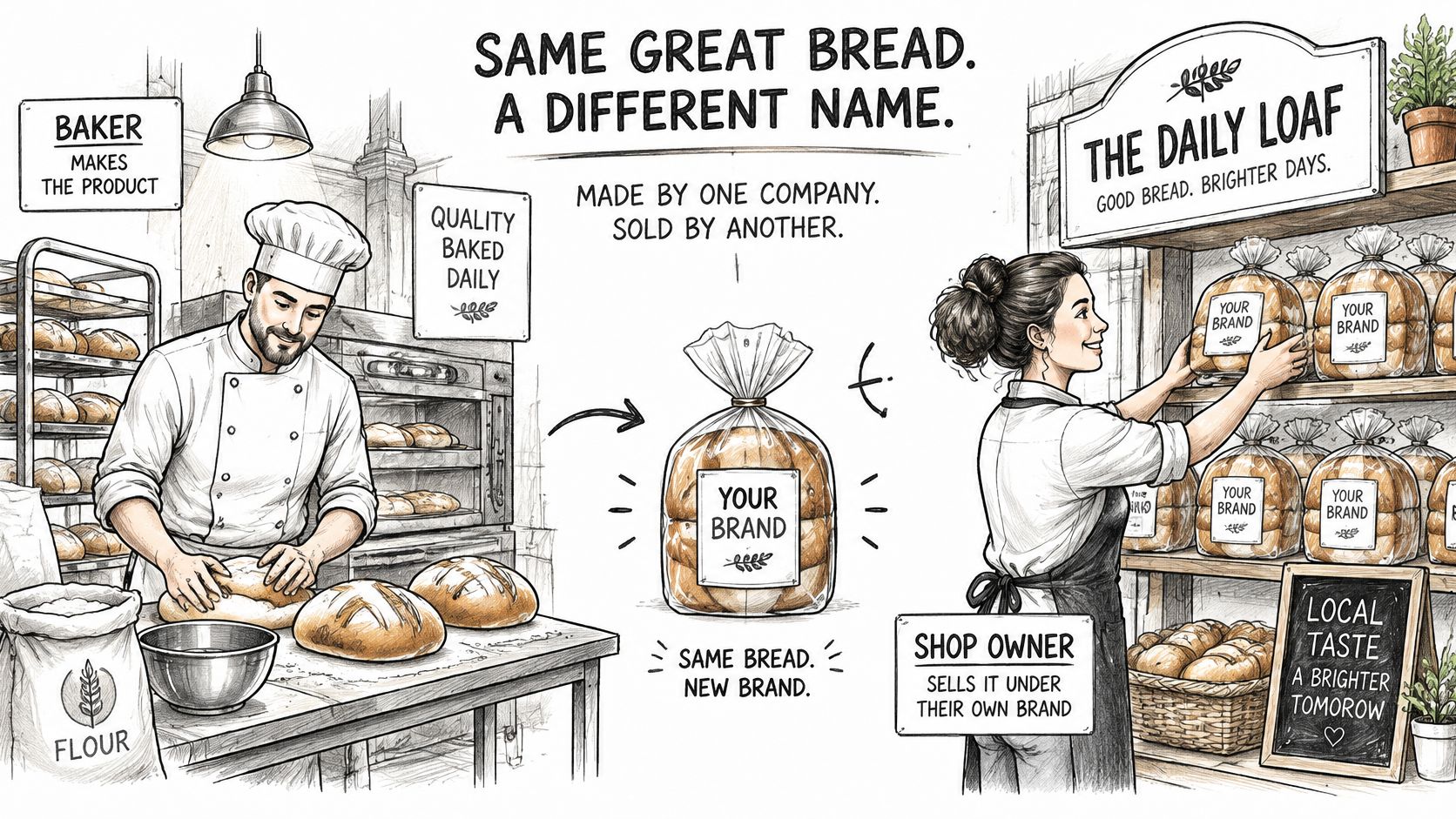
The Private Label Manufacturers Association describes white labeling as one company producing a product or service while another sells it under its own brand. In shops, the same idea is usually called private labeling. A third-party manufacturer supplies the goods, and the retailer markets them under its own name or under a brand created only for its shelves. Food, household products, cosmetics, health and beauty, over-the-counter medicines, pet products, and hardware all travel this way.
Production stays with the provider. The provider keeps the systems, the specialist people, and the infrastructure. The reseller keeps the customer, the price, and the presentation. The reseller can offer a finished product without owning a factory or a specialist bench. The provider reuses the same capability across many branded clients, which is why the economics scale.
The same split in services
Services follow the identical shape. An SEO specialist can research publishers, write the piece, and verify the placement. The agency then delivers that package to its own client under the agency's name. The client never meets the specialist. The agency owns the relationship and the invoice.
A reseller that only refers a customer to a supplier is not white labeling. A reseller that owns the customer-facing brand and presents the output as its own commercial offering is.
Apply one test to any deal on your desk. Who would the customer call when something goes wrong? If the answer is you, you are the brand, and you are carrying the reputation, whether or not you baked the bread.
Who Controls What and How to Contract It
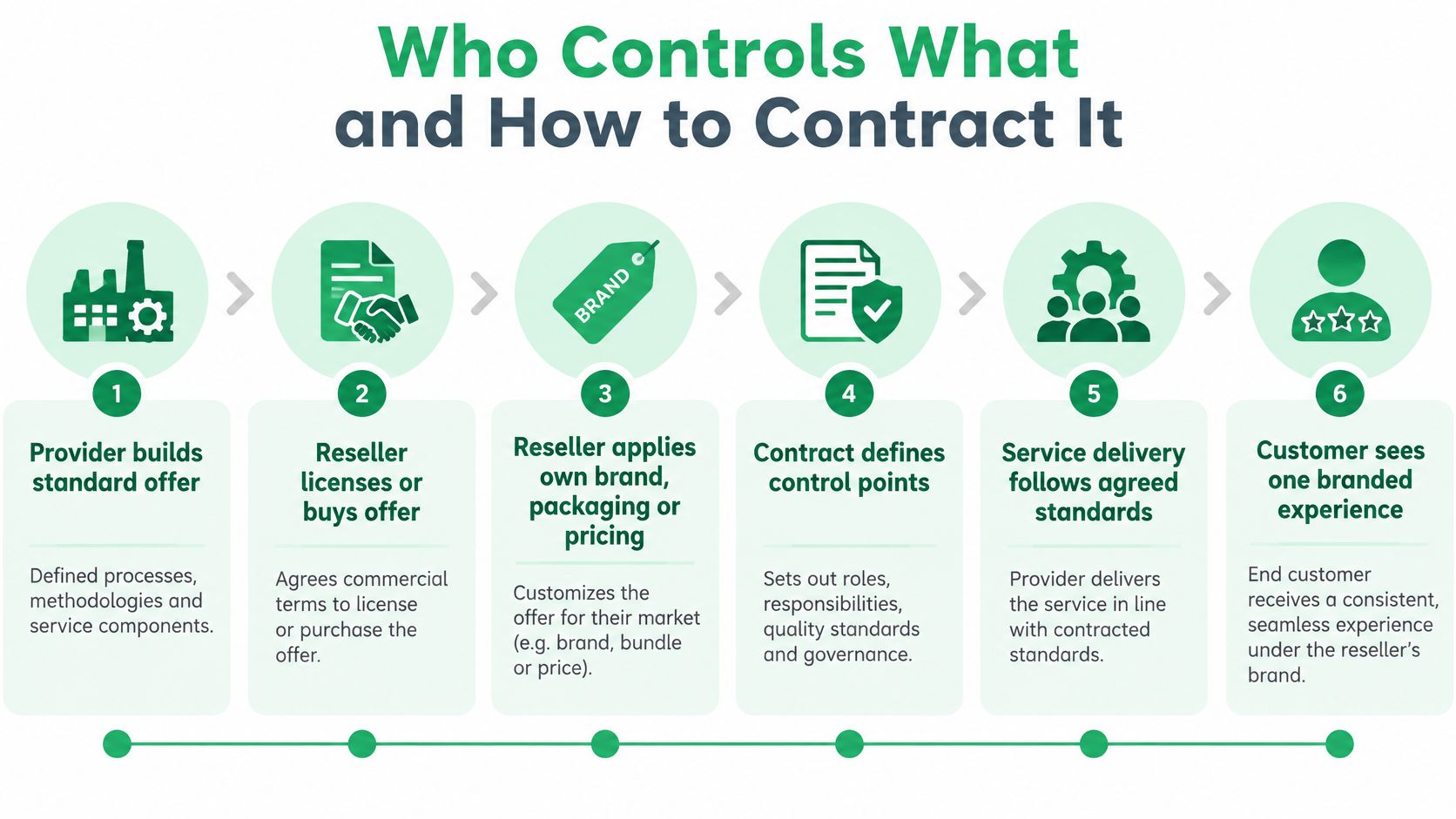
A white-label deal is a handoff of work, not a handoff of the customer's trust. The SPS Commerce guide to becoming a private-label supplier puts the split cleanly. The supplier normally owns the production system, the delivery infrastructure, and the process know-how. The reseller owns the brand, the pricing, the presentation, and the client relationship.
Six stages, then the split
- The provider builds a standard offer with defined processes, so the same system can run for more than one buyer.
- The reseller licenses or buys that offer rather than rebuilding the bench.
- The reseller applies its own brand, packaging, or presentation, and it sets the price the end client sees.
- The contract names the control points: deliverables, approvals, turnaround, and who escalates.
- The provider performs the work behind the scenes, and the reseller returns the output under its own name.
- Both sides review quality through reports and approvals before the client is told the job is done.
Because one provider can sell the same underlying offer to many resellers, you don't differentiate with exclusive core technology. You differentiate with branding, configuration, workflow, support, and reporting. For an SEO agency, a fulfillment partner can run research, outreach, content, placement checks, and reporting while the agency presents the coordinated output as its own.
| Function | White-label provider | Reseller |
|---|---|---|
| Production and delivery | Performs the work | Orders and reviews the output |
| Process know-how and systems | Owns and maintains them | Does not need to build them |
| Brand and presentation | Works unbranded or hidden | Presents under its own name |
| Pricing to the end client | Charges a wholesale rate | Sets the final price |
| Client relationship | Usually no direct contact | Owns the relationship |
| Reporting | Supplies verifiable data | Presents it to the client |
| Reputational risk | Limited direct exposure | Absorbs failures in the client's view |
Read the last row twice. A broken placement, an unverifiable URL, or a sloppy report lands on the agency brand. The client doesn't have a relationship with the hidden producer.
Terms that keep the reseller whole
Capacity without a contract is just borrowed risk. Lock these points before the first order.
- Deliverables and quality criteria in writing. For link work, that means placement count, publisher type, and how a live URL gets verified.
- Service levels for turnaround and reports. Name the clock and the format, not a vague promise of "regular updates."
- Approval gates. Pre-approve domains or topics, and cap how many revision rounds are included.
- Confidentiality before strategy moves. We offer an NDA before any competitor or strategy specifics are discussed.
- Usage rights. Upon full payment, clients receive a non-exclusive license to use the deliverables for their business. Non-exclusive means the provider can serve other resellers with the same underlying system.
- A liability cap you can explain. Our aggregate liability for any claim will not exceed the amounts paid for the services in the 3 months preceding the claim. That cap limits recovery to recent fees, so it doesn't replace your own client promise.
- One escalation owner, plus records. Keep approvals, reports, and live URLs. If you can't replay what was promised, you can't defend the claim.
Rebranding doesn't move advertising responsibility with the logo. The FTC's revised endorsement guides say advertisers can be liable for deceptive claims made through endorsements, testimonials, and other marketing channels, and that endorsers and intermediaries may also face liability depending on their role. Material connections that would change how an audience evaluates a claim must be disclosed clearly and conspicuously.
Practical rule: Fulfillment confidentiality is a contract choice. Presenting outsourced expertise as an internal capability you don't have is a claims problem. You should be able to substantiate every performance line you send.
The trade-off is simple. The model adds capacity without a new hiring round. Defects, thin proof, and inconsistent quality become your problem in the client's eyes. A short walkthrough of how branded delivery is staged is here.
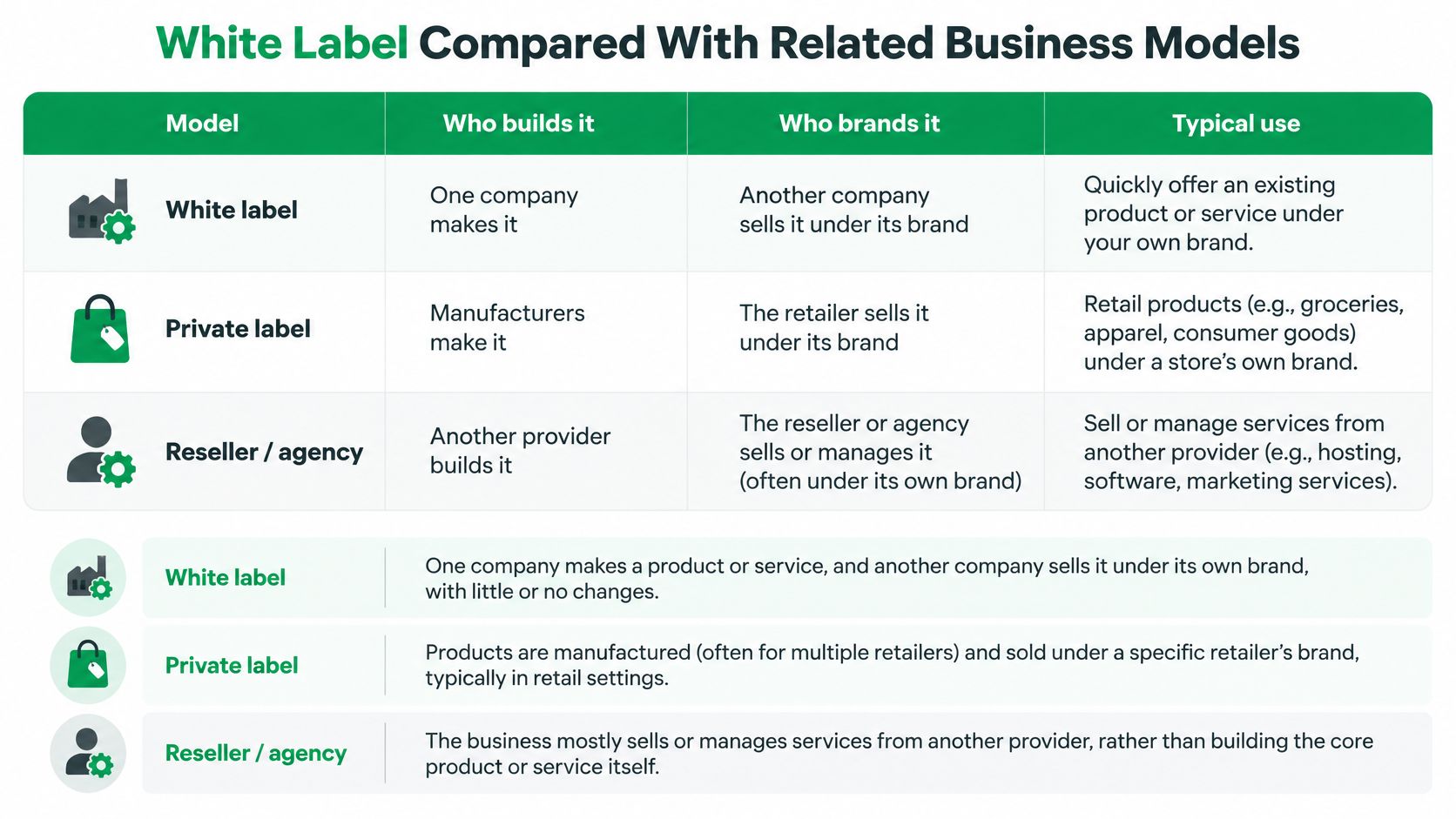
White Label Compared With Related Business Models
People mix these labels because every one of them involves someone else's product. The ownership of the brand and the customer is what separates them.
| Model | Who makes it | Whose brand is shown | Who owns the customer |
|---|---|---|---|
| White label | Provider, unbranded | Reseller | Reseller |
| Private label | Third-party manufacturer | Retailer | Retailer |
| Wholesale or reseller | Supplier | Supplier | Reseller |
| Dropshipping | Supplier | Store owner, often with supplier packaging | Store owner |
| Affiliate referral | Merchant | Merchant | Merchant, with affiliate sending traffic |
| In-house production | Business itself | Business itself | Business itself |
Where people get the rows wrong
Private label is the retail cousin. A manufacturer makes the pasta sauce or the pet treats, and the supermarket sells them under its own brand. White label covers that pattern and also covers services and software sold under any reseller's identity, not only a grocer's.
Wholesale keeps the supplier's name on the box. You buy branded inventory and resell it. The customer can still see who made it. A white-label reseller removes that name. A landing-page builder licensed to agencies, then published on each agency's domain with the vendor hidden, is white label. The same builder sold with the vendor's logo in the footer is closer to wholesale software.
Dropshipping uses the supplier's fulfillment, and the store owner often has little say over packaging or quality. A white-label arrangement usually specifies the output and an approval step before the customer sees it. If you can't reject a bad unit, you don't have the control the model assumes.
Affiliate referral sends the customer onward and earns a commission. The merchant still owns the relationship. A white-label reseller doesn't hand the client off. An agency buying white-label SEO and delivering placements under its own name still answers the client's email.
In-house production gives you the bench, the process, and the brand together. You also take the hiring time and the idle cost when volume dips. That control is worth it when the work is your core skill and the volume is steady enough to feed a team.
If the reseller keeps the customer and the brand, but not the production, you're looking at white labeling.
Market Scale and Buyer Trust
A retailer can put its own name on a product while a supplier makes it. That model has grown well beyond a niche shortcut: private-label products now compete across price points and categories. The figures below use different measures, so compare like with like.
| Measure | Figure | Scope or source |
|---|---|---|
| Private-label share of worldwide FMCG value sales, 2023 | 19.4% | Worldwide, NielsenIQ |
| Private-label share of FMCG value sales, 2023 | 26% | Western Europe, NielsenIQ |
| Private-label share, separate measurement | 36% | Western Europe, different measurement base, NielsenIQ |
NielsenIQ's branded-versus-private-label analysis reported a 19.4% worldwide value share in 2023 and a 26% share in Western Europe. A separate NielsenIQ measurement put Western Europe at 36%. These figures use different measurement bases, so they are not interchangeable.
Buyers are choosing the shelf brand on purpose
In 2025, 53% of consumers across 25 countries said they were increasingly purchasing more private-label products, according to a NielsenIQ survey of more than 17,000 online consumers. In the same year, 69% of surveyed consumers across those 25 countries said private-label products offered good value for money, according to NielsenIQ's shelf report.
Retailers use own brands across premium, wellness, sustainability, and convenience ranges, not just low-priced products. White labeling can therefore help a business offer a distinct service under its own brand, as well as extend its capacity.
Trust doesn't disappear, it relocates
Deloitte's reporting on retail consumer trends found that 84% of respondents trust private-label quality as much as or more than national-brand quality. That finding concerns consumer products, so it cannot establish trust in expert services. A buyer of SEO, payments infrastructure, or legal support needs evidence about the work, its reporting, and who will answer when it falls short.
White labeling also changes where accountability sits. The supplier performs the work, but the reseller's brand is visible to the client. If the deliverable is poor, the client is likely to hold the reseller responsible, regardless of who did the production.
That exposure matters when choosing a supplier. The fee buys capacity, but it does not transfer the client relationship. Teams considering link building for SaaS still need to explain how placements fit the product and what they can substantiate about the work.
Before selling a white-labeled service, agree on quality criteria, records the reseller can inspect, and a route for escalating problems. A live URL on an approved domain is a verifiable output. A ranking by a particular date is an outcome neither party can promise with the same certainty.
Common Questions About White Labeling
Is white labeling legal
Yes. It's a standard commercial arrangement in goods and in services. Legality doesn't travel with the logo, though. The company that publishes a performance claim still has to be able to substantiate it, and people who pass along endorsements can share liability depending on the role they played. If your report says a placement is live, you need the URL, not a forwarded screenshot you never opened.
Must clients be told who did the work
Confidential fulfillment is a legitimate contract choice, and many agency agreements are built on it. You still can't describe a skill you don't have as if your staff performed it. Disclose a relationship when it would change how a sensible reader judges a recommendation or a testimonial. Hiding the baker is fine. Inventing the bakery is not.
Who is liable for an inaccurate report
The reseller who sent the report to the client owns that communication. Your contract should say who owns claims, and it should require the provider to correct errors at the provider's cost. A fee cap on the provider's side, limited to recent invoices, doesn't shrink what you promised your own client. If you can't replay approvals and live URLs, you'll be arguing from memory.
Does it apply beyond products
Yes. Consumer private label already covers food, cosmetics, pet products, and hardware. In services, a specialist can deliver the work under another firm's identity. An SEO provider researching publishers and verifying placements, while an agency brands the monthly report, is the same structure as the café and the bakery. The customer-facing firm is still the one on the hook for what the report claims.
The safest operating habit is dull on purpose. Use a written scope, keep auditable delivery records, assign internal ownership of every claim, and disclose when a relationship would change how that claim should be read. Governance is the part of white labeling that protects the brand you just put on someone else's work.
Decide Whether White Labeling Fits Your Business
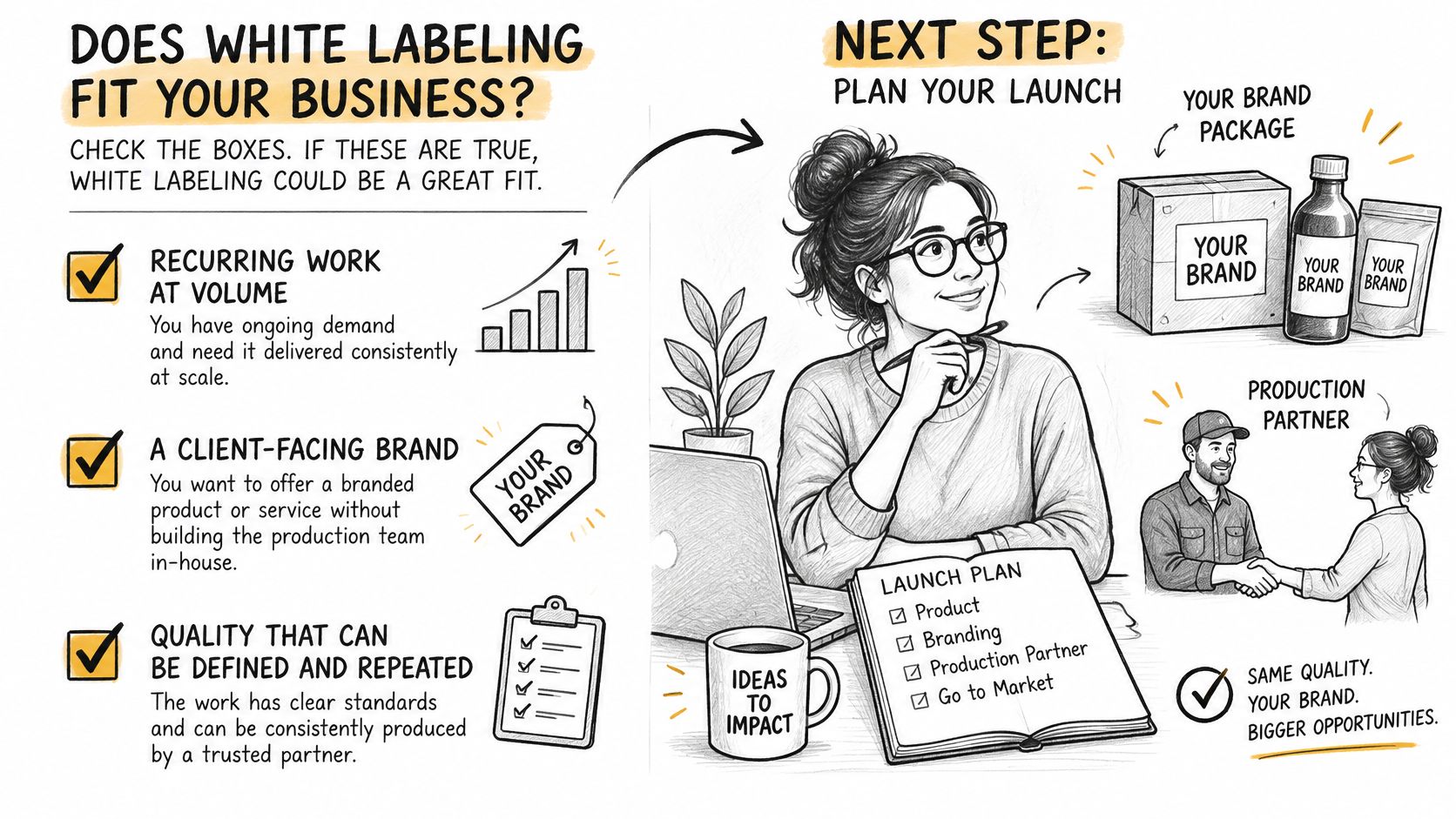
Run four checks before you sign.
- Recurring volume. You have the same class of work coming back often enough that a provider's process will stay busy.
- A brand you want to keep. You want the client relationship without building the production team.
- Quality you can specify. You can write criteria a stranger could apply, such as publisher type, topic fit, and a live URL.
- Records you will keep. Approvals, reports, and escalations have a named owner on your side.
If two or more of those fail, don't force the model. Build the capability in-house, or refer the client and stay out of the delivery. A referral is honest when you don't want the 2 a.m. complaint.
For SEO agencies and in-house enterprise teams, the next step is paperwork, not a pitch deck. We provide clear scope and pricing before any work starts, and you should ask for domain and topic visibility before you promise a client anything. Reports should show live links, not a summary slide. Our white-label delivery provides agency-ready deliverables you can resell under your brand, with bulk ordering, priority delivery, and reports ready for CSV or Looker, and the reporting shows live links on the campaign. Price that resale against your own monthly SEO costs so the margin is a number, not a hope.
This week, draft a one-page scope with quality criteria and send it to two providers before you decide. If either one won't accept approval gates and verifiable URLs, you've already learned what you needed.
Linkbuilding.services handles the production side of white-label link building, from publisher research and outreach through placement checks and live reporting, so your agency can sell the work under its own brand. You keep the client, the price, and the claims, which is exactly where the accountability sits. Visit Linkbuilding.services to request a scope before you put your name on the next campaign.