SEO Outsource Company: How to Assess One Before You Sign
Learn how to assess an SEO outsource company: service scope, expertise, transparency, link quality and reporting checks before you sign a contract.
You've got a backlog of technical fixes, a content calendar that's slipping, and a link target nobody on the team has time to chase. Hiring another full-time specialist would take months. An SEO outsource company looks like the faster path, until the proposal promises rankings you can't audit and a monthly fee that doesn't list what you'll receive.
You still own publishing quality, the pages that matter, and the report your finance lead will question. The provider owns production. Vetting should focus on what a contract can verify, not on a ranking promise nobody can keep. I would not sign on pitch quality alone. I'd start with scope, then method, then a small paid test.
What an SEO Outsource Company Actually Handles
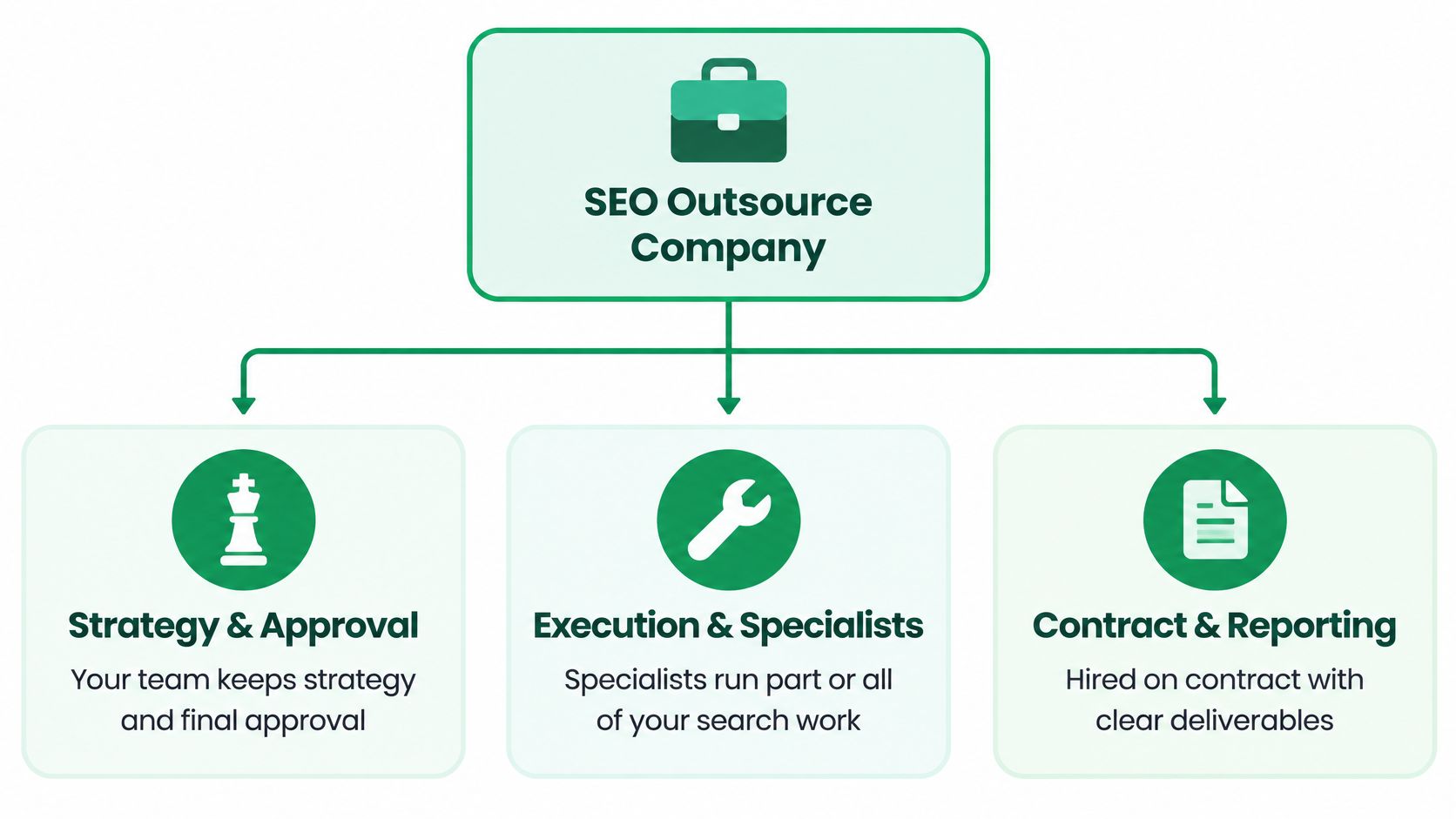
An SEO outsource company is a provider you hire on contract to run part or all of your search work. Your team keeps strategy and final approval. Specialists handle production.
Think of a building job. You can buy the materials and build it yourself. You can hire a subcontractor for one trade, such as wiring. Or you can hand the whole job to a general contractor who answers for the result. Search work splits the same way. Some teams outsource one trade. Others outsource the build and keep the sign-off.
That model sits inside a much larger services market. Grand View Research estimates global digital-marketing BPO revenue reached US$9,544.4 million in 2025 and projects US$21,432.9 million by 2033, a 10.7% compound annual growth rate. The same estimate puts North America as the largest regional contributor in 2025, and India as the country expected to grow fastest from 2026 through 2033. Buyers are purchasing specialized capacity instead of staffing every function.
Service scope you can map
| Service area | Provider delivers | Client keeps |
|---|---|---|
| Technical SEO | Audits, fix lists, and implementation support | Approving changes and site access |
| Content production | Briefs, drafts, and expert-written guest posts | Final sign-off on accuracy and brand voice |
| Link building | Publisher research, outreach, placement, and verification | Approving domains, topics, and target pages |
| Reporting | Placement logs, live URLs, and periodic reports | Tying metrics to revenue in their own analytics |
| Strategy | Competitor research, an opportunity map, and a 90-day roadmap | Business goals, budget, and priority pages |
Three link formats show up constantly.
Guest posts use content written by subject-matter experts. You approve the domain and the topic before writing starts, and the report includes the live link.
Niche edits add a contextual backlink to an existing article on a site that already ranks and brings in search traffic. Selection uses minimum traffic and authority requirements, so you're not buying a new page built only to hold the link.
White-label delivery gives an agency placements it can resell under its own brand, with bulk ordering, priority delivery, and reports ready for CSV or Looker.
Pricing usually takes one of three shapes: a monthly retainer, a per-placement fee, or a fixed project fee. Ask for an itemized quote that lists deliverables, not a single total. We put scope and pricing in writing before any work starts, so the line items are visible before you commit.
Before you compare providers, write down which of the five areas you want to hand over. A team that only needs links shouldn't buy a strategy retainer it won't use.
How to Judge Expertise Behind the Sales Pitch
A polished deck proves little. Expertise shows up as a history you can check and a method you can follow on a niche that isn't already in the slides.
Four tests that survive a sales call
Time in the field. We ran SEO for a decade before starting the company, and we've been doing link building since 2016. A launch-year shop can still be capable. A longer record gives you campaigns, publishers, and former clients you can ask about.
Niche evidence. Ask for past work in your vertical, whether that's SaaS, ecommerce, B2B, or enterprise. Then ask how that market was researched. "We cover every industry" isn't evidence. Three campaigns in your category, with the pages and the goal written down, is.
Scale you can sample. We've placed over 2,500 links, we work with over 30,000 publishers, and we serve over 40 niches. Those figures help only if you can open sample placements and see the pages. A number without samples is a slogan. Teams weighing that handoff can compare it with how outsourcing link building is usually scoped.
Method on a new niche. A workable process scans the market, reads competitor link profiles, and picks target pages before anyone sends an email. If the answer is "we already have a list," you don't have a method. You have a catalog.
Say a SaaS founder asks for three past SaaS campaigns and lines the stated goals up against the outcomes. A result such as +212% organic traffic from March to December 2025 for one SaaS client means little on its own. You still need the baseline, the pages involved, and a hard limit: treat that lift as a case, not a warranty. No provider can guarantee rankings or revenue. Algorithms, competitors, and demand sit outside any statement of work.
Practical rule: A credential counts only when you can tie it to a baseline, a niche, and a specific method.
Three questions close the call. Who manages the account day to day, by name? Which tools feed the research? What happens, in writing, when a placement fails, including who replaces it and who pays?
I would score those answers before I looked at the fee.
Transparency Signals and Live-Link Checks
A provider can show you a polished dashboard and still leave you blind. Real transparency means you can verify each deliverable yourself, before money moves and after it does. That accountability stays with you as the buyer: the provider owns the work, but you own the standard it gets measured against.
Six signals before you sign
| Signal | Strong provider | Warning sign |
|---|---|---|
| Scope and pricing | Written before work starts | Vague bundles with no deliverable list |
| Publisher visibility | Domain and topic shared before pitching | Placements revealed only after payment |
| Link method | White-hat methods, documented in writing | Private blog networks or unexplained link sources |
| Confidentiality | NDA signed before strategy talks | Requests for full strategy before any agreement |
| Reporting | Live placement URLs and verifiable reports | Summary counts or screenshots only |
| Expected results | Outcomes described as developing over months, with no guarantees | Promised rankings or fixed traffic numbers |
We share domain and topic before a pitch, offer an NDA before competitor or strategy specifics are discussed, and use white-hat methods only. If a provider won't put those three points in an email, the table has already done its job. Whatever they confirm verbally belongs in the statement of work, not in a chat thread.
Check one live link yourself
Google's documentation on crawlable links says Google can generally crawl a link when it is a standard HTML <a> element with an href that resolves to a valid web address, and that it uses links to discover pages and assess relevance. A real placement should appear in the source, resolve without redirect chains or errors, point to the approved target, and not sit behind scripts or forms.
Open the referring page. View the source. Search for the target URL. Confirm the anchor text and the rel attribute match the report. If the link only exists in a screenshot, you don't have a placement yet.
When you score each opportunity, page-level signals such as URL Rating and the quality of its referring domains are a more useful guide than raw traffic counts. Weigh topical alignment, page-level link popularity, referring-domain diversity, organic visibility, editorial placement, and technical accessibility. Traffic supports that score, but a minimum traffic floor on its own is not a reliable proxy for ranking value. A domain can clear a visits threshold and still carry a weak or irrelevant page.
Placements disappear or change after delivery, so the work doesn't end at the report. Ask whether live links are rechecked on a schedule, how a removal shows up in the log, and who pays for a replacement. Get that replacement clause in the contract before the first order. A provider who answers these questions in writing has already passed the first filter.
Publisher Quality and Link Risk Controls
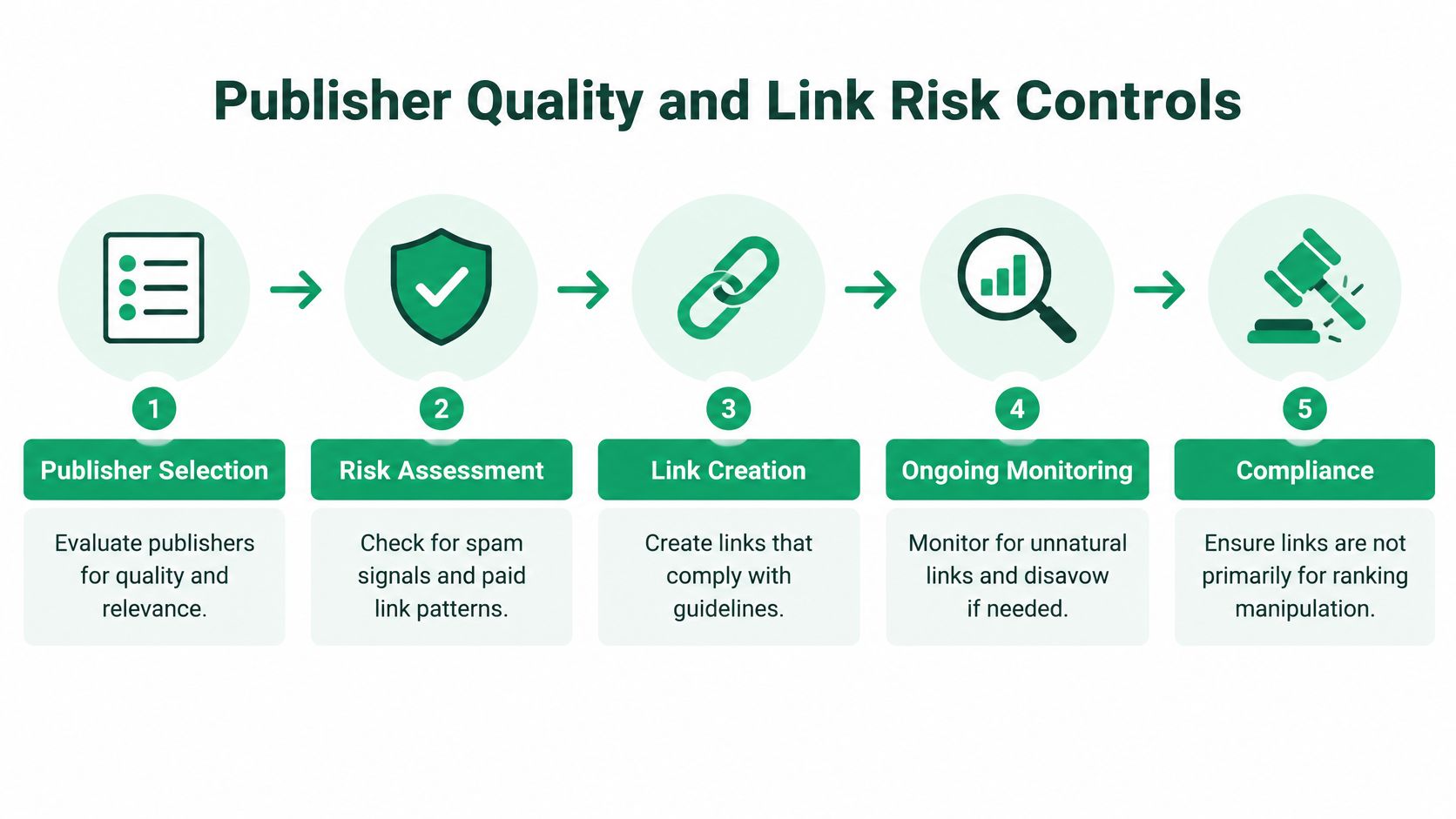
Publisher choice is risk control, not a shopping trip for domain metrics. A high score on a toolbar doesn't tell you whether the link is editorial, paid, or stuffed into a template.
Google's spam policies classify links created primarily to manipulate rankings as link spam. That list includes paid links, automated link services, excessive reciprocal links, and links embedded in sponsored content without appropriate qualification. Links still influence discovery and relevance. For paid or otherwise commercially arranged links, Google recommends rel="sponsored" or rel="nofollow". No provider should promise that every delivered link will pass ranking value.
A qualification workflow
- Confirm a real audience. The publisher should rank for relevant keywords and earn traffic from Google. We skip dead sites, private blog networks, and domains with no audience.
- Match the page, not just the domain. The specific article has to fit your topic. We use Ahrefs, Semrush, and our own research, plus a guest-post inventory you can filter by domain rating, referring domains, and traffic.
- Confirm the link is crawlable. The anchor has to be a normal link to the approved URL, visible in the source, not injected by a script.
- Record the attributes. Note whether the link is unqualified,
sponsored, ornofollow. Don't assume equity you weren't sold. - Watch for sitewide patterns. Footer and sidebar links repeated across a template are easy for a reviewer to spot, and they rarely look editorial.
- Keep an audit log. Store the live URL, anchor text, target URL, publication date, and attributes. If you can't rebuild the placement from the log, the log isn't finished.
How domain and topic approval works before a pitch goes out is spelled out in our guest posting guidelines.
Say a B2B team receives forty placements in a month. Every one uses the same exact-match anchor on a thin article. The count looks strong. The pattern is exactly what a reviewer would flag. A 90-day plan should favor durable relevance over raw velocity. Repetitive anchors, thin pages, and manipulative commercial terms raise the chance that Google discounts the links or treats them as a policy problem.
A slower, more relevant campaign is usually the safer buy. I would rather approve twelve pages I can defend than forty I can't explain.
Campaign Oversight and Reporting That Proves Value
The useful question isn't how many links were built. It's which approved pages, audiences, and conversions the work touched, and which risks came with it.
Google's guidance on qualifying outbound links says links can connect users and search engines to relevant pages, and that links to untrusted content should carry an annotation such as nofollow. A larger link count can be worth less than fewer placements tied to commercial pages and a user journey you can measure.
What each metric is for
| Metric | What it proves | Red flag |
|---|---|---|
| Baseline dates | A fixed starting point for every change | No baseline before the first placement |
| Target-page mapping | Which approved pages each link supports | Links pointed at unapproved or random URLs |
| Branded vs non-branded traffic | Whether growth reflects real search demand | Totals reported without the split |
| Assisted conversions | Leads or revenue influenced by the pages | Only rankings and link counts shown |
| Indexing status | Whether placements can be discovered and counted | Placements never checked for indexing |
| Null results | What did not move and why | Only wins presented |
Reconcile, then show what failed
Provider numbers should match your analytics and Search Console. Split branded and non-branded traffic. Segment by country and device. Map each link to an approved URL, and keep the link attribute, the publication date, and the index status on the same row. We provide live reporting on campaigns because a count you can't open isn't a report. The standard we hold is simple: reporting should be clean enough that you could rebuild it from the URLs.
Every report needs a null-result section. Rankings that didn't move. Cannibalization between two of your own pages. Placements that were never indexed. A process for pages that get edited or taken down after you paid.
Say a campaign delivers sixty links. The count looks healthy. The target page's rankings are flat, and a sibling commercial page has lost traffic. A report that shows only the link count hides the problem. A report that shows both lets you change the target pages instead of buying more of the same pattern.
A report that only lists wins is a brochure. A report that lists what failed is a management tool.
Contract Terms for AI-Era Deliverables
Search presentation has changed, and the contract has to change with it. Google's 2025 guidance on succeeding in AI search says the same foundational SEO practices remain relevant to AI Overviews and AI Mode, with weight on crawlability, helpful people-first content, and material that's unique rather than commodity copy. Outsourcing doesn't move publishing quality off your desk. Technical access and useful pages stay your requirements, even when someone else writes the draft.

Clauses worth negotiating
Ownership. Content, accounts, and reports should name an owner. If the engagement ends, you keep the files and the logins that belong to you.
AI use. The contract should say whether AI tools may draft copy, and that a person reviews the output before it goes live. Disclosure and fact-checking belong in the same clause, not in a footnote nobody reads.
Revisions and replacements. You need revision rights, plus a written rule for weak, removed, or unindexed placements. Replacement is a deliverable, not a goodwill gesture after a complaint.
What you can hold someone to. Controllable outputs are technical fixes completed, content you approved, outreach that's documented, and placements you verified. Rankings and traffic depend on algorithms, competitors, and demand. Measure the first group. Only describe the second. We do not guarantee specific rankings, traffic amounts, or revenue outcomes. How teams budget the controllable side is covered in our notes on monthly SEO costs.
Acceptance checklist
- Named deliverables: each item has a count, a format, and an owner.
- Approval deadlines: you have a set number of days to accept the work or send edits.
- Replacement rule: removed or unindexed placements get a documented swap.
- Tool disclosure: any tool used to generate content is named before you accept the draft.
I would not sign a scope that only counts links and stays silent on who reviews them.
Run a Paid Pilot Before You Commit
Don't sign a year-long retainer until a provider has passed a small, measurable pilot. A pilot shows response speed, how a rejected domain gets handled, and whether the report matches the live links. A deck can't show any of that.
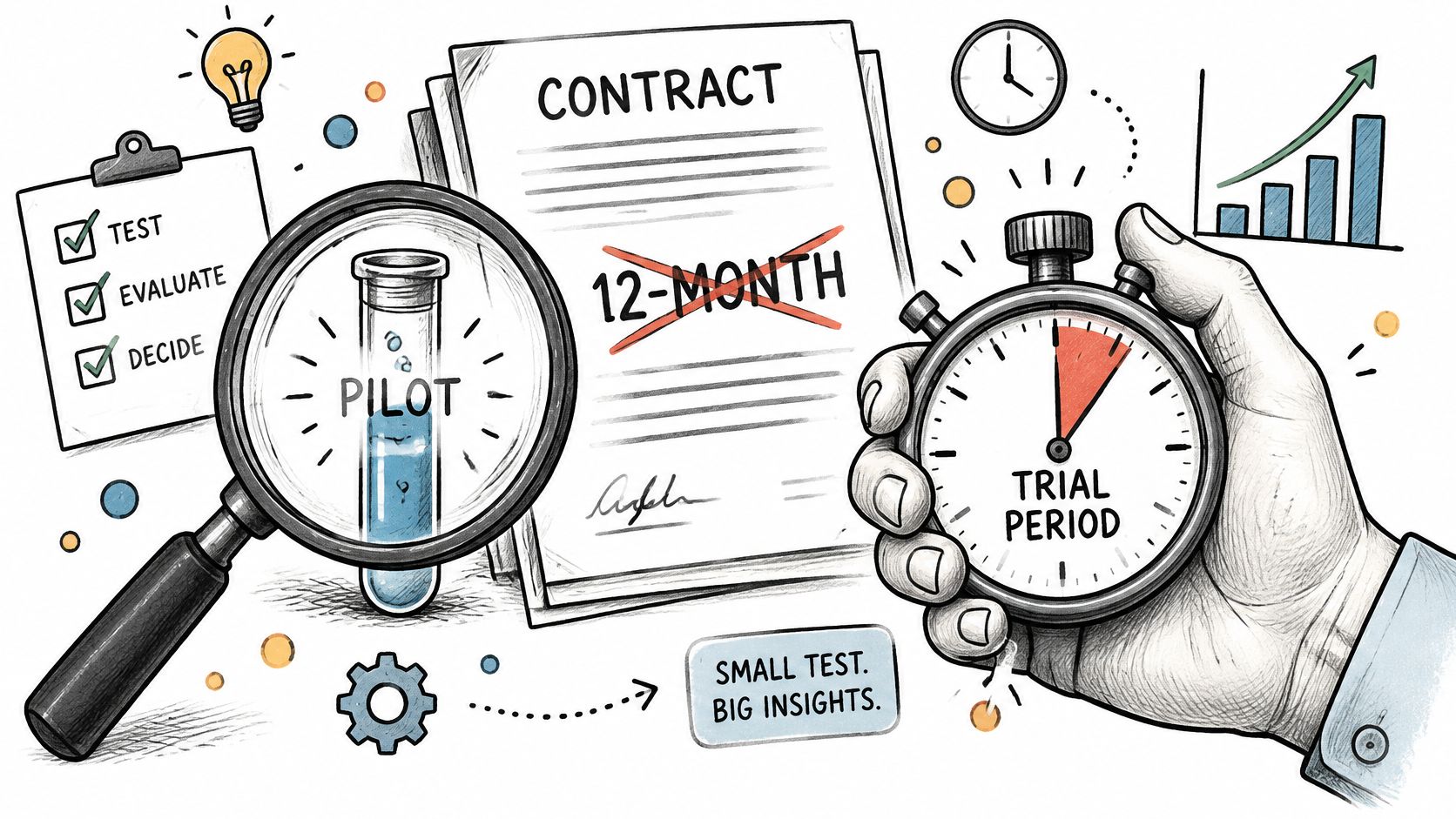
Six steps for a four-week test
- Shortlist three providers that have already worked in your niche. We adapt the process to the niche in front of us, researching the market and the competitors for each project. Expect the same from anyone else on the list.
- Send the same brief to each one, with the target pages and the goals written the same way, so the comparison isn't tilted by a friendlier email.
- Approve three to five placements. Review the domain and the topic before any pitch goes out.
- Verify each live link in the page source, against the approved target, the reported anchor, and the
relvalue. - Compare the first report with your own analytics, including anything that didn't move.
- Score responsiveness, placement quality, and report honesty, then decide whether a 90-day roadmap is worth buying.
Say a SaaS team runs a four-week pilot with two providers. One placement gets rejected for thin content. One report leaves out a null result. The second provider wins because its report can be checked line by line, not because the slide looked cleaner.
If you want a short framing of how a careful test is set up before you lock the dates, this walkthrough is a useful companion to the checklist above.
Sign a pilot, not a retainer. Set the 90-day review date before the pilot starts. I would put that date on the calendar this week, even if the shortlist isn't finished.
Linkbuilding.services runs managed link building through guest posting, niche edits, and white-label delivery, with publisher research, live-link checks, and reports you can audit before you scale. If you're comparing an SEO outsource company and want scope, pricing, and placements you can verify, start from a defined brief rather than a ranking promise. Visit Linkbuilding.services and scope a pilot against the pages you already care about.