Outsourcing Link Building: A Practical Guide for 2026
Learn how outsourcing link building works, which model fits your team, and how to vet providers, paid placements and risks before you sign.
The top-ranking page had, on average, 3.8 times as many backlinks as pages ranking in positions two through ten in an analysis of 11.8 million Google search results, described by 6S Marketers. That helps explain why businesses invest in link acquisition, but it doesn't prove that buying more links causes better rankings.
Outsourcing link building means hiring outside specialists to research publishers, contact editors, create content, and verify placements. The important distinction is outsourcing production isn't the same as outsourcing ranking-risk management. You can delegate the work, but you still need to decide where your brand belongs, which claims it can support, and which acquisition methods you'll accept.
Outsourcing Models Compared at a Glance
A 2026 survey of 518 SEO professionals found that 55.98% outsource at least part of their link-building work to agencies or freelancers, according to Editorial.Link's link-building statistics. For buyers, the useful question isn't only whether to outsource. It's which responsibilities to delegate.
Outsourcing covers a spectrum, from a freelance writer producing an occasional article to a managed team coordinating research, outreach, publication, and reporting. Choose the model around the capacity you're missing, not the longest deliverables list.
Outsourcing models compared
| Model | What the provider handles | What you still control | Best fit |
|---|---|---|---|
| In-house team with freelance writers | Writing and occasional outreach | Strategy, prospecting, placement checks, and reporting | Companies with spare SEO staff time |
| Freelancer paid per link | A discrete outreach or article assignment supporting a placement | Target page, publisher choice, anchor text, and quality checks | Small sites needing occasional links |
| Full-service agency | Research, outreach, content, placement, and reporting | Goals, budget, and approval of domains and topics | Brands wanting low-touch campaign management |
| Managed service with white-label delivery | Publisher research, outreach, placement, and branded reporting | Client approval, reseller pricing, and final report branding | SEO agencies reselling link building |
| Hybrid with internal strategy and outsourced execution | Outreach, writing, and placement verification | Target pages, publisher criteria, and anchor policy | Teams with strategy but limited outreach capacity |
Freelance writing support works when your SEO team already knows which publications to approach and can manage the process. Per-link freelance arrangements require tighter acceptance criteria because paying for a placement doesn't automatically include strategic planning or ongoing monitoring.
A full-service agency takes on more coordination, but low-touch shouldn't mean no oversight. White-label delivery adds another responsibility layer: the reseller must translate client requirements accurately and retain control over what reaches the client.
The hybrid model keeps campaign judgment close to the business while giving repetitive work to specialists. It's a practical starting point when internal SEOs understand their market but don't have enough outreach capacity.
Decision rule: Keep the decisions you can make well. Delegate the work you can't resource consistently.
The survey is a directional benchmark, not proof that outsourcing suits every team. If you have neither strategy nor execution capacity, start with a full-service agency that shares its proposed plan before work begins.
What the Provider Takes On and What You Keep
Outsourcing link building is like hiring a general contractor. The contractor schedules the trades and coordinates construction, but the homeowner still approves the design and inspects the finished work. Likewise, your provider can manage production without becoming the sole decision-maker for your brand.
The provider's operational scope can include competitor research, publisher prospecting, qualification, outreach emails, negotiation, article writing, placement coordination, live-URL verification, and reporting. Specify which tasks are included, who performs them, and what evidence marks them complete.
Production and judgment need different owners
- Provider responsibility: Research opportunities, execute approved outreach, manage drafts, record publication terms, and document delivery.
- Buyer responsibility: Set commercial priorities, approve destination pages, establish brand boundaries, and decide what constitutes an acceptable placement.
- Shared responsibility: Resolve unsuitable opportunities, approve substantive changes, and investigate discrepancies between agreed requirements and published work.
A volume-only brief leaves too much undefined. A provider measured solely on completed placements has little contractual reason to prioritize audience fit, useful context, or your preferred destination pages unless you've made those requirements explicit.
Consider a hypothetical SaaS company requesting links to its pricing page using branded anchors. The provider can pursue that assignment, but the buyer must decide whether a pricing page gives publishers a useful resource to cite. An implementation guide might be a better destination for an educational article, while the pricing page could fit a genuine buying comparison.
An ecommerce store could instead require publishers whose search visibility relates to its product category. That turns a generic delivery quota into a more focused assignment: the provider must explain how each proposed publication reaches relevant readers.
Approval shouldn't become a bottleneck
Give one internal owner authority to approve routine opportunities and identify who handles technical, legal, or brand-sensitive questions. Record decisions in a shared tracker rather than scattering them across email threads.
We adapt our process to each niche by researching the market and competitors for the project. That research supports recommendations, but the buyer still needs to supply context about product priorities, restricted claims, and commercially important pages.
Before signing, settle the destination pages, excluded publisher categories, and approval owner. Those decisions define the assignment before anyone starts pitching.
Publisher Quality Metrics That Matter
A single authority score can't tell you whether a publisher is worth approaching. A site can have an impressive link-strength score while offering little relevant readership, and a placement quota can conceal repeated URLs from a narrow group of domains.
An analysis of approximately 920 million pages found a positive correlation between unique referring domains and organic search traffic, as explained in Ahrefs' guide to referring domains and backlinks. The finding is observational, not a formula for purchasing results.
Publisher quality signals and what to require
| Signal | What it tells you | Warning sign | What to require |
|---|---|---|---|
| Domain rating | Rough link-strength score | High score with almost no traffic | Use as one signal, never the only one |
| Referring domains | Breadth of unique sites linking to the publisher | Many links from one small network | Unique, topically relevant referring domains |
| Organic traffic | Whether the site has a search audience | Flat or declining traffic across the review period | Search visibility in the target niche |
| Keyword rankings | Whether the site ranks for topics it covers | Rankings only for brand terms | Rankings for terms close to your niche |
| Topical relevance | Fit between publisher and target page | Unrelated sections or generic posts | Editor-approved topic matched to the target page |
| Indexation and live link | Whether the linking page is indexed and the link remains present | Page not indexed or link removed | Verified live URL and periodic rechecks |
Read these signals together. When considering what makes a good domain rating, compare the score with the publisher's actual subject coverage, ranking keywords, and relevant audience.
Traffic estimates need interpretation. A publisher with broad traffic from unrelated topics may offer less useful exposure than a specialist publication whose readers have a direct reason to visit your destination page. Declining visibility warrants investigation, not an automatic accusation that the site is unsuitable.
Check the page, not just the domain
Open the proposed section and read recent articles. Look for coherent subject coverage, identifiable editorial standards, and links that help readers understand the topic rather than interrupting it.
For an existing article, inspect the exact passage where your resource would appear. For a new article, require an outline showing why the destination URL belongs in the discussion; site-wide metrics can't establish that contextual fit.
Keep publisher referring domains, new referring domains gained by your campaign, and total placement URLs separate in reporting. They answer different questions and shouldn't be combined into a single headline total.
Prioritize placements that make sense for both the topic and the reader. Treat traffic as validation, not proof of ranking impact.
Document rankings and qualified organic traffic before launch. When evaluating changes, account for content updates, internal linking, seasonality, and other SEO work rather than crediting every improvement to new links.
How a Managed Campaign Runs, Step by Step
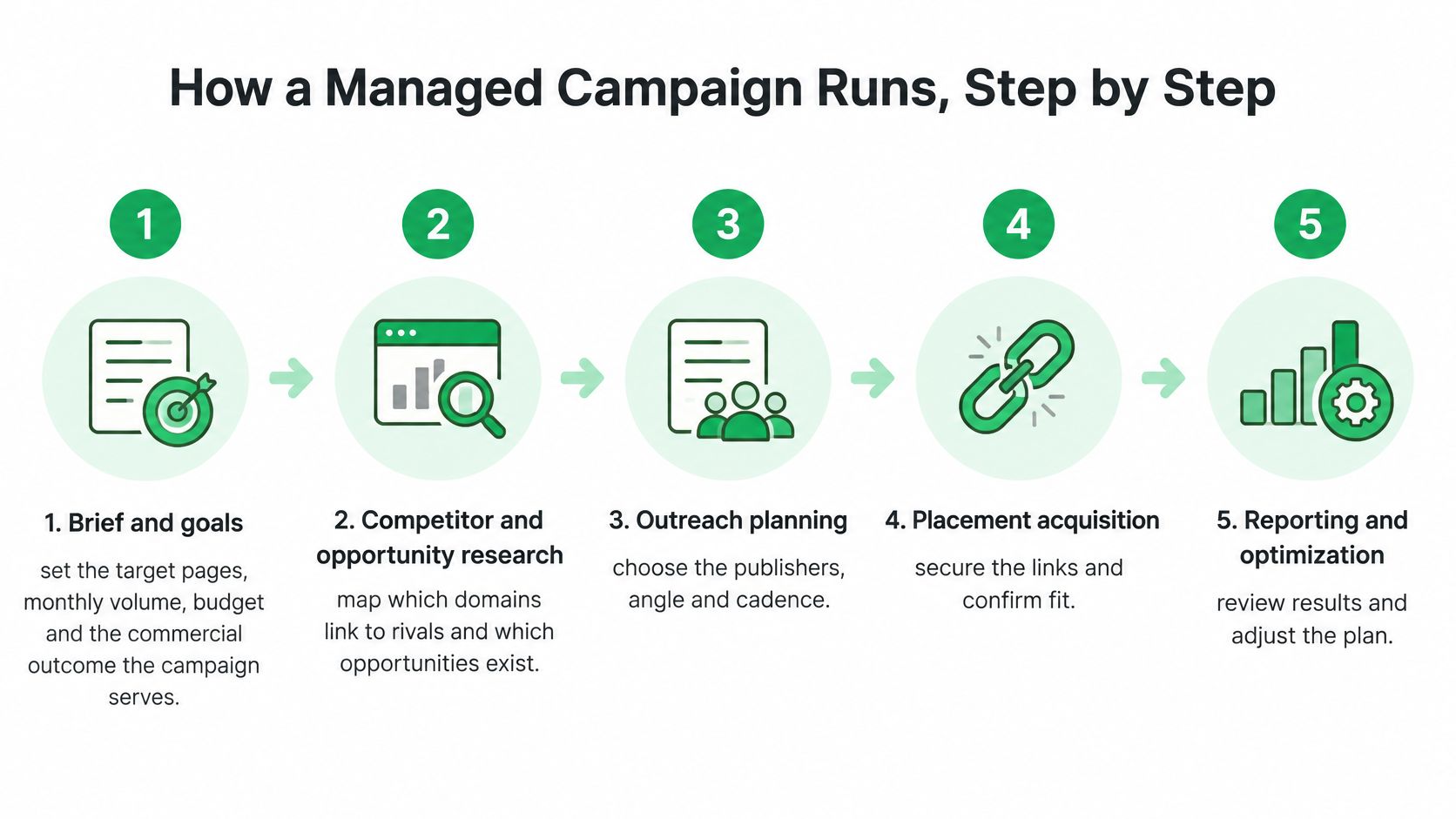
A managed campaign needs visible checkpoints, not just a delivery date. Each checkpoint should show what the team decided, who approved it, and what remains unresolved.
This overview groups the campaign into its main phases.
From brief to verified delivery
Brief and goals. Set destination pages, a monthly delivery target, budget, and the commercial outcome the campaign supports, such as qualified visits to a product-category guide. The common slip is choosing a link quota without checking whether the destination content is ready to help readers.
Competitor and opportunity research. Map domains linking to relevant competitors, then identify which publications could reasonably cover your subject. Copying competitors' entire backlink profiles is the mistake to avoid, because their links aren't automatically appropriate for your brand.
Publisher shortlist. Evaluate organic visibility, ranking keywords, topical relevance, domain rating, and referring domains together. We use Ahrefs, Semrush, and our own research to find publishers matching a client's niche and audience, rather than accepting an authority score as sufficient evidence.
Approval. Confirm domains and article topics before pitches go out so the team doesn't negotiate opportunities you would reject. The common slip is treating silence as approval, so record an explicit decision and the name of its owner.
Outreach and negotiation. Contact editors manually and document any compensation, required link attributes, publication terms, and proposed content angle. A clear guest-blogging outreach process prevents the team from promising content or placement terms it hasn't cleared.
Content production. Have a subject-matter expert draft or substantively review the article, then fact-check it and secure approval. The usual failure is approving the topic but never reviewing the actual claims or the passage containing the link.
Placement and verification. Record the live URL, inspect the destination and anchor text, check the
relattribute, and assess indexation status. Don't count an accepted pitch as a completed placement, and record indexation as pending if it hasn't been confirmed.Reporting and weekly review. Review live URLs, outstanding pitches, exceptions, and proposed changes to anchors, destination pages, or volume. We provide live campaign reporting so buyers can inspect delivery rather than rely solely on a retrospective summary.
Separate delivery from performance
A provider can commit to a documented workflow and agreed deliverables without controlling search results. Build the review around both operational evidence and business outcomes, keeping those measures distinct.
This video provides an additional format for reviewing the campaign workflow.
Plan for ongoing assessment rather than immediate ranking changes. No provider can guarantee a ranking, and an unresolved delivery problem shouldn't be excused by saying that SEO takes time.
Paid Placements and Google Link Rules
Paying a provider doesn't make every link it acquires acceptable. Paying for outreach labor and paying a publisher for a ranking-credit link are different arrangements, and your reporting must distinguish them.
Google's spam policies classify buying or selling links intended to manipulate rankings as link spam, including exchanging money for links or posts containing links. Advertising and sponsorship links are permitted when appropriately qualified with rel="sponsored" or rel="nofollow".
Link types, labels and risk
| Link type | Attribute | When it applies | Risk if handled wrongly |
|---|---|---|---|
| Editorial link earned without payment | Standard link, no special attribute required for payment | Publisher independently links because the content is useful | Lower payment-related policy risk, but still subject to context and intent |
| Paid guest post | rel="sponsored" | Money or other value exchanged for a link in an article | Ranking value may be nullified or action may follow if unqualified |
| Paid sponsorship or advertising link | rel="nofollow" or rel="sponsored" | Advertising placement or sponsored content | Unqualified links can create link-spam risk |
| Undisclosed paid link | Requires rel="sponsored" or rel="nofollow" | Payment is concealed from the buyer or audience | High risk when used to manipulate rankings |
Google can nullify detected link schemes rather than transfer ranking value, and manipulative campaigns can lead to algorithmic or manual action. Understanding follow and nofollow links helps buyers inspect implementation, but attributes don't replace a sound acquisition strategy.
Put disclosure into the scope
Require a placement record containing:
- Commercial relationship: Whether compensation, products, services, or another exchange was involved.
- Technical requirements: Required
relattribute, destination URL, and approved anchor text. - Publication evidence: Publication date and a screenshot or live verification record.
- Remediation owner: Who contacts the publisher if a link is removed, redirected, deindexed, or published incorrectly.
Prohibit private-network and automated link inventory in the written scope. Require a human reviewer to assess relevance and audience before approval, and define how noncompliant links will be removed or qualified.
A paid article doesn't become an independently earned endorsement because the writing is strong or an editor approved it. Likewise, an HTML attribute doesn't settle every question about advertising disclosure; assess applicable disclosure obligations separately.
Risk boundary: Outsource acquisition work, but retain visibility into how every placement was obtained.
For white-label campaigns, carry the commercial relationship through to client-facing records rather than hiding it behind a branded report. Measure qualified sponsorships for relevant exposure and referral activity, not promised ranking credit.
A smaller campaign of properly qualified placements can be safer and more transparent than a larger campaign sold primarily on do-follow volume.
Content Quality Controls for Outsourced Articles
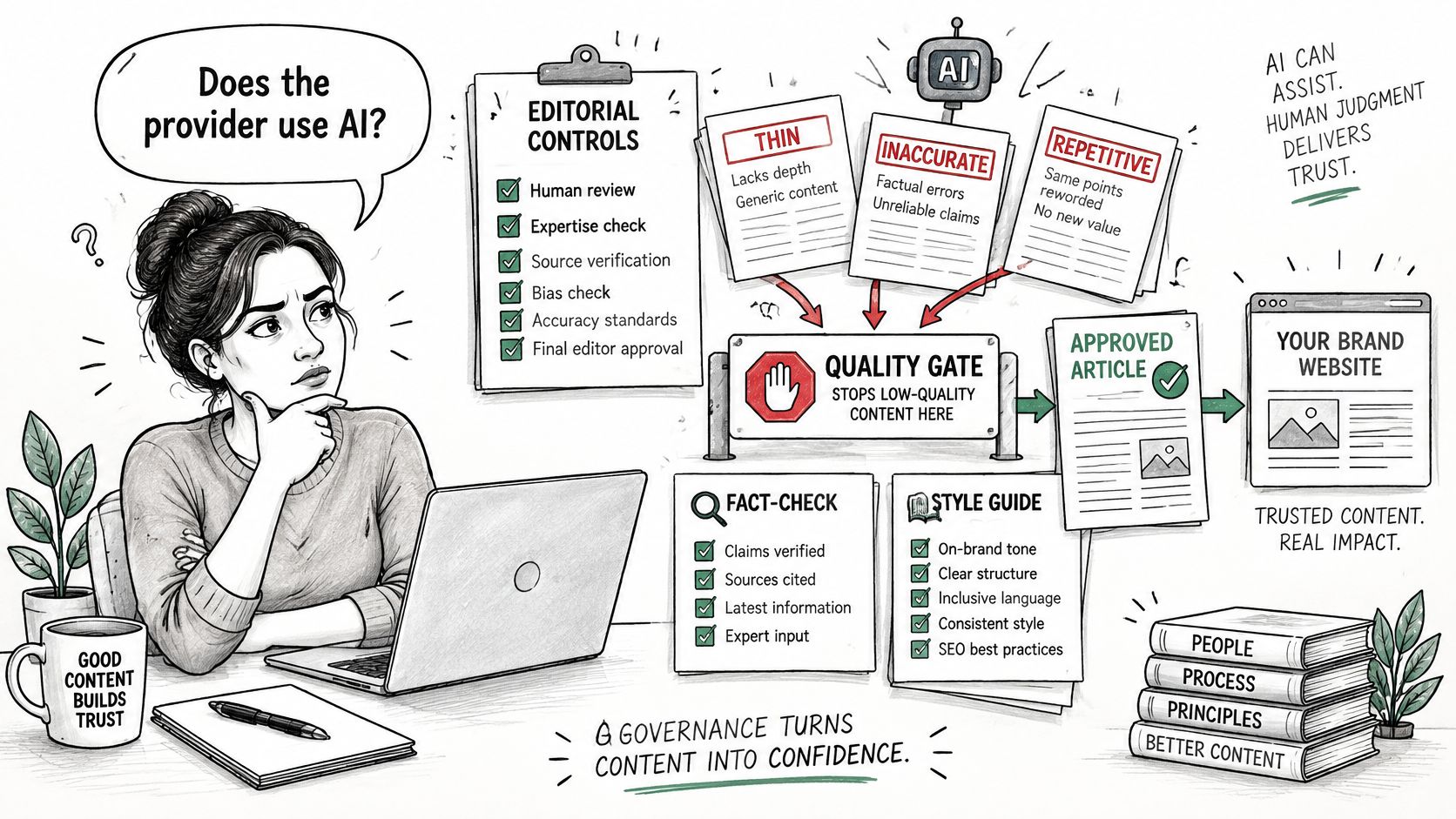
Buyers often start by asking whether the provider uses AI. The better question is what editorial controls prevent thin, inaccurate, or repetitive articles from carrying the brand's name.
Google's guidance on generative AI content warns that generating many pages without adding value may violate its scaled-content-abuse policy and emphasizes accuracy and manual fact-checking. The useful distinction is between assisted production with accountable review and unchecked publishing.
Editorial ownership should remain visible throughout production.
What weak review can cost
Consider a hypothetical SaaS article that incorrectly describes how a security feature stores customer data. A reader repeats the claim publicly, leaving the brand to correct a statement it never properly reviewed.
Or consider an ecommerce campaign that republishes nearly identical advice across different publishers. Editors may reject subsequent submissions or end the relationship when they discover the duplication, leaving the buyer with fewer credible places to contribute.
Define an editorial acceptance standard
- Subject expertise: Require specialist review for technical, financial, health, or otherwise sensitive claims.
- Original contribution: Include useful examples, original evidence, or genuine expert input rather than rearranged generic advice.
- Factual and plagiarism checks: Trace claims to reliable sources and investigate copied or closely paraphrased passages.
- Publisher requirements: Match the publication's audience, style, sourcing rules, and disclosure expectations.
- Rejection rights: Allow substantive revision or rejection when an article offers no genuine reader value.
Audit published work as well as drafts. Sample articles regularly, verify factual claims against their underlying sources, and search distinctive passages to identify duplication across other placements.
Keep the approved draft and published version together. If a publisher changes a claim, removes context, or inserts unsuitable material, assign someone to request correction.
Cheaper automated drafting may reduce writing expense while increasing review work, compliance exposure, or the risk of losing publisher relationships. Evaluate the cost of an accepted, defensible article, not merely the cost of generating a draft.
What Outsourcing Costs and How Pricing Models Differ
There isn't a useful universal price for outsourcing link building without a defined scope. A quote for writing alone can't be compared fairly with one covering research, negotiation, editorial review, verification, and monitoring.
Start by identifying what triggers payment. Then establish which work and remedies the price includes.
Compare the commercial models
| Pricing model | What you're buying | Main trade-off |
|---|---|---|
| Per-link pricing | Each placement meeting agreed acceptance rules | Easy to compare, but can encourage volume over suitability |
| Monthly retainer | Recurring outreach, content, coordination, and reporting | Supports steady work, but needs explicit scope and targets |
| Project fee | A defined campaign or destination-page initiative | Clear boundaries, but additional work needs change control |
| White-label pricing | Fulfillment an agency resells under its brand | Agency retains margin decisions and client-service obligations |
Publisher suitability and niche difficulty influence the effort required. So do outreach personalization, article depth, specialist input, placement type, and the frequency of post-publication checks.
Distinguish earned-link campaign labor from paid sponsorship inventory when reviewing quotes. Otherwise, apparently similar unit prices may describe very different acquisition methods.
Normalize quotes around accepted delivery
Use total campaign cost divided by approved, live, verified placements as an operational comparison. Don't divide by emails sent or pitches made, because those activities aren't completed deliverables.
For earned-media work, also evaluate research quality and useful campaign assets rather than forcing every engagement into a guaranteed placement model. Editorial acceptance remains the publisher's decision.
Check whether content revisions, rejected publishers, removed placements, and noncompliant links create extra charges. Put replacement or remediation terms in writing rather than assuming they're included.
A low unit price isn't a saving if your team must redo the qualification, rewrite the article, and chase the publisher afterward.
Budget-allocation benchmarks describe spending priorities, not market prices. A quote excluding verification or clear remediation terms may cost more over the campaign's life once you include internal cleanup time.
Confirm the Provider Checklist Before You Sign
A provider is worth signing only if it passes the checklist before work starts. First settle which destination pages matter, which publisher niches and sites are out of bounds, and who approves each opportunity.
Use this checklist to make those decisions visible.
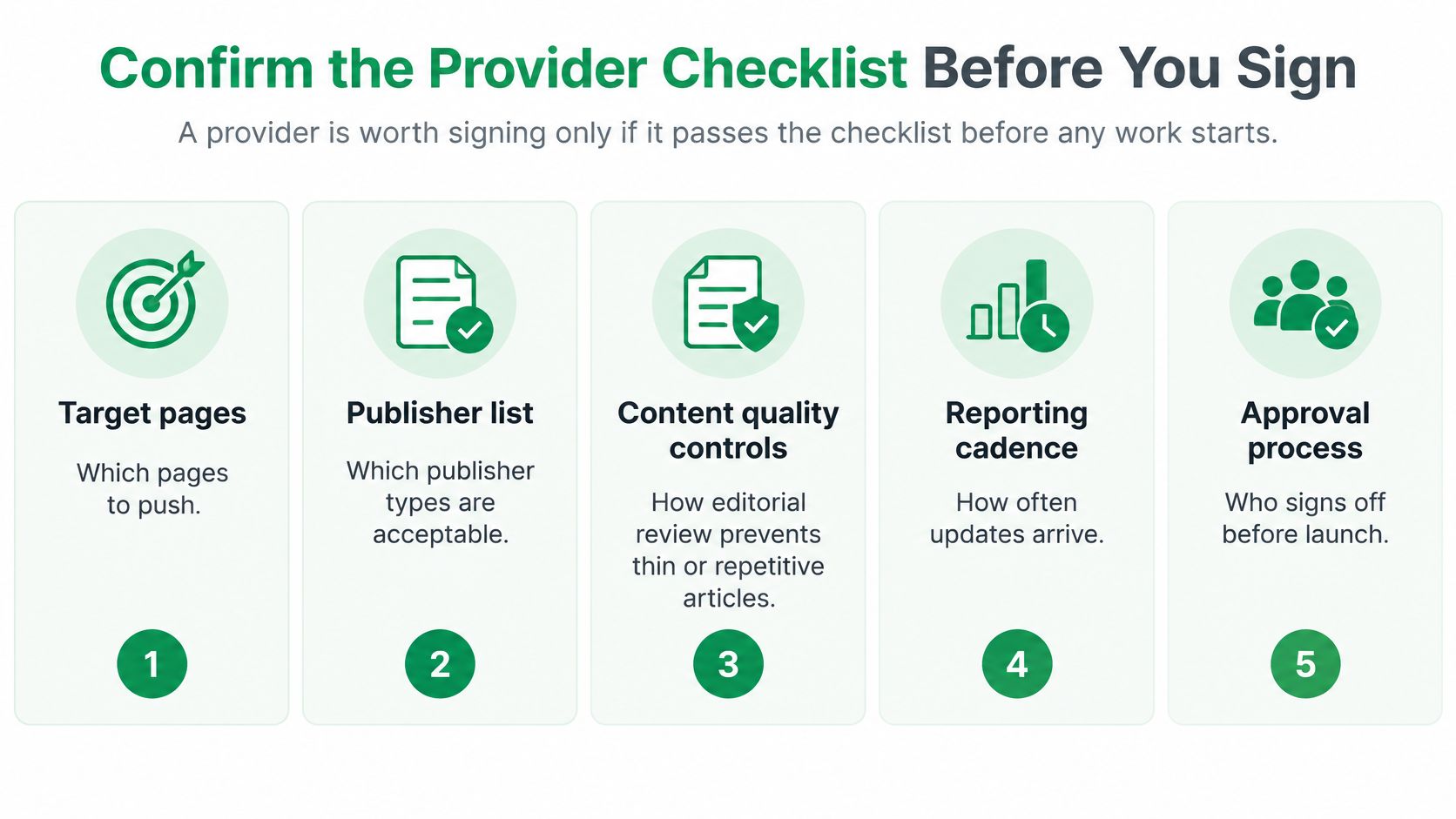
Confirm the non-negotiables
- Written scope: Identify deliverables, pricing, exclusions, acceptance rules, and responsibility for corrections. We provide clear scope and pricing before work starts.
- Acquisition standards: Document permitted methods and prohibited inventory. We use white-hat methods only and avoid dead sites, PBNs, and domains without an audience, focusing on publishers that rank for keywords and earn Google traffic.
- Inspection rights: Require verifiable placement records, editorial approval ownership, and a reporting cadence your team can maintain.
- Realistic commitments: Separate delivery commitments from business outcomes. We don't guarantee specific rankings, traffic amounts, or revenue.
- Exit and remediation: Establish how unresolved defects, unpublished work, and noncompliant placements will be handled.
Test the agreement with a pilot
Treat ranking guarantees, domain-rating-only selection, concealed payment arrangements, and refusal to share sample placements as reasons to pause. A missing removal or correction process is also a contractual gap, not a minor administrative detail.
Start with a small pilot whose size you agree in advance. Review every placement for audience fit, acquisition disclosure, technical implementation, and editorial quality before expanding the scope.
Keep an exception log showing the issue, responsible person, required correction, and completion status. Scale only when the pilot meets the agreed acceptance standard, not because the provider delivered on schedule.
Request a pilot brief, a sample report containing live URLs, and the written scope. Set a follow-up date to recheck the pilot placements and confirm that any promised corrections were completed.
Linkbuilding.services provides managed publisher research, outreach, content production, placement verification, and live reporting, with client approval of domains and topics. Visit Linkbuilding.services to discuss a pilot around your niche, destination pages, and budget, and request a written scope before work begins.