Guest Posting Guidelines: Rules for Publishers and Links
Guest posting guidelines for choosing publishers, pitching topics, writing content and keeping links compliant, with checklists, tables and examples.
The guest post most likely to damage a site isn't the one an editor rejects. It's the one that goes live, gets indexed, keeps its exact-match anchor for eighteen months, and never gets opened again by anyone who knows what to look for.
Google doesn't prohibit guest posting. Its spam policies target contributed articles whose links pass ranking credit, particularly when the anchor text is tuned for rankings. That distinction moves the question from yes or no to something far more operational. Every rule in a workable set of guest posting guidelines should name the check that proves it was followed, and that check should be runnable on a live URL by someone who wasn't in the room when the post was commissioned.
Core Guest Posting Standards at a Glance
Two things decide whether a guest post deserves publication. The first is whether the host has readers who could act on it. The second is whether anyone can prove, months later, that the post met the standard it was commissioned under. Put both in the same document and a vague argument about quality turns into a short list of tests.
| Area | Standard | Verifiable check |
|---|---|---|
| Publisher | Real audience, topical fit and no network signs | Organic traffic and ranking keywords visible in Ahrefs or Semrush |
| Topic | Original angle relevant to the host's readers | Editor approves topic and outline before drafting |
| Content length | 1,000 to 1,500 words, original and sourced | Plagiarism check passed and every statistic linked to a named source |
| Author | Named author with a two-to-three sentence bio | Bio matches a verifiable profile and stated expertise |
| Links | One or two contextual links inside relevant paragraphs | Link count matches the approved plan |
| Anchors | Descriptive, varied and natural to the sentence | No repeated exact-match keyword across posts |
| Disclosure and attributes | Visible label on paid posts; rel=sponsored on paid links | Label visible on mobile and desktop; attribute present in page source |
Every row pairs a rule with a check. A standard that can't be verified is a preference, and preferences lose the first time a client asks why a placement was rejected or a publisher asks why a draft came back.
The baseline that fits most hosts is a word range rather than a single count, one or two contextual links sitting inside paragraphs where they answer a reader's question, a named author with a two-to-three sentence bio that traces to a real profile, and a visible label on any post that was paid for. None of those is universal, and treating them as law is how programs end up rejecting good publishers for the wrong reason.
Thresholds move by niche and by publisher. A technical audience expects a longer piece with worked examples. A trade blog that publishes 800-word field notes will cut anything longer. The standard you write should state the default and the condition for an exception, so nobody has to guess which one applies.
Work through them in the order a placement moves: publisher criteria, pitching, content rules, link attributes, disclosure, post-publication checks, then the violation patterns that show up when a step gets skipped. Copy the table into the top of your outreach template this week. Every pitch then gets tested against the same baseline before anyone spends an hour on research.
Publisher Criteria to Check Before You Pitch
The filter that removes most candidates isn't authority. It's whether anyone reads the site. A domain rating is a link-profile score, not an audience measure, and plenty of high-scoring domains publish to nobody.
| Metric | Acceptable signal | Red flag |
|---|---|---|
| Organic traffic | Steady monthly search visits, around 1,000 or more | Traffic flat, or from one referral source only |
| Keyword rankings | Ranks in the top 20 for relevant, non-brand terms | Rankings only for brand terms or none |
| Referring domains | Natural growth over time | Sudden spikes or links from unrelated sites |
| Domain rating | Used as context alongside traffic | Chosen over traffic and relevance |
| Topical relevance | Recent posts in your niche | Mixed, unrelated categories |
| Recent activity | Posts published in the last 90 days | Last post more than a year old |
| Audience engagement | Comments, shares or a newsletter | No engagement signals at all |
Reading the numbers in the right order
Start with traffic, because it's the only metric that shows a publisher has readers. Pull a twelve-month organic traffic chart in Ahrefs or Semrush and look at the shape: flat, rising, or a cliff. Then check which keywords produce that traffic. A site with steady visits from forty niche terms is worth more than one drawing the same volume from a single viral post about a celebrity.
Referring domains come next, and the pattern matters more than the total. Look for links arriving across months rather than in one week. A sudden block of referring domains, especially from sites in unrelated languages or verticals, is the signature of a network.
Our own vetting screens every publisher on domain rating, referring domains, organic traffic and topical relevance before a single pitch goes out, in that combination rather than on any one number.
What disqualifies a publisher outright
Five categories get removed from the list no matter what their scores say:
- Private blog networks. Shared hosting footprints, identical themes and cross-linked posts. One placement here can cost more than it returns.
- Dead or dormant sites. No posts in two years, broken category pages, an author page with no authors.
- Domains without an audience. Traffic that exists only on a chart, with no rankings for the topics you'd write about.
- Sites that publish unrelated categories. A personal finance blog with a sudden section on vape hardware isn't a topical fit for anyone.
- Sites that sell links with no disclosure policy. If every post carries a paid link and no label, the host has already told you how the placement will be treated.
The placement policy we hold to excludes dead sites, PBNs and domains with no audience, and targets publishers that rank for keywords and earn traffic from Google instead.
A worked example on two real candidates
Say a marketing blog shows about 3,000 monthly organic visits, ranks in the top 20 for roughly 40 niche keywords, and has published three posts in the last 30 days. It has a contributor page, an editor's name and comments on recent articles. It passes, even if its domain rating sits in the forties.
Now take a domain rated far higher, with traffic that hasn't moved in two years and no new posts since a dated archive. It fails, and it fails on the row that matters most to a reader.
Hard rule: if a publisher's traffic is flat or falling and its most recent post is more than a year old, no authority score rescues the placement.
Before you open a single contact form, answer three questions. Does the site get search traffic? Does it publish in your niche? Would its readers find the article useful if the link were removed? Three yes answers send you to the pitch. Any no ends the conversation.
How to Pitch a Topic and Get It Approved
An editor decides whether to keep reading a pitch in seconds, and the deciding factor is almost never the writer's résumé. It's whether the pitch shows the site was read.
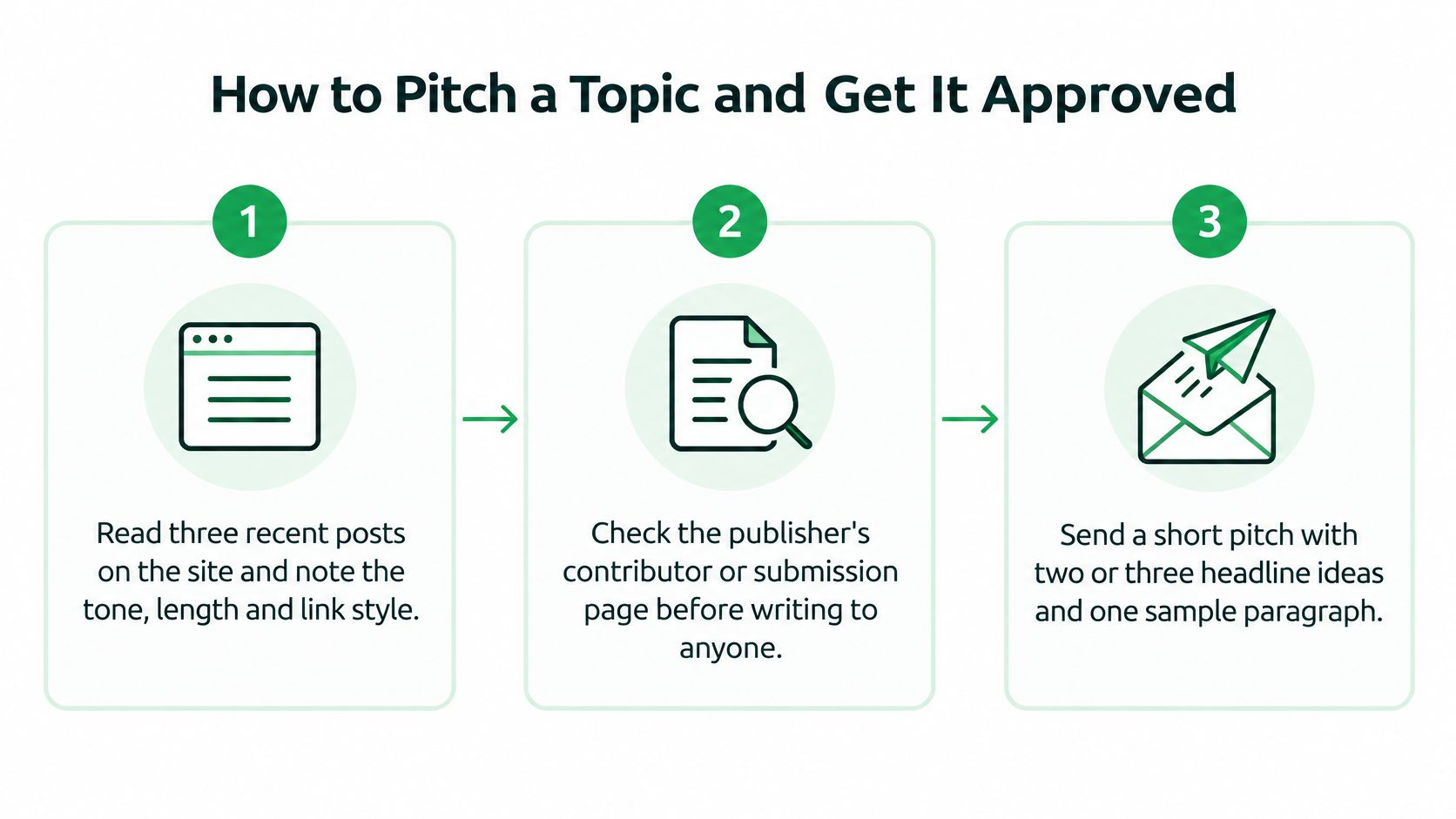
Read three recent posts before you write anything. Note the length, tone, heading pattern and how links appear in the body. The first slip is pitching a 900-word listicle to a host that publishes 2,000-word case studies.
Find the contributor or submission page first. Many hosts publish word counts, link limits and payment terms there, which stops you proposing something the site will never run. The second slip is emailing a general address when the page names the editor.
Send two or three headline options, not a request for topics. Each should carry the reader problem it solves and one line on the experience behind it. The slip here is the same generic pitch sent to fifty editors, which reads exactly as it is.
Offer an angle the site hasn't published. A teardown of a campaign with real numbers, a comparison of two tools the audience already uses, a field account of a process that went wrong. Don't propose the fifth ultimate guide to a topic their archive covers in triplicate.
Wait for topic and outline approval before drafting. Editors reject unrequested drafts, and a full draft attached to a first email signals that nobody read the guidelines. Approval on the outline is also your protection when the brief changes later.
Submit the outline with the proposed link placement and anchor. Name the paragraph the link sits in and the anchor text you want, then get written agreement. Without it, you find out after publication that the link moved to the bio or got stripped.
Log the pitch, the approved topic, the date and the agreed placement. A tracker row costs a minute. Reconstructing an agreement from a six-week-old inbox thread costs an afternoon.
The editors who publish our placements stay first in the process, because a contribution that serves their readers is what earns a second placement. A pitch that leads with a link request has already told the editor where the value is going.
If you want the full outreach sequence, including follow-up timing and reply tracking, the process expands in this guide to guest blogging outreach.
The pitch worked when the editor asks for a draft or proposes a publication date. Anything vaguer than that is a no you haven't been told yet.
Content Rules for Guest Articles
The draft is where a one-off placement turns into a recurring relationship, or where it dies. Editors approve fast when the submission reflects their house style and needs almost no editing.

Originality is the first check an editor runs
The article must be written for this host and nobody else. Reused intros, spun paragraphs and pieces that appear on three sites in the same month all get caught, usually in the first paragraph by an editor who reads their own niche daily. Run a plagiarism check before you submit and fix anything that scores high, including your own earlier work.
Length follows from the topic, not the other way round. A standard blog post at 1,000 to 1,500 words covers most hosts, and a technical or comparison piece may need more. Padding is the failure mode to watch for. If a section exists to reach a count, cut it and add depth where the reader gets stuck.
Sourcing and author identity are one requirement
Every statistic needs a named source and a link in the article, and any claim about a trend or a threshold should carry its date. A sentence that says "studies show" without a citation tells an editor the writer didn't check, which casts doubt on the rest of the draft.
The byline matters as much as the body. Use a named author, a bio of two to three sentences, a real photo if the host requires one, and credentials that match the expertise the article claims. A generic "guest contributor" line on a piece about technical SEO fooled nobody.
Keyword use and editorial balance
One primary keyword, placed naturally in the title or opening section, is the limit. Repeating an exact-match phrase through headings and body is the pattern that turns a contribution into something a search engine reads as manipulation.
Balance is what separates an article from an advert. Include the trade-offs, the limits and the cases where the recommended approach doesn't work. A post that helps a reader decide is more useful than one that only concludes in favour of the author's product, and editors notice which one they've been sent.
A guest post that reads like a contribution gets invited back. One that reads like a link drop gets edited, delayed, or quietly rejected.
The pre-submission check
Run these five checks before the draft leaves your side.
- Length and structure: word count inside the agreed range, headings matching the approved outline.
- Sources: every statistic linked to a named source, claims dated.
- Bio and photo: named author, correct credential, image supplied if required.
- Links: count matches the plan, each one inside a paragraph that needs it.
- Pitch drift: no product claims beyond what the editor approved, no anchor text changed at the last minute.
Link Attributes and Anchor Text Standards
Attributes are the part of a placement that a search engine reads directly, which makes them the element an auditor verifies in the page source rather than in a screenshot or a spreadsheet.
| Link situation | Required attribute | When it applies |
|---|---|---|
| Paid or compensated placement | rel=sponsored | Advertising, sponsorship or any agreement where the host is paid |
| User-submitted or contributor link | rel=ugc | Links added by users in comments, forums or contributor profiles |
| Link the publisher does not endorse | rel=nofollow | When the host does not want to imply endorsement or association |
| Editorial citation to a source | No attribute (followed) | Ordinary references in the article body; do not add nofollow |
Every row in that table traces to a rule an editor can look up. Google introduced rel="sponsored" and rel="ugc" in September 2019 for links created through advertising, sponsorship, contributor content or other compensation agreements, and it treats those values as hints it may use rather than directives it must obey, as Google's announcement of the sponsored and ugc attributes explains. On the enforcement side, Google's spam policies class guest-post links that pass ranking credit, especially ones carrying optimized anchors, as link spam, and a site accumulating them at scale can face a manual action or algorithmic demotion.
Anchors that read like the sentence around them
Anchor text should describe what sits at the other end and fit the grammar of the sentence holding it. Mix branded terms, partial phrases and plain natural wording across a campaign. The pattern that creates risk is the same optimized keyword repeated across placement after placement, because repetition across many hosts is the signature of a link scheme rather than a set of independent citations.
A three-post campaign shows the standard in practice. The first anchor is the brand name. The second is a partial phrase describing the resource, something like "a template for publisher vetting". The third is a bare URL where the sentence calls for it. If the placements are paid, every one carries the sponsored attribute, and the mix still holds.
Practical rule: if you can swap the anchor text into a different sentence without rewriting anything, it's descriptive enough. If it only works because it repeats a keyword, rewrite it.
Proving the attribute is there
Open the published page, view the source, and search for the link URL. Read the rel value on the tag and compare it against the approved plan, then confirm the anchor renders as agreed rather than shortened or swapped at publish time. For a batch of placements, crawl the URLs and export every outbound link so the report reflects the live pages. A tracker that records "sponsored" while the source shows nothing hides the problem instead of catching it.
The check runs the other way too. Adding nofollow to every editorial link removes the signal from honest citations and flattens the difference between a trusted reference and a paid placement, which is the distinction the attributes exist to preserve. Deciding the difference between follow and nofollow links belongs at the planning stage, while attributes can still be changed in bulk before placements go live.
Disclosing Sponsored and Paid Placements
Readers need a different signal from the one search engines get. An attribute in the source code tells a crawler how to treat a link. It tells a reader nothing, and a reader who can't tell a paid post from an editorial one has been misled regardless of what the HTML says.
The U.S. Federal Trade Commission is explicit that native advertising must not imply promotional material is independent or editorial when it is sponsored, and that any necessary disclosure must be clear, prominent, easy to read and placed as close as possible to the advertisement, as its native advertising guide for businesses sets out.
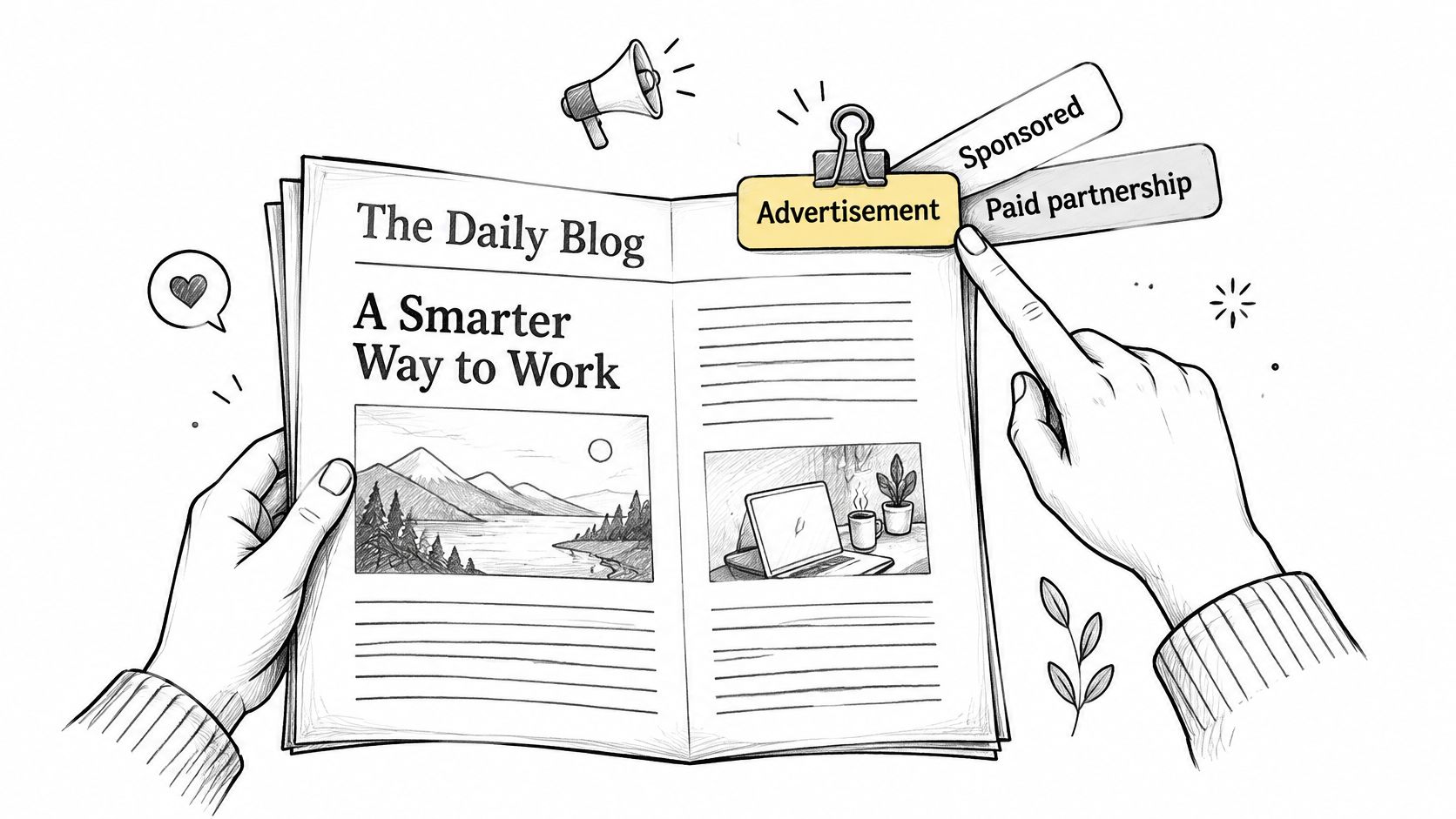
Labels readers can see without scrolling
Use unambiguous wording near the headline or the opening content: Advertisement, Sponsored, or Paid partnership. A note in the footer, a line below the twelfth paragraph, or a tag hidden behind a click fails the standard even when the wording is perfect.
The label has to stay visible on mobile and desktop layouts, since a sidebar placement on desktop often collapses to the bottom of an article on a phone. Test both before you sign off.
Two controls, two jobs
Naming who paid, and whether an agency materially shaped the content, belongs in the disclosure. So does publisher approval of the final presentation, including where the label sits, before anything goes live.
The two controls work in parallel and neither replaces the other. rel="sponsored" communicates link treatment to search engines. The visible label communicates commercial intent to readers. A placement with one and not the other is either compliant in code and deceptive on screen, or honest to readers and unqualified for crawlers.
For the audit file, capture the live post on mobile and desktop, and store both images with the placement record. When a client or a publisher disputes what the page looked like on publication day, the capture settles it without an argument.
Post-Publication Link Checks
A placement isn't finished when it goes live. Links get removed during a site migration, anchors get rewritten by a new editor, and an attribute can disappear in a theme update nobody announced.
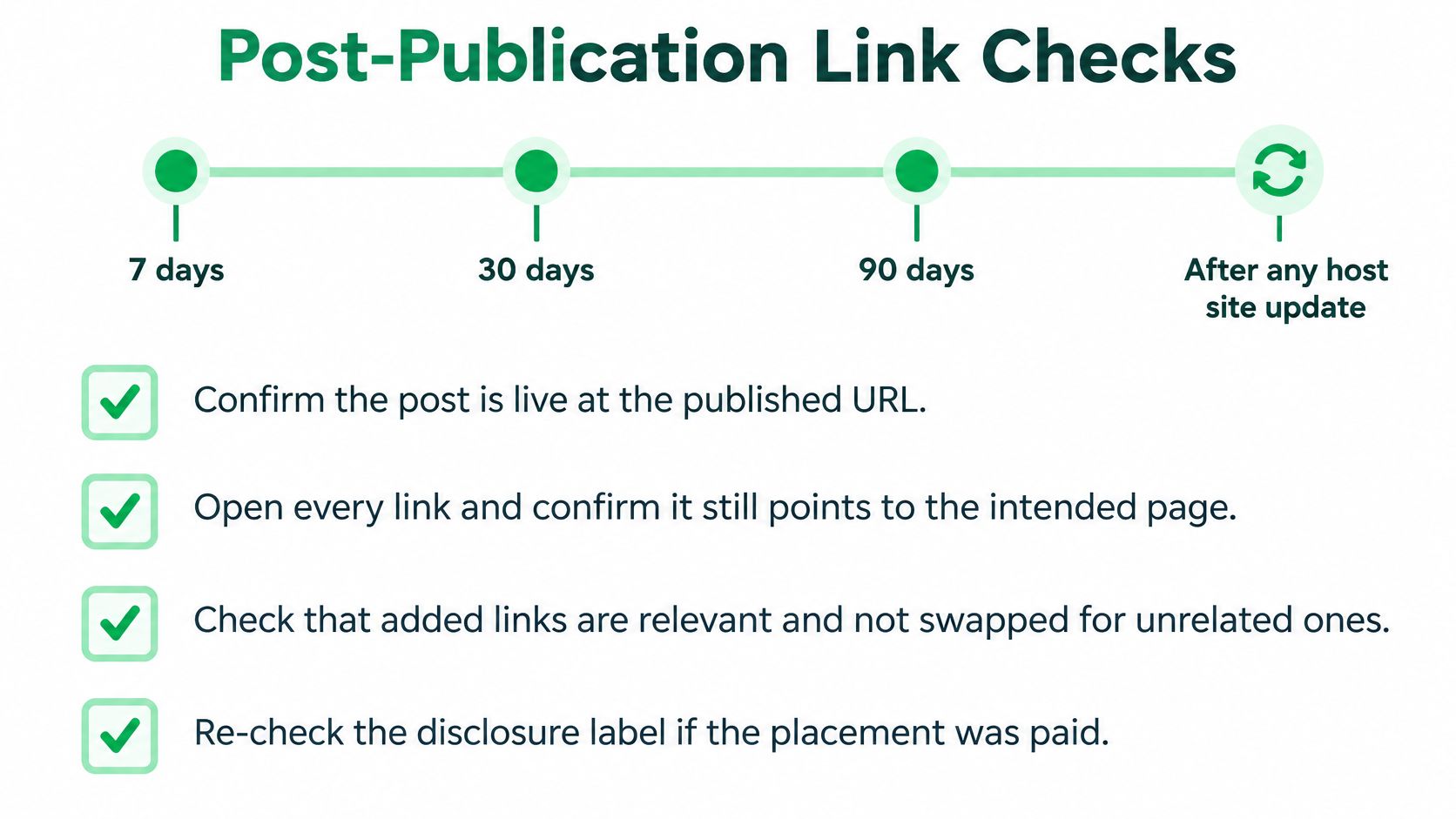
Check every live link at 7, 30 and 90 days after publication, and again after any host site update. Three dates catch the three common failures: a link stripped during editing, an anchor changed in a later tidy-up, and a page removed in a redesign.
The checklist to run at each date
- Live and indexable: the post returns a normal status, the URL is the one you approved, and no noindex tag has appeared.
- Link intact: open every link and confirm it points to the intended page, not a redirected domain or a homepage.
- Attribute and anchor match the plan: the
relvalue and the rendered anchor text are what the approval specified. - Label visible: for paid placements, the disclosure still shows on mobile and desktop.
- Bio and sources present: the author bio, credentials and citations haven't been trimmed.
- Page still substantive: it hasn't become thin, duplicated or folded into a category page.
When a link disappears
Contact the editor with the live URL and the original approval, and ask for restoration or a replacement placement on the same site. Keep the tone factual. Most removals are housekeeping rather than bad faith, and a polite request with evidence gets a faster answer than an accusation.
Reporting should be clean and verifiable, because a dispute about a link resolves in minutes when the record already exists. A tracker built from a template with these columns, live URL, publish date, anchor text, attribute, label status and last check date, turns a he said, she said into a screenshot.
Threshold: if more than 10 percent of a campaign's links are missing or altered, pause new orders and review the process that produced them before spending more.
If you're still building the list those placements run against, this guide on how to get backlinks covers the acquisition side before the audit side matters.
Common Violations and How to Avoid Them
The comfortable assumption is that a bad placement can be patched later. Usually it can't. By the time an exact-match anchor pattern is visible across twenty posts, the pattern is the problem, and fixing one link doesn't change what the batch looks like.
| Violation | Risk | Fix |
|---|---|---|
| Exact-match anchors on every link | Over-optimisation pattern that invites action | Mix branded, partial and natural anchors |
| Paid post with no visible label | Breaks the disclosure standard for readers | Add a clear label near the headline |
| Paid link without rel=sponsored | Spam-policy exposure for the link | Add rel=sponsored to every paid link |
| Spun or duplicated content | Duplicate content and editorial rejection | Write an original draft and run a plagiarism check |
| Links from private networks or dead sites | Link devaluation or manual action | Vet traffic and activity before pitching |
| One article reused across hosts | Duplicate content across domains | Write a unique article for each host |
Google's spam policy names paid articles, advertorials and guest posts containing links that pass ranking credit, especially with optimized anchor text, as examples of link spam, while recognising that buying and selling links can be a legitimate part of online advertising when they're properly qualified with rel="nofollow" or rel="sponsored", according to Google's spam policies. The same guidance recommends rel="ugc" for user-generated content and reserves rel="nofollow" for cases where a publisher won't imply endorsement.
One batch, three violations
Say a program places twenty posts across domains that share hosting and cross-link to each other, with identical author bios and the same exact-match anchor in every piece. Nothing here is a single mistake. It's a network, duplicated identity and an over-optimized anchor pattern at the same time.
That batch doesn't get repaired link by link. It gets rebuilt: new publishers vetted against the traffic and activity thresholds, unique drafts written for each host, and anchors redesigned per placement. Anything less leaves the footprint in place.
A violation you can describe in one sentence is fixable. One you can only describe as a pattern across a batch is a rebuild.
Fix in this order
- Add rel=sponsored to every paid link. It's the fastest change and the one a search engine reads directly.
- Add a visible disclosure label near the headline. Nothing below the article body counts.
- Replace exact-match anchors with a mix of branded, partial and natural phrasing, one per placement.
- Remove links from private networks and dead sites. Ask for removal, and write off the placement if it doesn't happen.
- Replace duplicated articles with unique drafts written for each host, each passing a plagiarism check.
Each of those maps back to a rule already in your standard, which is the point of writing the standard first. A violation list without the underlying rules is just a list of things to argue about after the fact.
Set Your Guest Posting Standards Before the Next Pitch
Adopting a standard is a decision, not a document. Three moves make it real.
- Name an owner for each control. One person owns publisher vetting, one owns content review, one owns the link audit. Shared ownership of a check means nobody runs it.
- Pilot on five publishers. Vet each against the seven metrics, run the pitch procedure, publish, then audit at 30 days using the tracker columns. Five placements will expose the gaps a template hides.
- Decide between in-house and managed delivery. In-house buys control and costs capacity: research, outreach, writing and verification all sit with your team. A provider buys throughput, so judge it on process rather than promises. It should vet publishers before pitching, exclude dead sites and networks, state scope and pricing before work starts, and hand you live URLs with attribute and label status for every placement.
No provider can guarantee rankings, traffic or revenue, and any that does has told you something useful about how it sells.
The template fields to fill in
Write these down and date the version, so a change is visible rather than remembered.
- Publisher criteria: the seven metrics and the exclusions.
- Topic approval step: who signs off, and what the outline must contain.
- Word count range: the default and the exception condition.
- Bio requirements: length, credentials, photo policy.
- Link count and anchor mix: per placement, with the branded, partial and natural split.
- Attribute per link type: sponsored, ugc, nofollow, followed.
- Label wording and position: exact text and where it appears on both layouts.
- Audit dates and pause threshold: 7, 30 and 90 days, and the missing-link limit that stops new orders.
Our guest posting service is built on the same sequence: subject-matter experts write the drafts, domains and topics get approved before outreach, and reporting carries live links you can check yourself. Scope and pricing are set before any work starts, which is the minimum for comparing one provider against another.
Approve the standard, pick five publishers, and put the first audit date in the calendar before the first pitch goes out. The audit date is what turns a policy into a system.
If you'd rather not build the vetting, writing and verification cycle from scratch, Linkbuilding.services runs guest posting campaigns on exactly this standard: publishers screened on domain rating, referring domains, organic traffic and topical relevance before any pitch, subject-matter experts writing to each host's own guidelines, and reports carrying live URLs so you can inspect every anchor, attribute and label yourself. Bring your target pages and your niche to Linkbuilding.services and we'll show you the domains and topics before anything is placed.