Link Building for Ecommerce: Tactics That Drive Sales
Learn how link building for ecommerce works: which assets earn links, how to pick publishers, and how to measure revenue impact.
A category page you've been pushing for a year sits at position 11. A competitor outranks you with thinner copy, worse photography and a slower site. You know exactly why. Somebody built twenty links to their category page while you built six to a blog post about how to choose the product.
So you buy a batch of placements on sites with strong authority scores, watch the referring domain count in Ahrefs climb, screenshot the dashboard and send it upward. Then you open revenue by landing page and the line is flat.
The problem isn't buying links. It's judging them by the easiest thing to count. A link is worth what the page it lands on earns, so judge every placement by the revenue page it lifts and the orders that follow. That single change makes a campaign smaller, slower and far more profitable.
Why Links Shape Ecommerce Visibility
Take a store carrying 8,000 products where the best-selling item sits four clicks below the homepage. The page is fine. Sharp photos, specific copy, real reviews. But nothing links to it except a faceted listing Google treats as a duplicate, so it gets crawled once a month and ranks for its own brand name.
Search engines use links for two jobs at once. They follow them to find pages, and they read them to decide which pages matter relative to everything else. Google Search Central's guidance on ecommerce site structure explains that link relationships, including the number of clicks needed to reach a page and the number of internal links pointing at it, feed into how Google treats that page. Most stores treat external links as the strategy and internal links as the developer's problem.
Two dimensions, one system. Internal linking distributes crawl access and prominence across a catalog. External acquisition adds authority from outside. Neither works alone for long.
The hierarchy Google recommends is unglamorous and effective. Menus link to category pages, categories link to subcategories, subcategories link to products, and every important page is reachable through a standard HTML anchor. When a product sits four clicks deep with two internal links pointing at it, it competes for attention against a homepage with thousands. It loses.
The working rule: buy an external link only when the page it lands on can pass authority onward. A link to a category page that feeds twelve product pages beats the same link pointed at a dead-end landing page.
Before pricing a single placement, map where competitors earn links and which of their pages receive them. Finding competitors' backlinks shows which pages attract authority in your niche, and that map tells you which of yours should. External links land where the sales are. Internal links carry that strength down to the rest of the catalog.
Linkable Assets Matched to Your Pages
Nobody links to a product page for a $24 phone case. Writers link to whatever proves a point, settles an argument or saves their reader an hour, which is why ecommerce link campaigns drift toward blog content and away from the pages that pay the bills.
Digital PR is the tactic most stores reach for when they want that editorial coverage. A 2025 ecommerce SEO study cited by Rankite's guide to ecommerce link building found that 52% of ecommerce sites used digital PR to build links, and that digital-PR backlinks carried an average Domain Rating of 46. Useful, but only if the asset behind the campaign maps to a page that converts.
| Linkable asset | Best target page | Why editors link | Example |
|---|---|---|---|
| Original product testing | Product pages in tested categories | Editors cite firsthand data | Battery life test of 40 portable chargers |
| Comparison methodology | Category pages | Gives journalists a neutral reference | Side-by-side scoring of 12 trail running shoes |
| Buying guide | Category and subcategory pages | Solves a reader problem before purchase | Choosing a yoga mat by thickness and grip |
| Category trend data | Category pages | Journalists need current statistics | Quarterly search demand for home office furniture |
| Sizing or accessibility resource | Product and category pages | Practical utility that editors recommend | Size chart with fit notes by brand |
| Expert commentary | Blog or resource hub linked to categories | Quotes add credibility to articles | Stylist advice on fabric care and garment life |
Work backwards from the target page. Name the question a shopper asks one step before buying, build the asset that answers it better than anyone else in the niche, then link from that asset to the category in the first screen with a descriptive anchor.
The failure mode is an asset built to promote one SKU. A page arguing that your jacket is the best jacket reads as an advertisement and gets ignored. A page helping someone choose between three jackets in different weather conditions gets cited by the writers who cover jackets for a living.
Pick one asset per target page and finish it before you pitch anyone. Half-built resources earn nothing.
If outreach is where your campaign keeps stalling, start with how to get backlinks and treat the asset as the thing you're selling, not the link as the thing you're buying. The asset has to be worth an editor's reputation.
Choosing Publishers and Avoiding Link Risk
Domain rating answers a question no ecommerce lead is asking: how strong is this website overall. You need to know whether the people reading it buy what you sell. Those are different questions with different answers.
Say a fabric retailer is weighing two placements. One is a sewing blog with 40,000 monthly visitors, most of them arriving on tutorials about hemming and interfacing. The other is a general news site with a much higher authority score, months of political coverage and no fashion readers at all. The sewing blog wins, because its audience already has a cart full of fabric.
Screen every prospect against the same checks before you write the pitch. A quick review you can apply in ten minutes covers topical fit, audience relevance, traffic quality, link placement and a risk review.
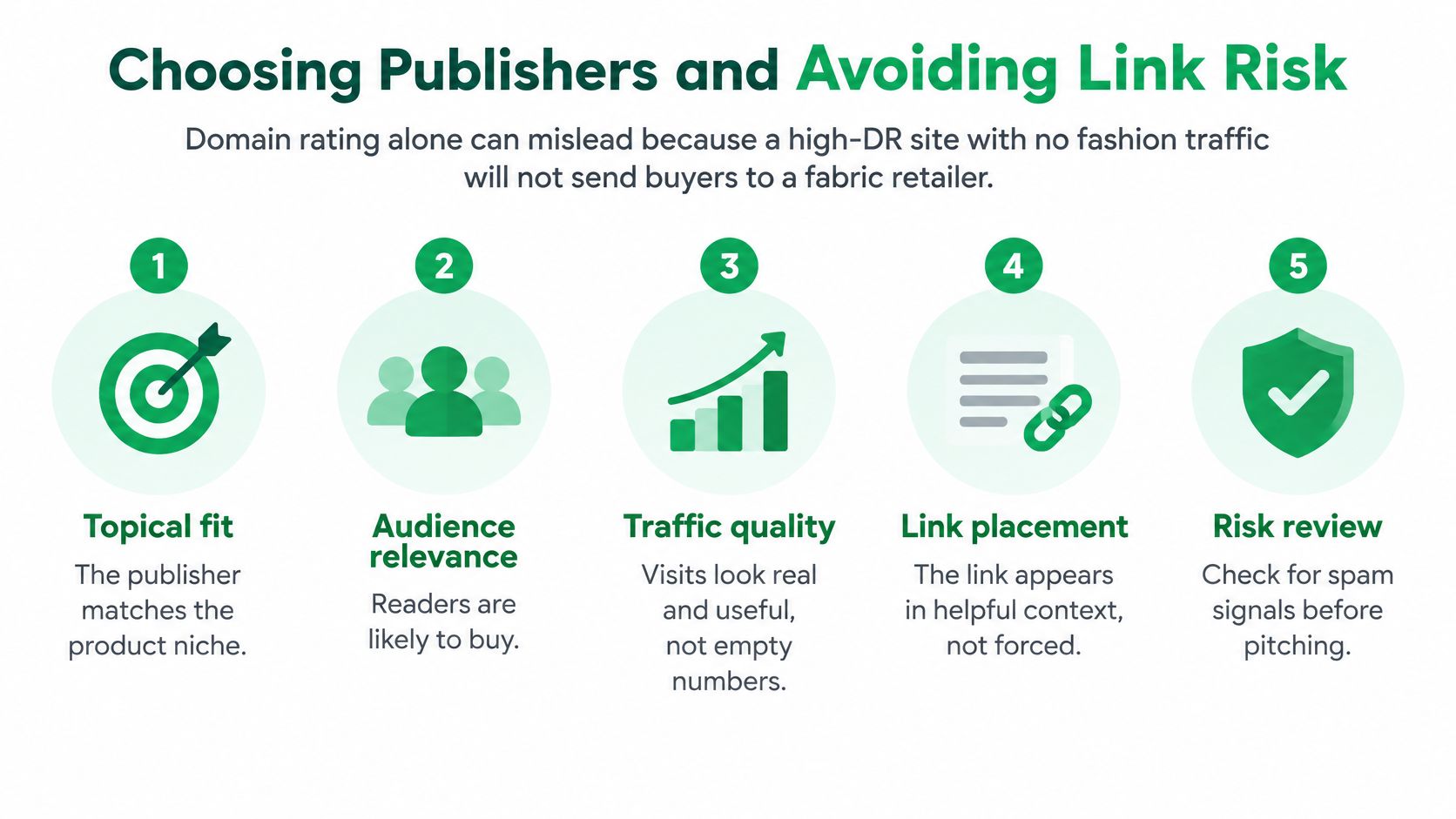
Five checks before you pitch a publisher
- Topical fit with the category. Not the industry, the category. A home decor site fits a furniture brand. A general lifestyle site with one home post doesn't.
- Organic traffic that looks real. Open Ahrefs and read the keyword count, not just the visit total. Traffic spread across hundreds of queries suggests a real publication. Traffic concentrated in a handful of unrelated queries usually means a site built to sell placements.
- Keyword rankings that match your buyers. If the site ranks for nothing your customer would search, its link does little beyond decorating your profile.
- Referring domains. A profile that grew steadily over years reads differently from one that jumped a thousand domains last quarter.
- Recent publishing activity. A site last updated in 2022 is a dead site with a domain score. Skip it.
Tools do the first pass. We use Ahrefs, Semrush and our own research to find publishers that match a client's niche and audience, then read the site manually before anyone gets pitched. Open three recent posts, read the openings and check where the outbound links go. A publication whose writers link out to relevant, credible sources is usually a fair place to appear.
The pitch is a separate skill from the screening, and this walkthrough of guest blogging outreach covers how to write one an editor will answer.
What the penalty history teaches about screening
Google's record here is well documented. On April 24, 2012, Google launched the Penguin algorithm update to target link spam, and Google's initial estimate, reported by Search Engine Journal and recorded in this timeline of Google algorithm updates, was that the update affected more than 3% of search results. Penguin 2.0 in May 2013 affected approximately 2.3% of queries. In September 2016, Penguin became part of the core algorithm and shifted toward real-time devaluation of spam links rather than broad sitewide demotions.
That last shift matters for how you budget. A single weak placement no longer drags a whole domain down, but a pattern of them makes every future link you earn work less hard, and cleaning up is slower than screening was.
Meanwhile the incentive to buy has not gone away. A 2024 survey of 113 SEO experts, reported by OpenCart's ecommerce link building guide, found that 92% believed competitors were buying links, while 58.4% rated links' impact on rankings as high. When most of your market assumes the competition is paying, screening quality becomes your only real edge.
Red flags in a placement you've already agreed to
- Anchor text that reads like a shopping query. A sudden run of exact-match commercial anchors on one URL is the clearest footprint of a paid campaign.
- Paid placement with no disclosure. Undisclosed paid links break Google's spam policies and put the risk on you.
- The same guest post across several sites. Editors don't publish the same article five times. Sellers do.
- Sitewide footer or sidebar links. A "partner" link on every page of another domain rarely looks editorial, because it isn't.
- Sites with no audience. If no human reads the page, no buyer clicks the link.
We don't work with dead sites, private blog networks or domains with no audience. We work with publishers that rank for keywords and earn traffic from Google, because that traffic is the whole point of the placement.
"Real sites with traffic beat DR games. Every time."
Judge each link by the publisher's audience and the page it lifts. A handful of placements on sites your customers read will outperform fifty on high-scoring domains that nobody visits.
Pitching Category Pages Without Sounding Like Ads
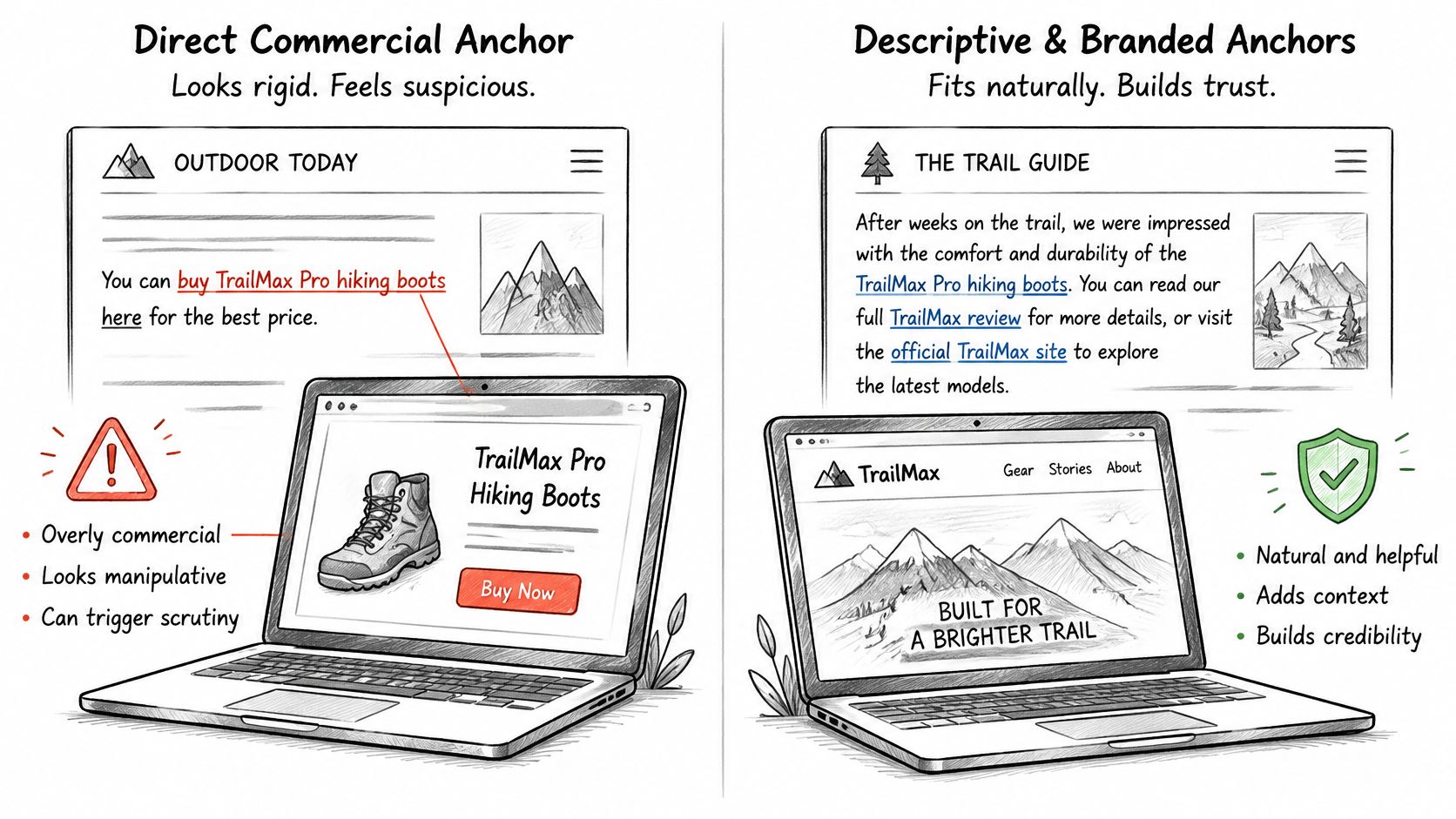
The anchor does most of the damage before the editor reads a word. A link that says "buy lightweight tents online" tells the editor you are buying placement. A link that says "lightweight two-person tents" inside a useful guide reads as a reference.
Take a camping gear store chasing coverage for its lightweight tents category. The weak pitch drops a commercial anchor into a generic guest post. The stronger one earns a citation inside a guide to choosing a backpacking tent, with a sentence noting that the category page lists weights and packed sizes side by side. Same destination, different reception.
Category and product pages are the hardest pages to earn links to, and the market knows it. In the 2025 link building survey from Citation Labs, which polled more than 300 SEO professionals, teams reported earning links to blog pages 68% of the time but to product pages only 41% of the time. That gap leaks revenue. Authority pointed only at blogs can lift a domain while the pages that take payment get nothing.
The sequence that earns those placements:
- Find pages already covering the topic. Search the category question, not the product name, and list the pages ranking on the first two screens.
- Read the editor's last five pieces. Their angle, their audience and what they have already linked to tell you whether your resource fits.
- Offer something with independent value. A comparison methodology, a tested dataset, original photography with usage rights, or an accessibility resource. A discount code gives the editor nothing to publish.
- Write the pitch for their readers. One line on what the resource does for the audience, one line on where it lives, one link so they can check it.
Shoppers increasingly start broad. Category and comparison pages carry much of that discovery load, which is why a link to a well-structured category page can move more revenue than a link to any single product.
A placement earned on merit also holds up better under review than a paid insertion, and it points authority at the page that converts. That is the difference between a link that lifts a revenue page and one that only inflates a count.
Editors come first. Send a contribution worth publishing, not a link drop with an invoice attached.
We adapt the process to each market, studying the competitors and the publishers already covering the category before a single pitch goes out. The resource that wins links for a tent retailer looks nothing like the one that wins them for a skincare brand.
Measuring Links by the Revenue They Lift
A link is only as good as the page it lands on, and plenty of ecommerce landing pages are technically unfit to receive one. Google recommends Product structured data on ecommerce pages and says it can increase eligibility for product-rich results covering price, availability, shipping and reviews, and it recommends pairing page markup with a Merchant Center feed to maximize eligibility, as set out in its ecommerce structured data guidance.
Before outreach starts, run a QA pass. Validate representative product and category URLs in the Rich Results Test, check rendered HTML and indexability, and confirm the link will land on a canonical URL rather than a redirect, an out-of-stock variant or a faceted duplicate. Fix those pages first, because authority pointed at a broken landing page is money burned.
| Metric | What it tells you | Where to check | Healthy sign |
|---|---|---|---|
| Referring domains to target page | Breadth of new authority | Ahrefs or Semrush | Steady growth from relevant sites |
| Indexation of target URL | Page is crawlable and canonical | Google Search Console URL Inspection | Indexed, canonical matches the linked URL |
| Rich result eligibility | Product markup is valid | Google Rich Results Test | No errors on sampled product URLs |
| Referral sessions to landing page | Qualified visits from publishers | Web analytics | Visits from the placement, with conversion rate in line with the site |
| Assisted conversions from linked pages | Revenue contribution | Analytics attribution report | Assisted orders rising month over month on linked pages |
| Ranking for target category keyword | Search visibility | Rank tracker | Upward trend across several months |
| Live link status | Placement still active | Monthly crawl of placement URLs | Link live at the agreed URL |
Read the rows together, not one at a time. Referring domains climbing while indexation breaks is a site problem, not a link problem. Referral sessions arriving with a conversion rate far below the site average usually means the publisher's audience isn't your buyer after all.
Tag every placement URL with UTM parameters and read landing-page revenue in GA4, so referral sessions tie back to orders rather than sitting in a traffic report. Structured data doesn't guarantee rankings or rich results, but it improves how Google reads the page your external authority reaches. Review the whole table monthly against revenue, and the conversation stops being about links and starts being about which pages are earning.
Confirm Your Next Link Campaign Step
Link campaigns fail from vagueness more than from bad publishers. The fix is a short written sequence everyone signs off on before outreach begins.
- Audit what you have. Pull your link profile, flag dead URLs with backlinks, and name the three revenue pages that would gain most from authority.
- Choose one asset per page from the mapping table, with a deadline and an owner.
- Shortlist ten publishers that pass the audience checks and match the category, not just the industry.
- Write a pilot brief covering target URLs, anchor types, publisher criteria and a 90-day window.
- Agree the measurement rows first. Referring domains, indexation, referral sessions, assisted conversions and live link status, reviewed monthly against revenue.
Budget is the easy part to get wrong. A 2024 survey of more than 800 SEO experts reported by uSERP found that nearly half of marketers spent between $5,000 and $10,000 per month on link building. That's a range, not a target. Your spend should follow what the pilot's rows show, which is why a single category beats a sitewide push for a first test.
Two things should be settled in writing before anyone starts. Scope and pricing get agreed upfront, and no provider can guarantee specific rankings, traffic or revenue outcomes. Anyone offering a guaranteed position is either guessing or buying low-quality links on your behalf. For context on what measurement looks like over a full campaign window, one ecommerce client we report on saw +148% revenue from SEO between March and December 2025, which is a trailing result over ten months, not a promise about your first quarter.
Run the pilot on one category. Expand only if the measured rows move.
Linkbuilding.services runs managed link campaigns for ecommerce stores, covering publisher research, outreach, content, placement verification and live reporting on every URL placed, with scope and pricing agreed before work starts. If the goal is category and product pages that earn orders rather than a dashboard full of new domains, Linkbuilding.services will map a pilot around your three most valuable revenue pages, from the asset each one needs to the publishers worth pitching. Bring the pages, and the plan starts there.