How to Find Competitors' Backlinks: A Step-by-Step Guide
Learn how to find competitors' backlinks with two index exports, page-level grouping, and a scoring method that filters out dead and spammy links.
Most advice on how to find competitors' backlinks tells you to export the biggest list you can and work through it. That's backwards. A huge export mostly gives you dead pages, duplicates, and links you'd never want to copy. It's no surprise that in 2025, 66% of link builders said they struggled to identify effective backlink tactics, according to Citation Labs and BuzzStream's survey of more than 300 SEO professionals. Start smaller, check what's still alive, and chase patterns you can repeat.
What a Competitor Backlink Count Really Tells You
A competitor's backlink total is a dated snapshot from one index on one day. Treat it as a starting sample, then account for the gaps before you let it shape outreach.
The three gaps in every total
- Dead links: A large share of historical links no longer resolve, so an old profile can badly overstate current link equity.
- Undiscovered links: No crawler sees the whole web. A link missing from your export may still exist and still count.
- Index disagreement: Two tools crawl at different times and depths, so they'll report different profiles for the same site.
Say a competitor shows 4,000 backlinks in one tool. Deduplicate that file and you might land near 300 referring domains. Check which sources still resolve, and only a few dozen may be live, indexed pages citing the same guide. That smaller set is the story. The other rows are history, templates, and noise.
The useful question is which patterns are still earnable: a resource page that keeps updating, a niche directory with real traffic, a comparison post that cites several vendors. A dead guest post or an old forum signature can inflate the count without giving you a repeatable move.
Record a discovery date for every link you keep, and split live links from historically reported ones in separate columns. Don't mix them and then argue about totals a month later.
Practical rule: A link counts for your research when it's live, indexed, contextually relevant, and repeatable. Anything else is background.
That standard will shrink your list fast. Good. Fewer rows mean more attention for pages that still rank, still send equity, and still leave room for you to earn a similar citation.
How to Export and Reconcile Competitor Backlinks
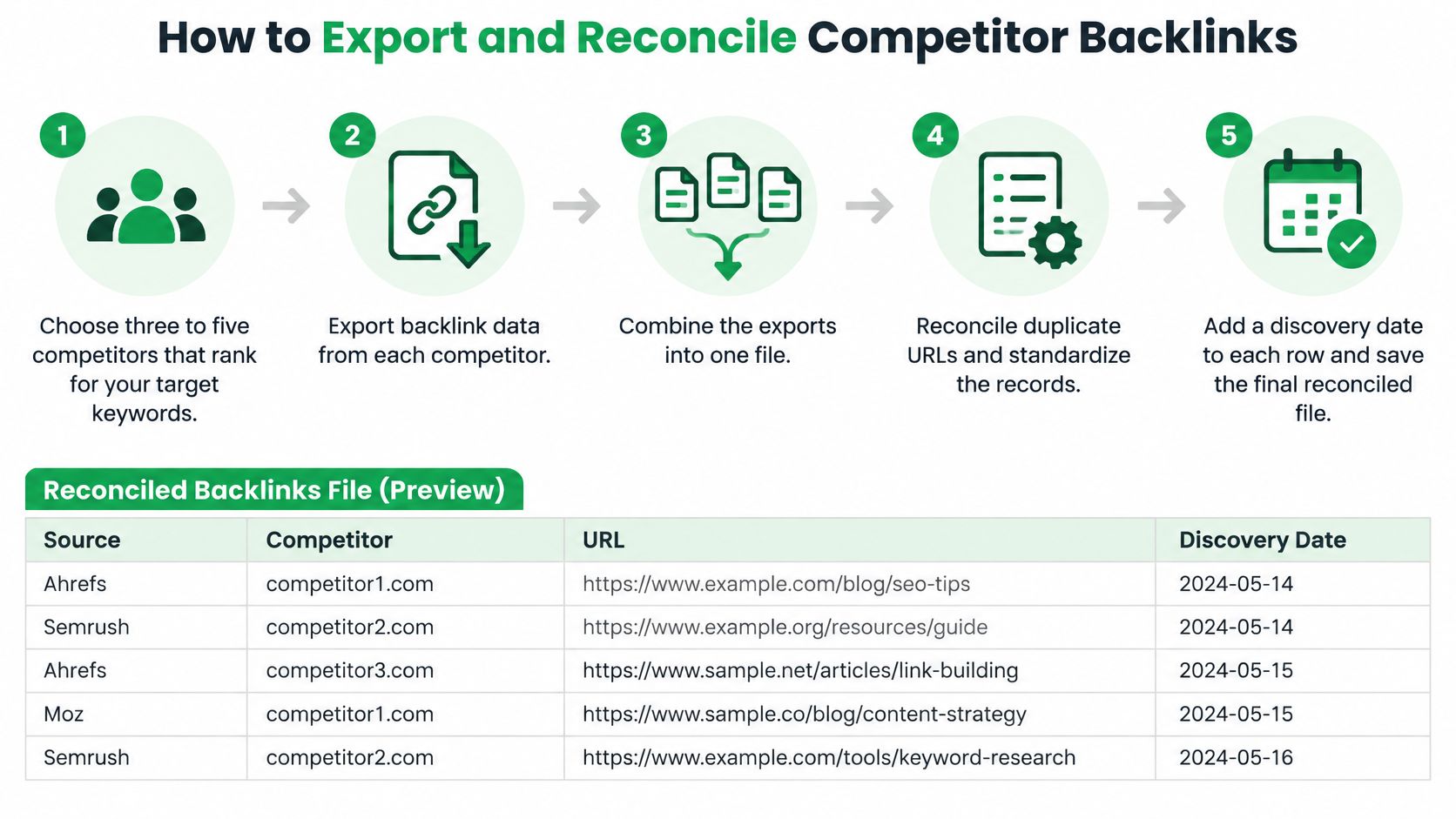
Your deliverable here is one reconciled file, not five tool exports in a folder. Every row needs a source URL, a target URL, and the date you found it.
The two pass workflow
- Pick three to five competitors who rank for terms you want, not just the biggest brands in the niche. A giant's profile will bury you in links you can't replicate.
- Export from your first index. Pull referring domains, backlink URLs, target pages, anchor text, link attributes, first seen and lost dates, and estimated organic traffic.
- Repeat on a second index. Coverage differs materially. In a 10,000 domain comparison covered by Semrush's backlink database study, Semrush reported at least one referring domain for 99.5% of analyzed URLs and found the highest backlink count for 39% of domains. One tool will miss links another catches.
- Normalize and reconcile. Lowercase the domains, strip tracking parameters, and build a canonical key from source URL plus target URL plus anchor. Use it to merge the files and drop duplicates.
- Verify the shortlist by hand. For high-value prospects, check HTTP status, indexability, canonical tags, robots directives, where the link sits on the page, and whether it's still live.
Treat the merged file as a discovery set, not confirmed truth. A row in two indexes is a lead. It becomes evidence only after you've opened the page.
Backlink data sources and what each one covers
| Source | What you export | Limit to remember |
|---|---|---|
| Ahrefs | Referring domains, backlink URLs, anchors, first-seen and lost dates | Coverage differs from other indexes, so reconcile before you trust it |
| Semrush | Referring domains, backlink URLs, anchors, authority and traffic estimates | Coverage differs from other indexes, so cross-check the same competitor |
| Google Search Console Links report | Top linked pages and top linking sites for your own verified site | Cannot inspect competitors, so use it as your baseline only |
I would not start analysis until the file is clean enough to sort without embarrassment. For most mid size niches, that means a few thousand raw rows collapsing into a few hundred unique source and target pairs. If your reconciled file still holds tens of thousands of rows, you haven't deduplicated, you've just stacked exports.
A smaller file you trust beats a bigger file you're afraid to open.
Group Links by Page and Referring Domain
One strong asset often explains most of a competitor's profile. A single research report or free tool can pull in citations for years while the rest of the site collects almost nothing. If you only read the domain level total, you'll miss that completely.
Sort your reconciled file by target URL and count unique linking pages per page. Then group those targets by type, such as product pages, comparison pages, research reports, and guides. This mirrors how Google's Links report documentation separates "Top linked pages", "Top linking sites", and "Top linking text" for a verified site. You're applying the same categories to competitors through a third party index.
What to record for each cluster
- Linking pages and referring domains: Both numbers, always. Fifty links from five domains is a different pattern from fifty links from fifty domains.
- Page type: Guide, report, product, or comparison page.
- The reason behind it: One line on the content or publicity event that attracted the cluster.
Broad coverage across many independent sites usually signals ongoing PR, partnerships, or content that keeps getting cited. A tight cluster around one asset signals a single launch or dataset. The outreach play differs, so don't blend them.
Inflated backlink counts and how to correct them
| Inflation source | How it shows up | Correction |
|---|---|---|
| Sitewide navigation or footer links | Thousands of rows from one domain | Count referring domains, not link rows |
| Syndicated copies | The same article appears on several hosts | Keep the original URL and drop the copies |
| Redirects | Two URLs for one page in the export | Map each source to its final canonical target |
| Repeated links from one domain | Many links from one sidebar, forum or profile | Keep one unique linking page per domain |
| Dead or non-indexable sources | 404, noindex or blocked pages | Remove after HTTP and indexability checks |
Apply one rule throughout. Count unique linking pages per referring domain, never raw link rows. That's the number you can compare fairly against your own pages in the same categories.
Classify Each Link Before You Chase It
Finding a link doesn't make it worth copying. Some competitor links are earned citations. Others are paid placements, thin directory entries, or forum drops that contribute little and can't be defended if anyone asks how you got yours.
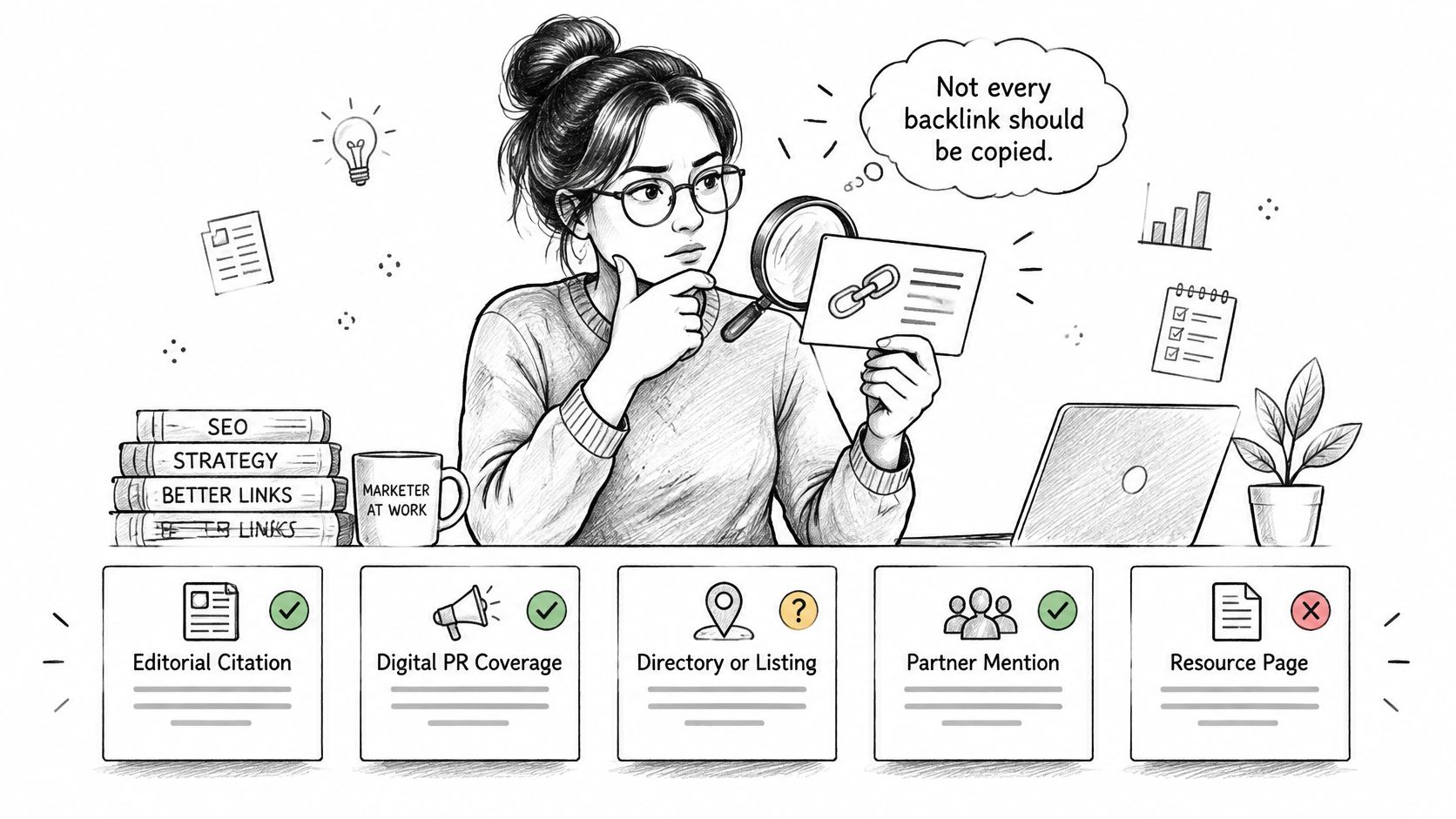
Google drew this line clearly with its July 26, 2021 link spam update. As Google's announcement of the link tagging and link spam update explains, the update rolled out over approximately two weeks, improved identification and neutralization of link spam across multiple languages, and highlighted affiliate links and paid or sponsored placements, which require rel="sponsored".
Link types, how to recognize them and whether to replicate
| Link type | How to recognize it | Attribute to expect | Replicable? |
|---|---|---|---|
| Editorial citation | Writer links to a resource inside a body paragraph | Followed link | Yes, with a stronger asset |
| Digital PR coverage | News or trade story citing a data point or launch | Usually followed | Relationship-dependent |
| Directory or listing | Business or tool listing on an index page | Followed or nofollow, often inconsistent | Rarely worth the effort |
| Sponsored or affiliate placement | Labelled sponsored, or a product page with an affiliate link | rel="sponsored" | Only with disclosed, honest paid terms |
| User-generated content | Forum post, comment or profile link | rel="ugc" or rel="nofollow" | Rarely worth pursuing |
Add qualitative fields to your export for apparent editorial context, and check attributes on every candidate. Our explainer on follow and nofollow links covers how those attributes change what a link can pass. Then label each opportunity replicable, relationship dependent, or non replicable.
We apply the same screen in our own work. Linkbuilding.services avoids dead sites, PBNs, and domains with no audience, focusing instead on publishers that rank for keywords and earn traffic from Google.
A competitor only link isn't automatically attainable. It may rest on proprietary data, a partnership, or journalism you can't reproduce.
The question isn't which links a competitor has. It's which patterns look durable, editorially defensible, and relevant enough to pursue.
Score and Prioritize Competitor Link Prospects
Start with pages that attract links from at least three relevant competitors. Group them by intent and format, then open the linking pages and write down why each one cited the resource. Was it a statistic, a definition, a tool, or a quotable claim? That reason becomes your angle later.
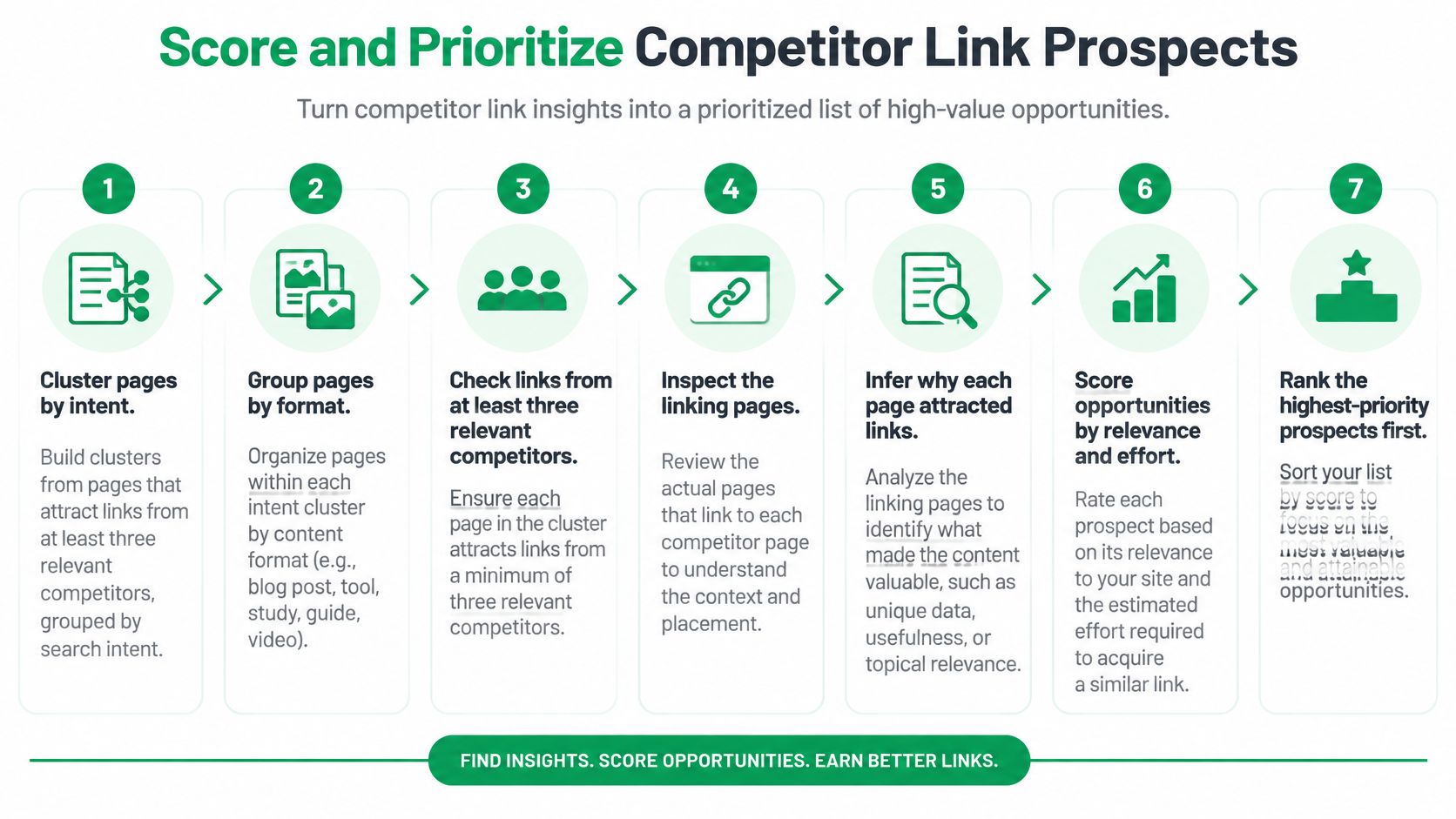
Score each candidate domain from 0 to 2 on six criteria, for a total out of 12. It takes one sitting for a shortlist, and it stops authority metrics from doing all the thinking. Our guide to what a good domain rating means explains why that number alone shouldn't qualify a prospect.
Scoring criteria for competitor link prospects
| Criterion | Scores 2 when |
|---|---|
| Topical fit | Source page covers the same subject as your target page |
| Relevant organic traffic | Source page or site earns search visits on its topic |
| Editorial context | Link sits in body copy, not a sitewide footer |
| Editorial quality | Publisher shows clear editorial standards and named authors |
| Competitor exclusivity | Domain links to one or two competitors, not all of them |
| Contactability | A real editor or author can be reached |
A domain with a high authority score but no visible audience or rankings should score low. Conversely, a modest trade publication with real readers and a named editor often deserves a 9 or 10. Exclusivity matters too. A site linking to every competitor may be a directory in disguise, while one linking to a single rival may reflect a genuine editorial choice.
Validate before you scale
Manually inspect every high priority domain and a random sample of lower priority ones. Confirm each source is accessible, relevant, and indexable, and check it isn't part of a private network. As Google's spam policies state, buying or selling links for ranking purposes and excessive link exchanges count as link spam, so don't copy those patterns just because a competitor uses them.
Label each scored opportunity replicable, relationship dependent, or non replicable before anyone writes a pitch. Then measure what matters. Qualified referring domains and earned placements are your success measures, not raw prospect counts or wobbles in an authority score.
Build Your Outreach Shortlist This Week
Take your top 15 to 20 scored prospects and confirm each linking page is still live, indexed, and followed. That check takes an afternoon and will kill a few names you're glad you didn't pitch.
Your first batch in five moves
- Group prospects by content cluster. One strong angle can serve several editors who cited the same type of resource.
- Write one specific reason per cluster. An updated dataset, a clearer worked example, or a missing comparison beats a generic request every time, and a structured approach to guest blogging outreach keeps those pitches consistent.
- Check your labels. Send replicable prospects first. Park relationship dependent ones until you have something worth a journalist's time.
- Log the discovery date. Keep it attached to each prospect so your review compares like with like.
- Set a 90 day review. Measure qualified referring domains and earned placements, then decide which clusters deserve a second round.
Whether you run this in house or hand it over, the checks don't change. We use Ahrefs, Semrush, and our own research to find publishers that match a client's niche and audience, and our first step is researching the client's niche, analyzing market, competitors, and current assets to map opportunities, delivering an opportunity map with link requirements and risk checks. That discipline is the point, whoever does the work.
Be honest about outcomes too. Linkbuilding.services does not guarantee specific rankings, traffic amounts, or revenue outcomes, and you shouldn't promise them internally either. You can guarantee a clean shortlist, verified live pages, and pitches an editor can say yes to. That's a solid week's work.
If you'd rather skip the exports, reconciliation, and manual checks, Linkbuilding.services will research your competitors, score the prospects worth chasing, and handle outreach and placement verification for you. You'll see domains before anything goes live and get reporting you can inspect. Visit Linkbuilding.services to talk through your niche and target pages.