How Do I Get Backlinks Worth Keeping in 2026
How do I get backlinks that stay live? Build a citable asset, pitch relevant publishers, and verify each placement instead of chasing raw link counts.
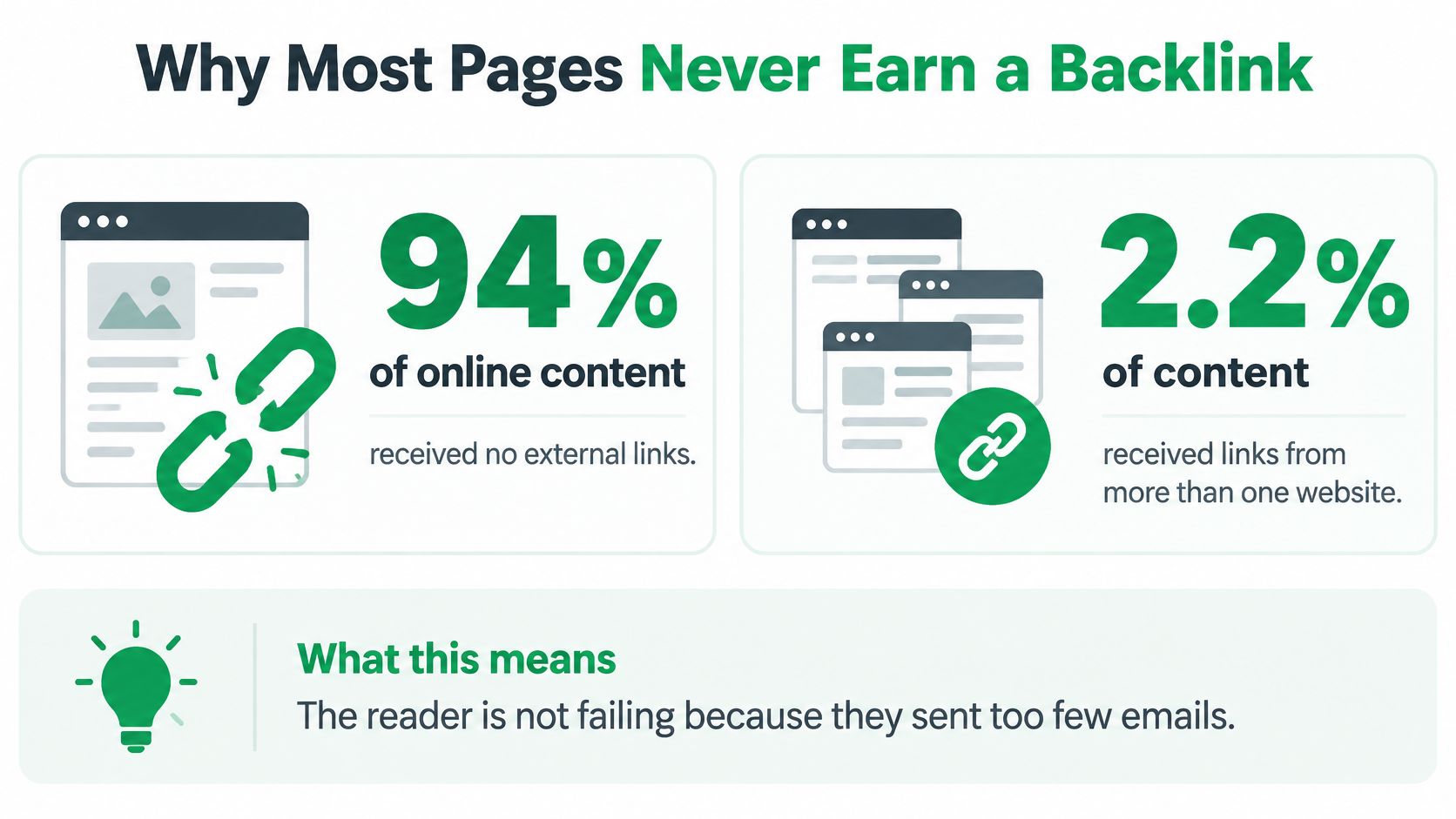
In 2024, 94% of online content received no external links, while only 2.2% received links from multiple websites, according to SEO.ai's compilation of backlink research. If you're asking, “How do I get backlinks?”, start with a different question: what could a publisher cite on your site that would make their own page more useful?
You don't need a bigger spreadsheet of websites willing to insert links. You need a repeatable way to earn relevant citations, confirm they stay live, and judge whether they bring the right people closer to your business.
Why Most Pages Never Earn a Backlink
A backlink is a clickable reference from another website to yours. A useful backlink gives readers a relevant next step. A vanity backlink adds to a report without giving anyone a good reason to click.
Say you run an ecommerce business selling commercial kitchen equipment. Your product page describes a mixer's capacity, attachments, and warranty. Those details help buyers, but a bakery publisher probably won't cite the page while explaining how to plan production.
A practical capacity-planning worksheet is different. If it helps bakers match batch sizes to equipment, an editor can reference it naturally within an article about kitchen workflows. The citation serves the publisher's reader, not just your SEO target.
The distribution below puts that challenge into perspective.
A useful reference has a clear job
Look at the linking page, not just the website's headline metrics. Does the publisher cover the same subject for an identifiable audience? Does the surrounding paragraph explain why readers might want your resource?
The anchor text, meaning the clickable words, should describe the destination. “Bakery production planning worksheet” tells readers what they'll find. A repeated commercial phrase inserted into an unrelated sentence doesn't.
Reader test: If the publisher removed every SEO consideration, would the reference still help someone reading that paragraph?
Internal links connect pages within your own site. They help visitors reach supporting material, but they aren't outside citations. Linking to your worksheet from your own buying guide doesn't mean an independent publisher has found it useful.
Activity isn't the same as progress
A campaign can look busy while producing nothing worth keeping. Watch for these distractions:
- An empty directory listing: The website accepts submissions, but you can't identify an audience that would use it.
- A pointless reciprocal swap: Both businesses add references that neither set of readers needs.
- A purchased ranking link: The only argument for the placement is that it passes ranking credit.
Competitor analysis can reveal publishers and page formats worth investigating. Use a guide to finding competitors' backlinks to understand why those references exist, rather than treating every competing link as something you must copy.
Choose a method that matches what you can contribute before writing a pitch. A useful worksheet, a defensible finding, and an expert explanation each give you a different reason to contact an editor.
Backlink Methods Worth the Effort
Original opportunities are a better starting point than imitation. In 2025, 66.6% of SEO professionals surveyed by Spiralytics said pursuing unique, original link opportunities provides more benefit than copying competitors' link profiles, according to Spiralytics' link-building statistics.
That doesn't mean inventing an elaborate campaign. It means identifying something your business can contribute that isn't already available from the sources a publisher cites.
Backlink methods compared by fit, effort, and proof
| Method | Best fit | Effort | Main failure | Proof it worked |
|---|---|---|---|---|
| Original research or data study | Pages that need outside citations | High, one asset and many pitches | Thin data nobody cites | Links from journalists or roundups |
| Expert commentary and digital PR | Launches or a real news hook | Medium and time-sensitive | Spray pitches with no story | Coverage plus referral sessions |
| Guest contribution | Niches with active publishers | Medium, one article per placement | Commercial anchors or paid dofollow | Editor-approved piece with a natural link |
| Resource or broken-link inclusion | Pages that already list tools or guides | Low to medium | Irrelevant roundup pages | Link on a page that ranks for the topic |
| Unlinked mention outreach | Brand already discussed without a link | Low | Sites with no organic audience | Mention becomes a relevant link |
| Original competitor gap | You can add what their sources lack | Medium research | Cloning their profile link for link | New referring domains they don't have |
Match the method to your available evidence
Original research fits a business with information it can publish responsibly. That might be anonymized product usage, a transparent survey, or a carefully documented comparison. Publish the methodology alongside the finding so an editor can judge what it supports.
Expert commentary fits a specialist who can explain a development, not merely react to it. A software security lead explaining the operational consequences of a new vulnerability has a clearer contribution than a generic company announcement.
Guest contributions require another kind of commitment: an article worth publishing on its own. Use a structured guest blogging outreach process to pitch an audience-specific idea, establish your qualifications, and understand the editor's requirements before drafting.
Resource inclusion and broken-link replacement suit practical assets. The replacement must answer the same reader need as the missing resource. A sales landing page isn't a useful substitute for a discontinued technical tutorial.
Unlinked mention outreach starts with existing recognition. Ask for a clickable reference when it would help readers find the product, research, or organization already discussed. Don't turn a simple attribution request into a demand for promotional wording.
Choose a contribution you can sustain
A competitor gap is useful when you can improve the available evidence. Perhaps competing guides describe a process but omit a usable checklist. Pitch the checklist because it solves that omission, not because the publisher links to a rival.
Choose the method your team can execute well, not the one with the most impressive name.
Keep bulk exchanges, forum signatures, and indiscriminate directory submissions off the working menu. They distract from the editorial question: why should this particular page reference yours?
For a hypothetical 90-day campaign, select a primary method and a target page. Keep secondary opportunities in a backlog so your team can improve the asset and pitch instead of changing tactics whenever an inbox stays quiet.
Run the Campaign From Asset to Verified Link
A campaign needs a clear destination, a specific contribution, and evidence that the promised placement exists. Start with the asset, not with an email quota.
The sequence is straightforward, but each handoff needs an owner.
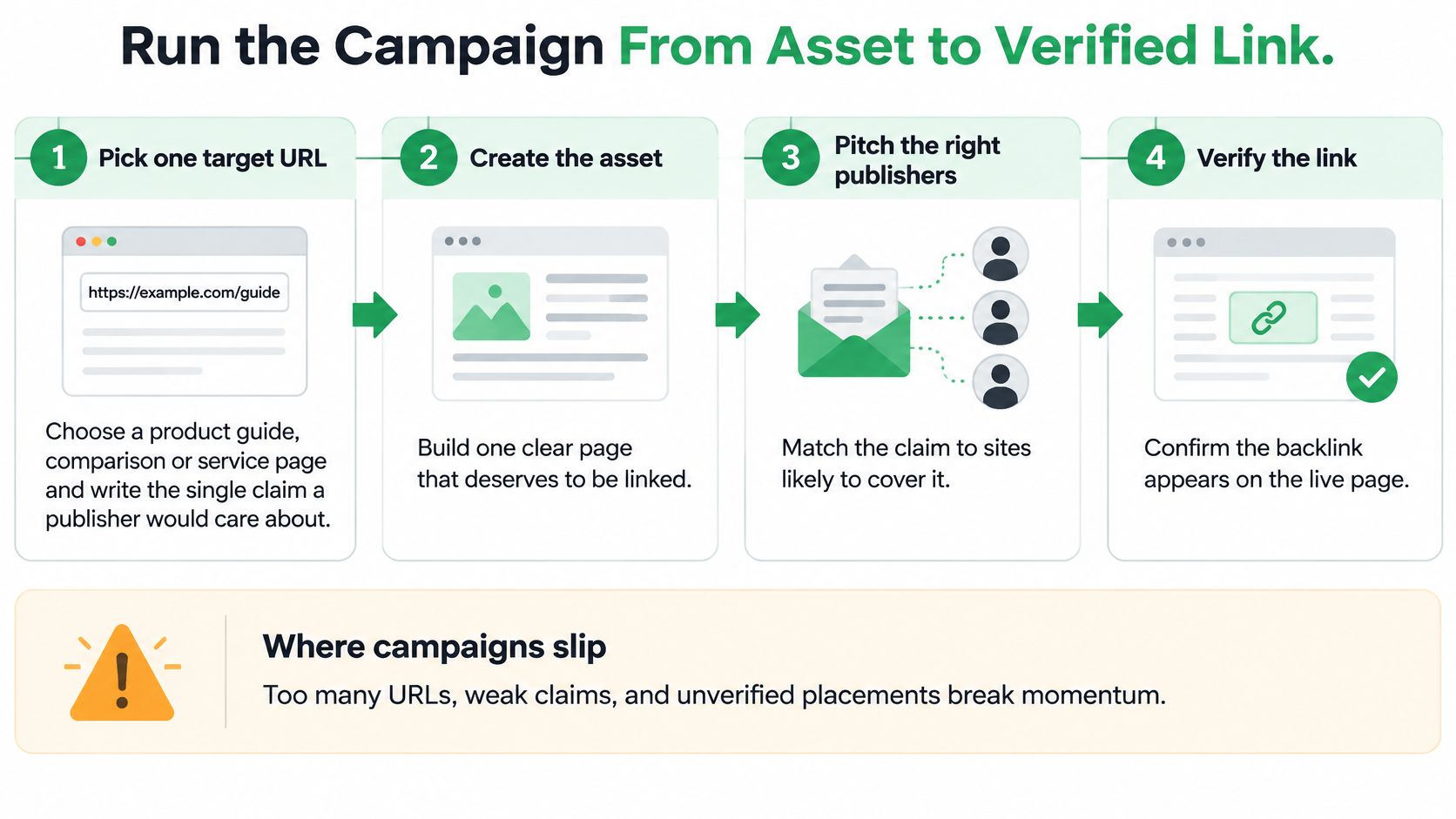
Build something an editor can use
Pick a target URL and a citation-worthy claim.
Choose a product guide, comparison, service resource, or research page. Then finish this sentence: a publisher would reference this page because it helps their readers understand or do something specific.
Say a B2B software team wants visibility for its pricing guide. “Our software is affordable” isn't a useful citation. A documented explanation of how billing units affect total cost gives an editor something concrete to reference.
Don't force every opportunity onto a commercial page. If the useful evidence belongs in a separate resource, publish it there and give readers an appropriate route to the relevant product information.
Strengthen the asset and check accessibility.
Add the material that makes the page worth citing: original evidence, an actionable checklist, attributed expert explanations, or a thorough answer to a difficult question. Make sources, limitations, authorship, and update information easy to find.
Discovery matters too. Google's SEO Starter Guide says its crawlers primarily find new pages through links from pages already crawled, describing links as the route through which the “vast majority” of new pages are discovered.
Before outreach, confirm the destination loads, doesn't require a login, and is reachable from other findable pages on your site. Use crawlable HTML links with an anchor element and an href attribute. An editor shouldn't need to troubleshoot your resource before evaluating it.
Build a qualified prospect list.
Search for resource pages, comparison articles, industry roundups, and journalists who cover the specific problem your asset addresses. Queries combining your topic with terms such as “resources,” “recommended tools,” or “comparison” can reveal appropriate pages.
Open each candidate rather than qualifying it from a tool export. Read its relevant paragraph, check the author or editor, and inspect what the website normally publishes.
Use Ahrefs or Semrush to examine keyword rankings and estimated organic traffic. Treat those estimates as screening aids, not proof of readership. A tightly focused publication can be useful even when its total traffic is modest.
Make the pitch about their paragraph
Explain the exact editorial improvement.
Name the recipient's article in the subject line. In the message, identify the relevant passage, explain the missing information, describe what your asset adds, and make a single clear request.
For the software pricing example, the pitch could say:
Your comparison explains subscription prices, but the billing-unit section doesn't distinguish seats from active users. Our pricing guide documents those definitions and explains how they change the calculation. Would it be useful as a reference in that section?
Add the asset link when sending the message. Avoid attaching an unsolicited article or asking the editor to choose among unrelated resources.
Personalize to the paragraph, not just the first name. Someone reading the email should immediately understand why you contacted them. Segment resource-page editors separately from journalists because they're evaluating different kinds of contributions.
Follow up briefly, then stop.
A follow-up should make the decision easier. You might clarify where the resource fits or offer a methodology explanation. Don't resend the entire pitch with more urgency.
Stop when the recipient declines or when your short sequence ends without engagement. Repeatedly contacting the same editor doesn't improve the asset's relevance.
The following video offers another way to review the practical workflow.
Separate agreement from delivery
Confirm the placement terms and save the live URL.
An editor's agreement is an intermediate status, not a completed backlink. Confirm the destination and whether the placement is editorial, sponsored, or qualified with nofollow.
Leave wording under editorial control rather than insisting on a commercial phrase. When the page goes live, save its URL and open it yourself. Check that the reference appears in the intended context and leads to the right destination.
If the publisher requests compensation during the conversation, pause the editorial workflow and resolve the advertising classification before proceeding.
Record the funnel and review retention.
Keep delivered messages, replies, positive replies, live placements, and referring domains in separate fields. A referring domain is a website linking to you, while an individual placement is a particular linking page.
Record the target page, contact, publication URL, anchor, attribute, and verification date. Assign an owner to revisit placements rather than assuming a published link will remain unchanged.
In a hypothetical campaign, a software team might pitch ten relevant roundups and earn three citations. That's a scenario, not a forecast. Its purpose is to show how a small, well-matched list can be evaluated by actual editorial outcomes rather than mailing volume.
Diagnose weak results before increasing volume
In Backlinko's analysis of 12 million outreach emails, only 8.5% received a response. That's a response benchmark, not a placement rate, and it includes replies that won't become links.
If delivered messages generate little engagement, inspect the prospect list and the opening explanation before sending more. Check whether you contacted the right person, whether the destination fills the stated gap, and whether your message reads like a reusable insertion request.
If editors respond positively but nothing gets published, investigate the handoff. They may need evidence, an editorial review, or a clearer explanation of the proposed inclusion. A polite reply isn't a placement, and increasing email volume won't fix an unresolved publishing step.
Pause a weak segment after enough comparable attempts to judge it meaningfully. Change the audience, asset, or value proposition deliberately rather than rewriting everything at once.
Link Spam Traps and Safer Alternatives
A publisher replies with a price for a guaranteed followed link. That isn't automatically a better opportunity because the conversation has moved forward. You're now deciding whether to buy advertising or participate in a ranking-manipulation arrangement.
Google's spam policies define link spam as creating links primarily to manipulate rankings. They identify paid ranking links, compensated exchanges, excessive reciprocal linking, and automated link generation as prohibited patterns, while allowing compensated links properly qualified with rel="nofollow" or rel="sponsored". Violations can cause sites to rank lower or disappear from results.
Link offers and the safer response
| Situation | Policy treatment | Safer response |
|---|---|---|
| Payment for a link that passes ranking credit | Buying links to manipulate rankings is link spam | Decline, or run it as an ad with nofollow or sponsored |
| Product or service traded for a link | Listed as link spam | Qualify and disclose, or skip the swap |
| Large reciprocal exchange pattern | Excessive reciprocal linking is link spam | Stop the pattern; one relevant mention is not a program |
| Automated link service | Automated link generation is link spam | Use manual outreach to real publishers only |
| Guest post with repeated commercial anchors | Optimized links can be treated as spam | Use a natural descriptive anchor and remove the manipulative intent |
| Old paid links already live | Removing credit may not restore lost benefit | Log and remediate them; don't rebuild the same pattern |
| Disclosed sponsorship | Allowed with nofollow or sponsored | Mark it as advertising in the tracker |
Qualification changes the transaction
A sponsorship can be worthwhile because it reaches prospective customers. Evaluate it as advertising, with an audience, message, and measurable objective. Don't justify the expense by assuming it will transfer ranking credit.
Understand follow and nofollow links before approving terms. An attribute is a classification you should inspect, not a reason to dismiss a placement that could bring qualified visitors.
Procurement rule: If payment is required, settle disclosure, link qualification, and reporting status before publication.
Guest contributions also need editorial independence. Replacing repeated commercial anchors with descriptive wording helps readers, but it doesn't make a ranking-driven arrangement acceptable by itself.
For older paid placements, document the URL, original arrangement, and remediation. Google's link-spam guidance warns that removing the effects of manipulative links can mean previously received ranking benefits won't return just because the links are changed.
Check the publisher behind the offer
At Linkbuilding.services, we use white-hat methods only. We avoid dead sites, PBNs, and domains with no audience, focusing instead on publishers that rank for keywords and earn traffic from Google.
Our team's stated position is: “Real sites with traffic beat DR games. Every time.”
Apply that standard through a human review. Look for coherent coverage, substantive articles, and an editor who evaluates the contribution before discussing insertion. A domain-rating number can help organize a shortlist, but it can't establish whether a publisher would run the piece without the backlink.
Measure Placements Before the Next Campaign
A followed backlink count doesn't capture every useful outcome. A 2025 analysis of 75,000 AI Overview-related results reported a stronger correlation between web mentions and brand visibility, 0.664, than between backlinks and visibility, 0.218, according to Ahrefs' brand visibility analysis.
That doesn't prove mentions cause visibility. It does challenge a reporting model that treats an unlinked reference as worthless and every followed link as a success.
Use a placement scorecard
Evaluate relevance, reader behavior, commercial contribution, and retention together. Treat weak signals as prompts to investigate, not automatic proof that a placement failed.
Placement scorecard signals
| Signal | Good sign | Weak sign |
|---|---|---|
| Referring-domain relevance | Site covers the same topic for its readers | Site with no organic audience |
| Referral sessions | Visits from the placement reach the target page | No visits by the scheduled retention review |
| Assisted conversions | Placement appears in conversion paths | No assisted conversions during the review period |
| Branded search | Branded queries rise after coverage | No movement after coverage |
| Link status | Live with a natural anchor and correct attribute | Removed, or attribute not logged |
Open the live publication page and confirm the anchor, destination, and rel attribute using the browser's inspection tools. Record changes, including a removed reference or a destination redirected somewhere irrelevant.
Use analytics to inspect referral visits and subsequent actions. Check Search Console for branded queries and target-page performance, while recording content updates, technical changes, and other campaigns that could also explain movement.
Interpret outcomes without inventing attribution
A relevant niche citation may bring a small but qualified audience. A prominent unlinked mention may create awareness without sending directly attributable visits. Neither outcome should be forced into a followed-link quota.
Likewise, a ranking improvement after publication doesn't isolate the backlink as its cause. Compare trends, note competing explanations, and distinguish observed results from your interpretation.
At Linkbuilding.services, we've been doing link building since 2016, have placed over 2,500 links, work with over 30,000 publishers, and serve over 40 niches. We report +212% organic traffic for a SaaS client from March to December 2025, but that campaign result isn't a prediction for another website or proof of an individual link's effect.
For your next 90-day review, complete a placement log containing the target page, publication URL, anchor, attribute, verification status, and available business signals. Revisit links after publication and record whether they survive. Don't commission another batch until you can explain what the existing placements delivered and what you'll change.
Linkbuilding.services offers managed publisher research, manual outreach, content production, placement verification, and reporting for businesses and agencies. Visit Linkbuilding.services to discuss a campaign built around your target pages, relevant publishers, and verifiable outcomes rather than a quota of followed links.