Link Building for Attorneys: A Compliant, Practical Guide
Learn how link building for attorneys works in 2026: find relevant publishers, stay ethics-compliant, and measure real client impact.
A backlink that never moves a keyword can still be the reason a referred client calls. Most link building for attorneys is sold as a race to page one. Prospects do not hire that way. They search, open a practice page, and check whether the firm fits the matter, the city, and the facts they already have. A citation earns its place when it helps that check, not when it only fattens a link count.
Which Link Sources and Target Pages Suit an Attorney Site
An attorney site gains most from links a bar association, university, local outlet, or legal publication would give on its own merits, pointed at one practice page. Discovery outside referrals is already common. Clio's 2019 Legal Trends research surveyed 2,000 U.S. consumers and found that 57% of people who had ever shopped for a lawyer searched independently rather than relying only on referrals. Among those independent methods, 17% used an online search engine and another 17% visited a lawyer's website. Those figures do not prove that backlinks alone generate clients. They show why a practice page has to be findable and credible once someone looks.
The same decision continues after a personal recommendation. Scorpion's 2025 Legal Consumer Insights Report indicates that 74% of legal clients research a firm online after a referral, while 66% begin their attorney search online. A niche citation from a bar association or local institution may barely move rankings and still help someone verify fit, location, and responsiveness. I would rather have that citation than a homepage link that only inflates a count.
Rank sources by editorial value
| Source type | Why it can link | Practice page to target |
|---|---|---|
| Bar association or state bar directory | Credible professional body that lists members and resources | Attorney bio and practice-area pages |
| Law school or legal clinic | Educational explainers and faculty commentary | Practice pages with explainers, such as immigration or estate planning |
| Local news or business journal | Coverage of cases, local legal trends, and community programs | Local office and practice-area pages |
| Legal publication or trade blog | Practitioner commentary on law changes | Topic explainers and case-law analysis pages |
| Local chamber or nonprofit | Membership, sponsorship, and community listings | Office location pages |
| Paid directory listing | Visibility with little editorial review | Only where the listing is reviewed and carries a sponsored rel attribute |
Pursue the first three before the rest. A bar listing should land on the bio and the practice page, after admissions and credentials are checked. A law-school or clinic mention should feed an explainer, such as immigration or estate planning. Local news should feed the office page or a practice page tied to the story, such as employment.
Where the link should land
A link to a specific practice page beats a homepage link for a relevant query. A chamber or sponsorship listing should use the same firm name, address, and phone as the office page. Map each destination to a question the prospect asks: consultation cost, case timelines, or local court rules. The highest-volume keyword is often the wrong target. The better page answers what a referred prospect checks before calling.
Before you accept a placement, run four checks:
- Relevant topic: The publisher's audience overlaps the practice, not a generic “legal” tag.
- Local audience: The outlet reaches the city or region the office serves.
- A real question: The destination page answers cost, timing, or procedure, not a slogan.
- Matching name and address: Firm name, street, and phone agree across every citation.
If you need a practical sequence for earning those mentions, start with how to get backlinks that a publisher would use even if search engines ignored the link. A link that helps a prospect verify fit is worth more than one that only raises a count.
Ethics Rules That Govern Attorney Backlinks
An attorney backlink is both a trust signal and a promotional asset. If its text or placement encourages prospective clients to retain a firm, treat it with the same care as other lawyer advertising.
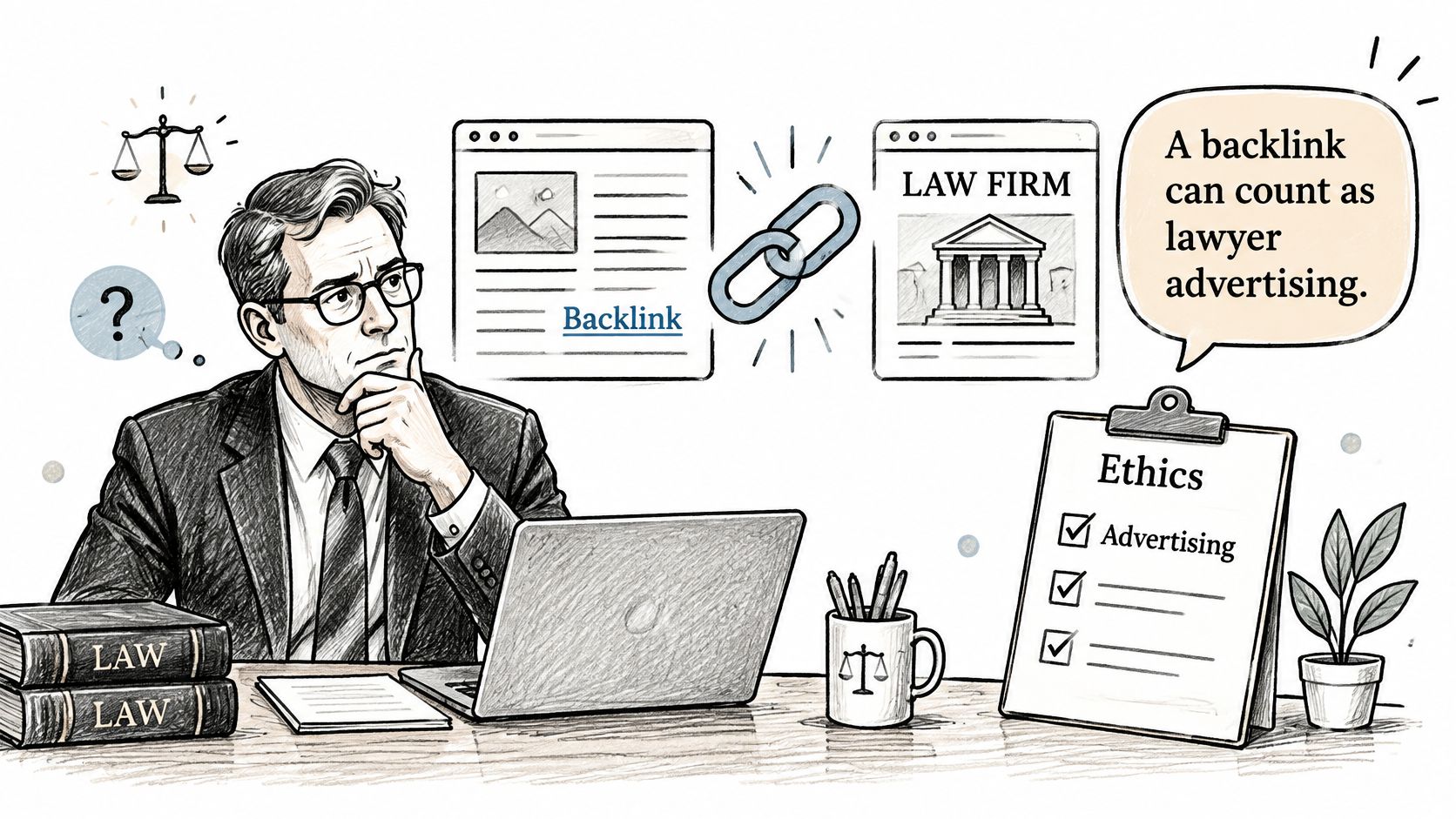
Review the linking page under the advertising rules that apply to the lawyer and the audience it reaches. Check the claims, context, and any required disclosures before publication. A link can be technically clean and still appear beside copy that creates an ethics problem.
Run this check before anything goes live
- Identify the relevant jurisdiction. Check the rules that govern the lawyer and the audience, not just the location of the publisher.
- Verify every claim. The firm name, admissions, and practice descriptions on the linking page must be accurate.
- Check the purpose and wording. Educational content can answer a legal question; language urging readers to hire the firm may be advertising.
- Include required disclosures. If the applicable rules require a disclaimer, make sure it appears where the promotional claim appears.
- Confirm who controls the page. Record who can change the content after publication, and arrange a review if the publisher edits it.
Avoid unsupported superiority claims, guarantees, unverifiable specialist labels, and testimonials that lack required qualifications. For a firm serving multiple states, review the placement against the rules in each relevant jurisdiction. A page available nationally can reach prospective clients beyond the state where the copy was prepared.
A business journal might cite a firm's employment explainer and refer readers to it. The citation can help a prospective client assess the firm's knowledge. If the surrounding copy promises results the firm cannot substantiate, the placement creates a separate advertising concern, regardless of its SEO effect.
Practical rule: Apply the same care to a claim on a publisher's page as you would to that claim on the firm's site.
Linkbuilding.services uses white-hat link building methods only. For attorney campaigns, that means evaluating a placement for its editorial value and promotional context, not treating a link as a reason to overlook questionable claims.
This short briefing covers how promotional claims and citations are reviewed before publication.
Link Schemes to Avoid and How Google Treats Each Link
Google's spam policies define link spam as creating links mainly to manipulate rankings. The list covers paid links, excessive reciprocal links, automated link creation, and optimized-anchor guest posts or advertorials that pass ranking credit. Editorial discovery and ranking manipulation are different jobs. Only the first belongs on an attorney site.
| Link situation | Google treatment | Handling |
|---|---|---|
| Editorial citation with no payment | Natural link that can pass value | Keep it and use a descriptive anchor |
| Paid placement or advertising | Should carry rel sponsored or nofollow | Set the rel attribute and log payment status |
| Reciprocal links swapped at scale | Link scheme risk | Decline the swap |
| Automated link creation | Link scheme risk | Refuse and remove any existing placements |
| Guest post with optimized anchor passing ranking credit | Link scheme risk | Replace with a descriptive anchor or decline |
| Publisher inventory mostly paid guest posts | Detectable footprint | Reject the publisher |
Paid placements can exist as advertising. The outbound link should use rel="sponsored" or rel="nofollow". Otherwise Google may ignore the links or apply algorithmic or manual actions. The attribute choice is covered in more detail in this guide to follow and nofollow links.
Keep a placement-level audit
One row per placement is enough if it records the publisher, URL, topical relationship, destination page, anchor text, payment status, and the rendered rel attribute. Keep exact-match anchors rare and descriptive. Spread destinations across practice areas instead of pointing every mention at one money page. Reject sites whose inventory is mostly paid guest posts.
A natural citation to original case-law analysis exists because the analysis is useful. A guest post whose only job is to pass a keyword anchor does not. Reciprocal swaps at scale and automated link tools are the traps that show up most often on firm sites. The aim is to protect referral value and professional credibility, not to avoid links.
Would this link exist if search engines did not? If the answer is no, treat it as a scheme risk.
For a live placement that fails that test, ask the publisher to remove the link or replace the anchor first. Use a disavow file only after removal fails, and log the outcome in the same audit row.
How to Pitch a Publisher Without Crossing the Line
Send a pitch a publisher can accept this week. Six elements, in this order, keep the ask inside both search policy and advertising rules.
- Subject line names their topic. Use the publisher's subject and the resource, not the firm name. The slip is a subject line that reads like an ad.
- Opening shows you read their work. One sentence on a recent piece, and why the asset fits that audience. A generic compliment fails this test.
- The asset stands alone. Offer a jurisdiction-specific explainer, a case-law summary, or a community resource they would use with or without a link. Do not attach a brochure.
- One ask, no anchor. Request a link to the resource or the new asset. Do not request keyword anchor text. Asking for an exact-match anchor is the slip that turns a citation into a scheme.
- Payment is labeled. If money, sponsorship, or a trade is involved, say the placement is advertising and that the outbound link carries
rel="sponsored"orrel="nofollow". Leaving payment undisclosed is the slip that creates both policy and ethics risk. - One follow-up, then stop. Wait seven to ten days, send one note, and move on. A sequence of identical templates to many editors is the other common failure.
Before you send, run the jurisdiction, claims, disclaimer, and page-control checks against the asset and the destination page. Log the publisher, the date, and the status. A pitch that promotes the firm's services instead of the resource should be rewritten, not sent.
Editors respond to contributions they can publish, not to link requests dressed as articles. For the outreach mechanics around contributed pieces, use this walkthrough of guest blogging outreach and keep the six elements above as the legal-specific filter.
Measuring Attorney Link Results Beyond Rankings
Page one is the wrong finish line. A link can raise visibility without a big rank jump, and a bar citation can strengthen trust while positions barely move.
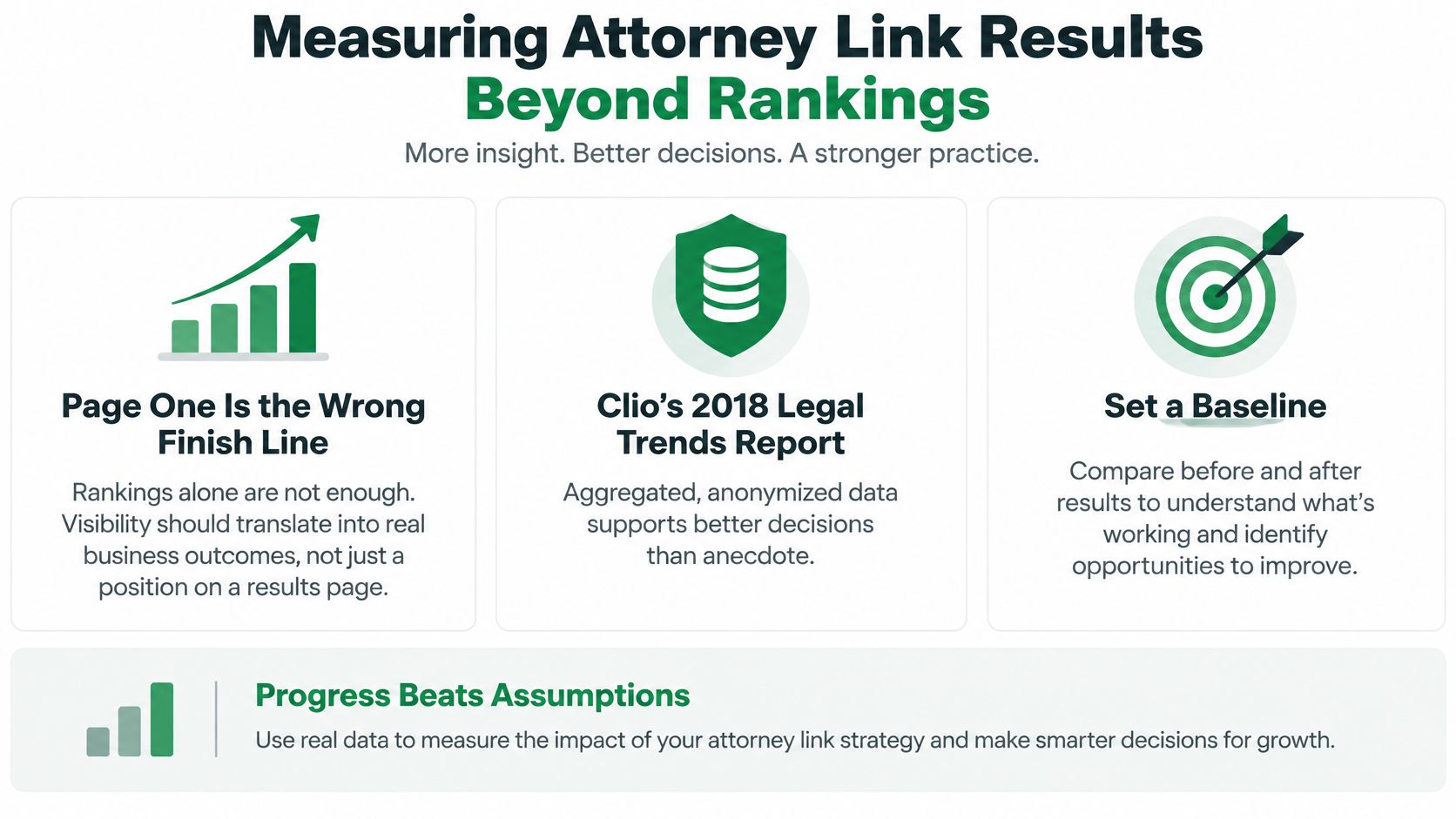
Clio's 2018 Legal Trends Report used aggregated and anonymized activity from nearly 70,000 legal professionals, surveyed 1,968 legal professionals, and surveyed 1,336 consumers. That scale is the lesson. Marketing decisions hold up better on broad operational data than on one anecdote or a screenshot of a rank. Record a baseline, set a dated window, separate branded from non-branded demand, and account for seasonality and local-market differences.
Read the set together
| Metric | What it shows | Reading rule |
|---|---|---|
| Referring domains to each target page | Breadth of new editorial links | Track monthly against the baseline |
| Organic impressions for practice pages | Visibility change on relevant queries | Compare to the same window before the campaign |
| Branded versus non-branded search | Whether demand is growing or only the firm name is searched | Report the two separately |
| Calls and form submissions from the page | Whether the page helps prospects act | Attribute only where tracking allows |
| Signed matters linked to the page | Business outcome | Review over a full quarter, not a single week |
Judge the campaign on at least one full quarter. Read referring domains next to inquiries, not in a separate deck. A spike that fades in two weeks is fluctuation. A gain that holds across the quarter, with cleaner referral traffic, is the result that matters. A high link count by itself does not establish value. Editorial context, audience, and whether the link is still live do.
Live reporting makes that check possible. We provide live reporting on link building campaigns, including placement URLs, so the firm can open each citation instead of trusting a spreadsheet total.
Say a personal injury page earns two relevant citations. Over three months, impressions on that page rise against the prior window, and callers mention the guide. The keyword moved only a spot or two. The campaign still worked, because the page helped the people who reached it.
Pick Your First Target and Run the Campaign
The first campaign is one practice page that a prospect uses to decide, plus the office page with the weakest editorial profile. That pair is the target. Every other practice area waits.
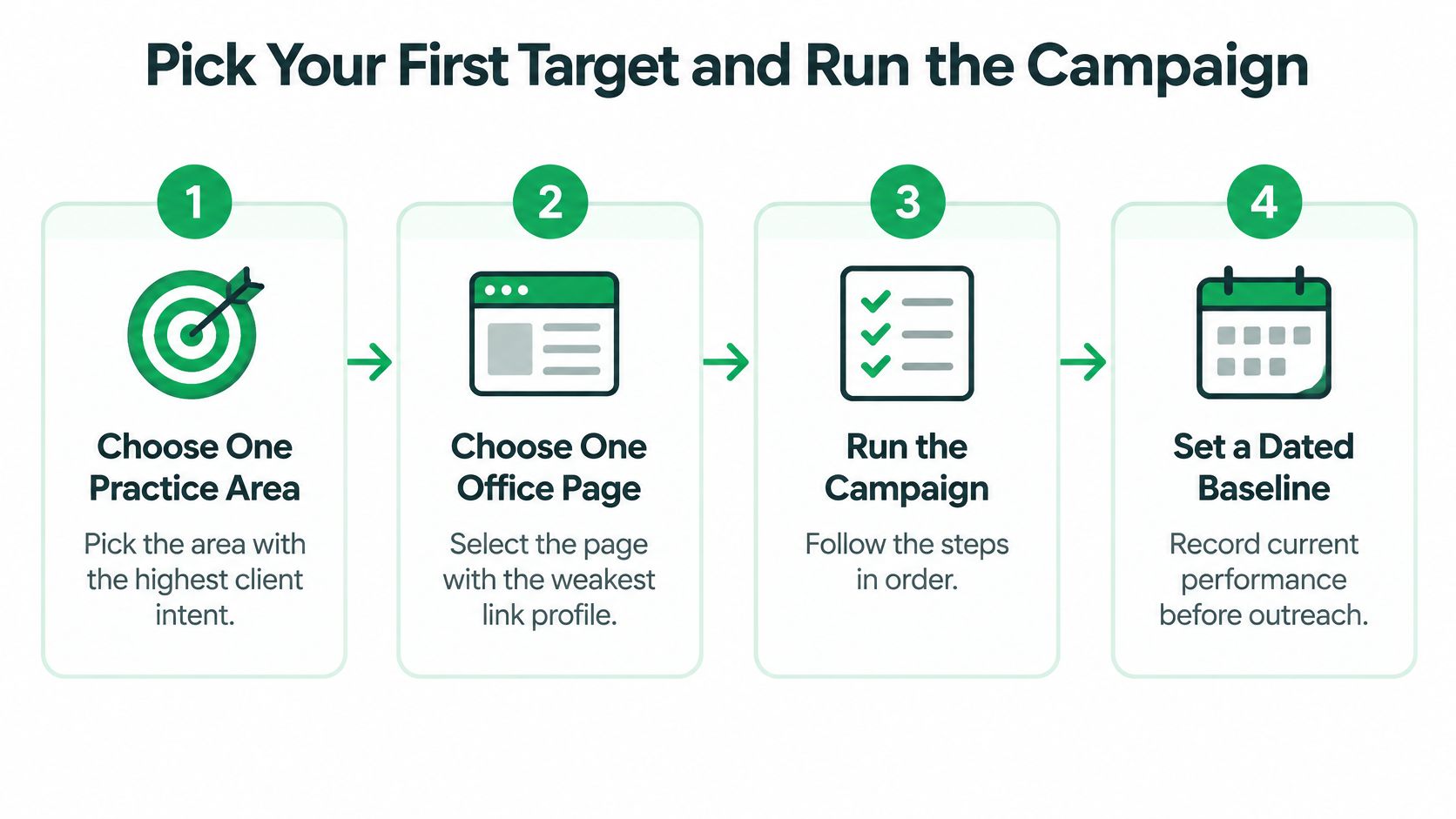
Treat each citation as a regulated promotional asset and a trust signal at the decision stage. A placement earns its place when it sits on a publisher a prospective client already reads, points to a page that answers their question, and can be opened and explained later. Page-one movement is a side effect, not the reason to start.
Work in this order
- Set a dated baseline first. Before outreach, record referring domains, organic impressions, and calls or form submissions for that page. Pitching first is the common slip. You then cannot separate a real gain from noise.
- Shortlist 10 to 15 publishers. Pull them from bar bodies, law schools, local news, legal publications, and chambers. Filter for topic and a real audience. Domain rating alone is a weak screen. Linkbuilding.services uses Ahrefs, Semrush, and its own research to find publishers that match a client's niche and audience.
- Drop paid-inventory sites. Read recent posts. If most are sponsored guest posts, remove the publisher.
- Prepare one asset per publisher. It should be something they would use anyway. Pitch it with their topic in the subject line, one ask, and no requested anchor.
- Check the link and the claims. Confirm the
relattribute and the jurisdiction checklist before the page goes live. - Log it, then review. After publication, record the URL, anchor, destination, payment status, and
relattribute. Every few weeks, adjust target pages, anchors, and volume. Do not add a second practice area until this page has a clean record.
Linkbuilding.services adapts its process to any niche, researching the market and competitors for each project, and provides clear scope and pricing before any work starts. A healthy picture at week four is a few relevant placements, no sudden spike, and an audit row for each one.
Three actions this week
- List three source types that fit the chosen practice area, starting with a bar body, a local outlet, and one educational or trade publisher.
- Pull current backlinks to the chosen page and note which ones already answer a prospect's question.
- Draft the compliance checklist and attach it to the first pitch so nothing goes out unsigned.
That is a campaign you can defend to a client, a publisher, and a bar counsel.
If you want the publisher research, outreach, and placement checks handled against a named practice page, Linkbuilding.services runs white-hat campaigns with live placement URLs and a defined scope before work starts, and reports what went live. Visit Linkbuilding.services to set the first target page and the measurement window.