Guest Posting Technology: 10 Sites to Pitch in 2026
Compare 10 guest posting technology publishers on pricing, traffic and editorial fit, with a checklist for judging audience quality before you pitch.
A technology publisher with a domain rating of 88 and no organic traffic is a weak placement. Nobody reads it, nobody clicks the link, and the page usually sits in a folder of near-identical sponsored posts. The screen that should come first is simpler: does this site rank for keywords in the client's niche, and does it earn traffic from Google for the pages it publishes?
The inventory numbers back that order. A study summarized from BuzzStream evaluated nearly 500,000 guest-post marketplace listings and kept 257,267 domains with reliable data; 96.2% were classified as low quality on domain rating and estimated organic traffic, and only 1.37% reached high-quality or top-tier bands, according to a link building statistics report. Most of what's for sale is filler.
So every source below gets judged on four things: topical fit with the client's niche, evidence of organic traffic and rankings, editorial standards, and whether you can approve the domain and topic before anyone pitches. Pricing and availability move constantly, so confirm current figures directly with each provider before you budget.
Real sites with traffic beat DR games. That's the filter. Here's how the ten options compare on it.
1. Linkbuilding.services
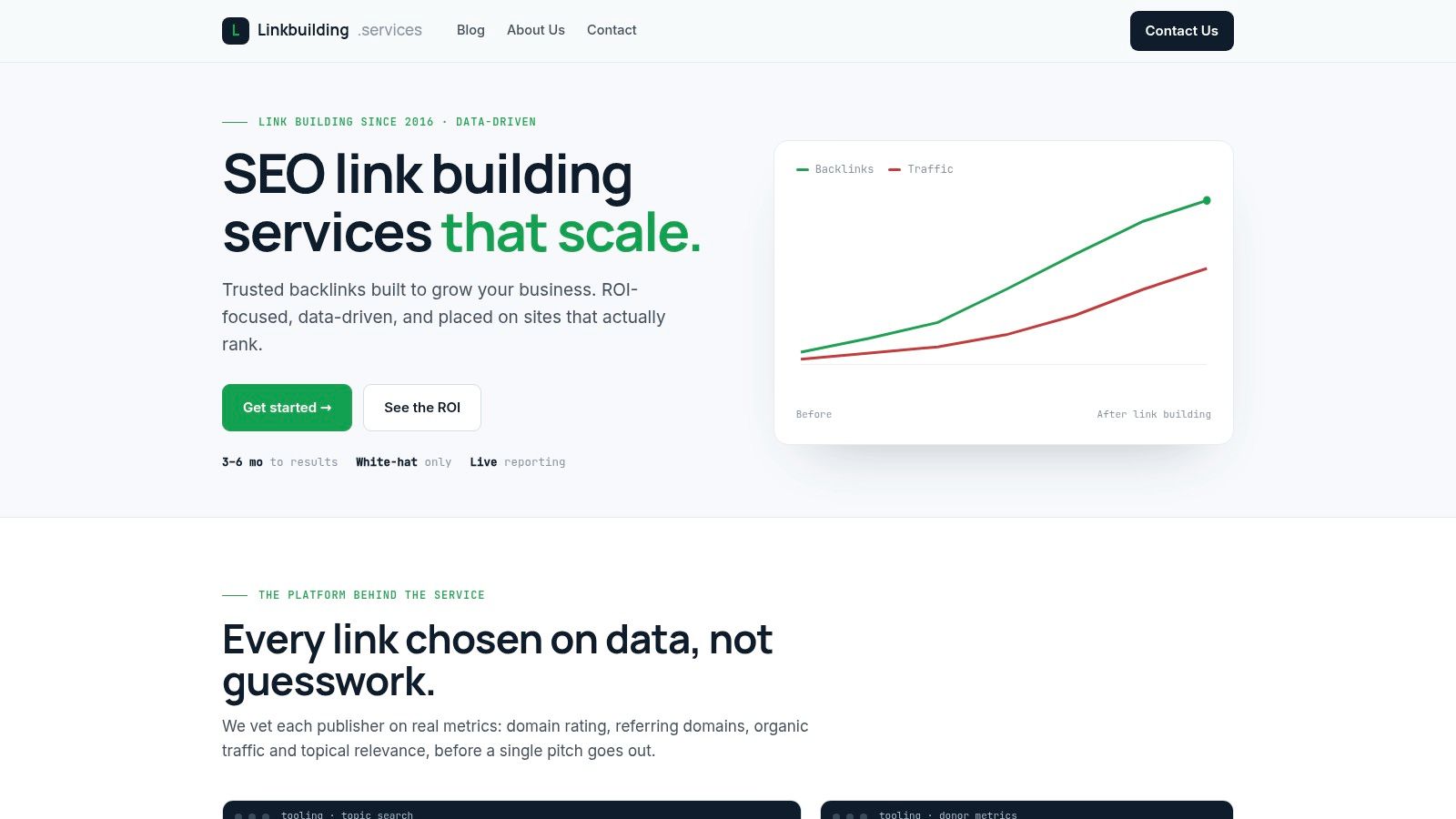
A high domain rating is not enough to qualify a technology guest-post source. Check whether its publishers reach the right audience, allow editorial review, and provide clear placement records. Linkbuilding.services offers managed link building, with campaigns shaped around client niches, target pages, goals, and budgets.
Where The Managed Route Earns Its Fee
The managed model suits agencies that resell placements and in-house teams without outreach capacity. For guest posts, clients can approve domains and topics before pitching, and subject-matter experts write the content. A specialist team coordinates delivery through a shared tracker, weekly checkpoints, and a private Slack channel. Reporting includes live links.
The company reports 2,500+ placements, access to 30,000+ publishers, and work across 40+ niches. Its publisher vetting considers domain rating, referring domains, organic traffic, and topical relevance. Ahrefs, Semrush, and its own research help identify publishers that match a client's niche and audience.
The practical benefit: your team can review the proposed domains and topics before outreach, then track placements through live reporting.
Editorial standards matter as much as publisher metrics. Search Engine Watch's account of the 2014 guidance from Matt Cutts discusses why guest posting for SEO should focus on editorial quality, relevance, and the value of the content, rather than link drops.
The Limitation
Pricing is not published, so you'll need a custom quote to compare the service with vendors that list rates. Before committing, ask which technology publishers are available and request their current traffic and referring-domain metrics. Then assess audience fit, editorial control, and how placements will be reported.
2. Loganix for Technology Guest Posts
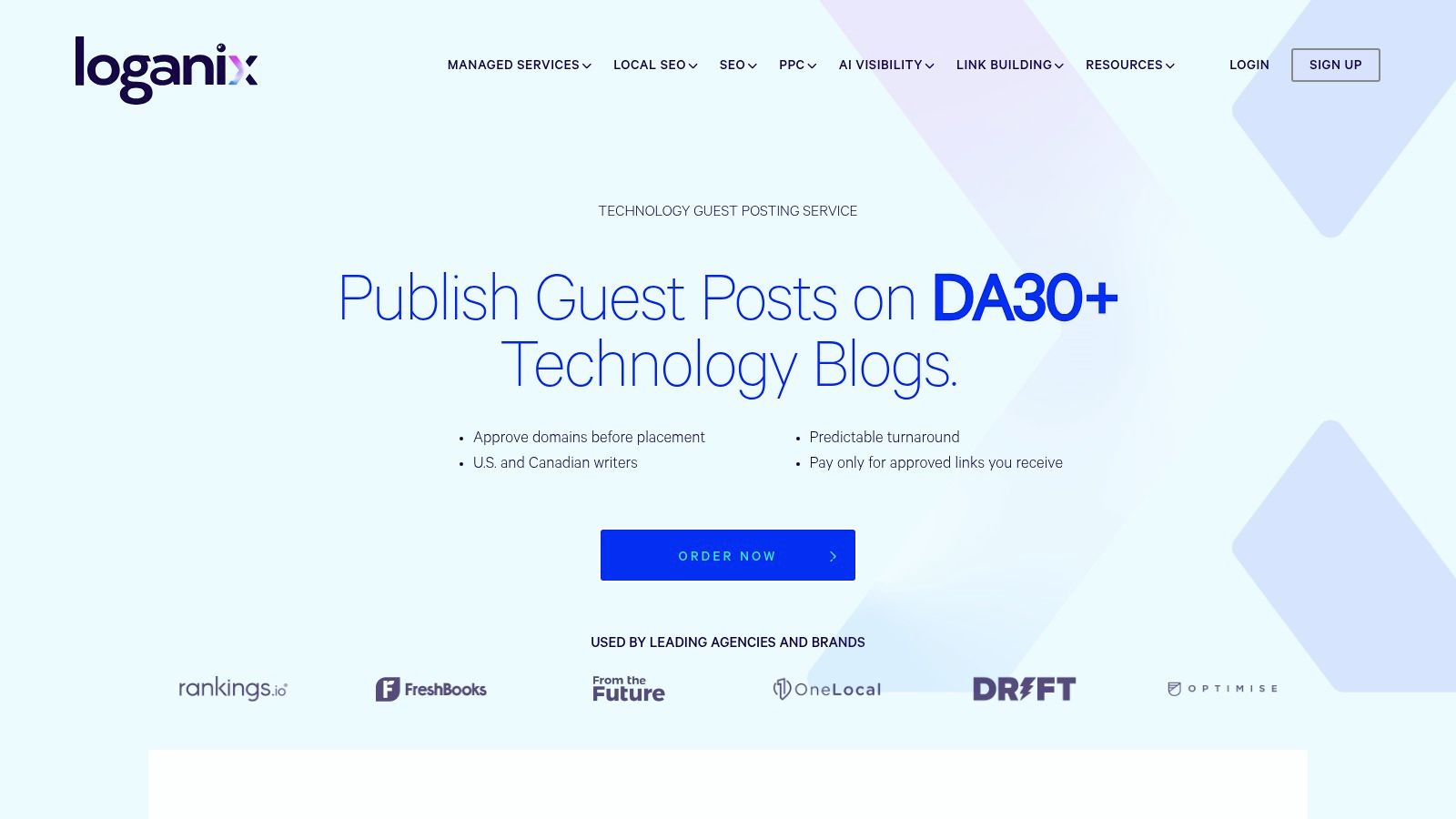
Loganix sells guest posting as a managed product with a technology-specific page, and the part worth caring about is the veto. You see candidate domains and can approve or reject them before content is written. Content, outreach, placement and manual link verification are included, plus a white-label report an agency can hand to a client.
Price is the honest differentiator: the page lists a $200 basic placement that includes content and a white-label report.
Two things need checking. Delivery is estimated at about a month, which fits a content calendar and fails a launch deadline. And the page also mentions other niches, so confirm how much of the inventory is technology rather than general business.
Put this question to them: which technology publishers are available this month, and what organic traffic do they draw?
The limitation: that $200 figure is a starting point, not a quote for the specific tech domain you want.
Visit Loganix's technology guest post service for current pricing.
3. GuestNiche
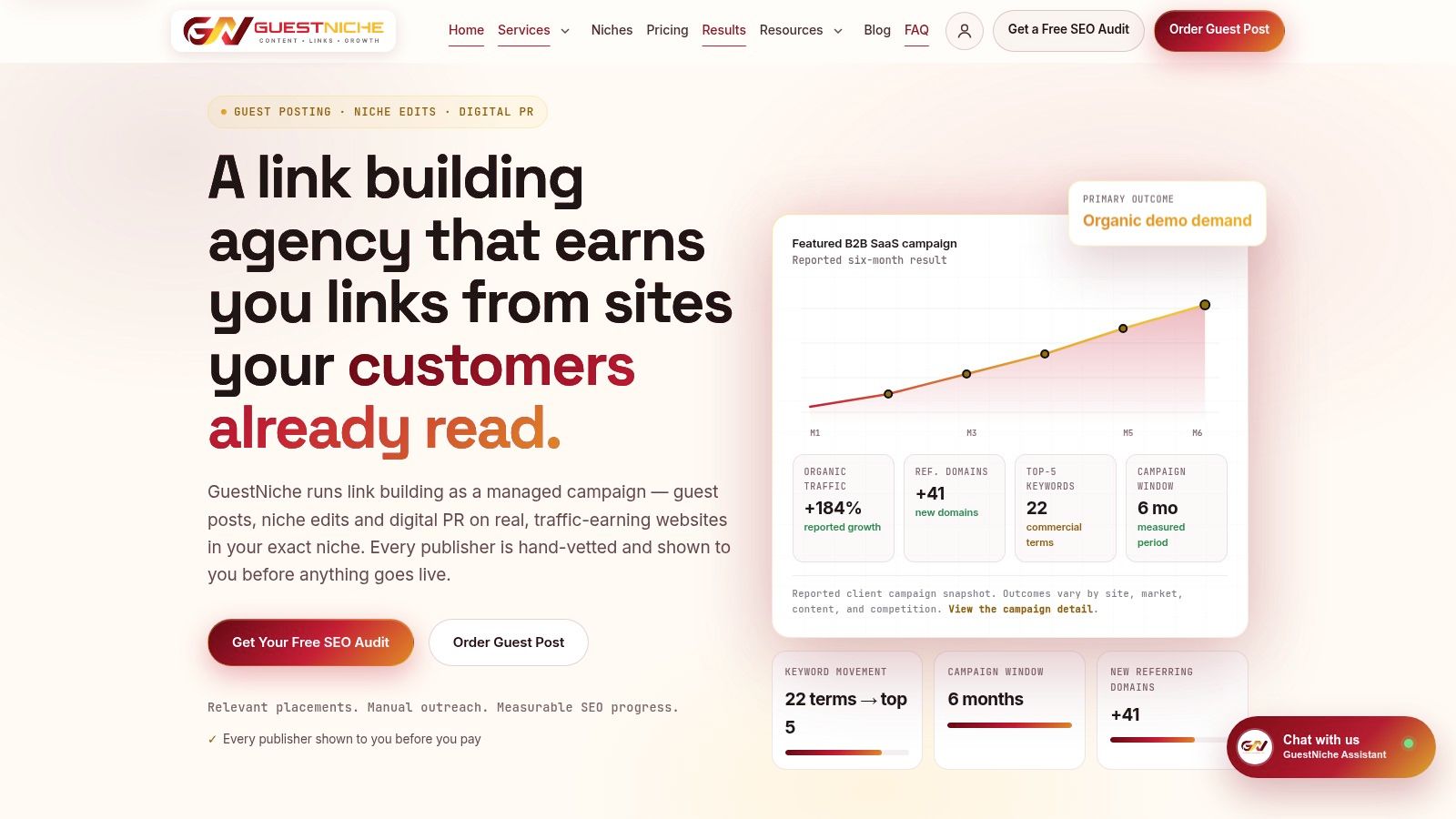
Published packages start at $35 for a guest post, with niche edits and digital PR also available. The stated process includes manual publisher research, relevance checks, editorial content, contextual links, live-URL placement reports and written replacement terms. Clients approve each placement, and white-label delivery is available.
Compare a proposed placement on three points: whether its audience fits your buyers, how much editorial control you get, and whether the published page is visible and verifiable. Domain metrics help screen publishers, but they cannot replace those checks.
The distinction between formats matters. A guest post and a niche edit place links in different editorial contexts, so ask why the proposed format suits your target page. Guest posting should be one part of a broader link-building plan, not the whole strategy.
The question to send: which technology or SaaS placements have you published recently, and can you share their live URLs and traffic figures?
The limitation: the $35 starting price does not establish what a technology placement at your target quality level will cost. Ask to review the specific publisher and page before you commit.
4. LinkBuilder.com Guest Posting
For technology guest posts, judge a source by audience fit, editorial control and placement visibility, not reach claims alone. Before pitching, apply the same checks to every opportunity: does the site reach the intended audience, can you approve the topic and draft, and will the published URL be visible in reporting?
LinkBuilder.com's section here does not establish its pricing, regional coverage or content process. Ask for current examples of technology placements, how publishers are selected, what review rights clients have, and how live URLs are reported. Those answers show whether the service fits a campaign better than a broad reach claim.
Use these guest posting examples to define what a suitable placement looks like before requesting examples from a provider.
Ask before ordering: can you review the target site, topic and draft before publication, then verify the live link afterward? That control helps limit placements that reach the wrong audience or provide too little visibility.
5. LinkNova Guest Posts

LinkNova lists technology as a supported industry and offers recurring guest-post campaigns covering sourcing, writing, negotiation, and placement in newly published articles. Packages start at $1,000 per month for five placements on sites rated DR 20+, with a six-month commitment.
Five placements a month is a steady cadence, not a one-off test. A survey of 70 guest-posting respondents found 60% produced between one and five posts per month, while 7% pitched at least 100 blogs monthly, according to Referral Rock's guest blogging statistics. The recurring model may suit teams planning consistent activity, but the term makes it harder to assess fit before committing.
Where it earns a place on the shortlist: LinkNova states its scope, tier pricing, and commitment up front, so you can assess the basic terms without a discovery call.
Ask before signing: can LinkNova share three recent technology placements on DR 20+ sites, along with each site's current organic traffic? Check audience fit, editorial control, and whether the published placement is visible before committing to a package.
The six-month term is a meaningful constraint. DR indicates site authority, not whether the site attracts readers. See LinkNova's guest post packages for current tiers.
6. Fatjoe Blogger Outreach
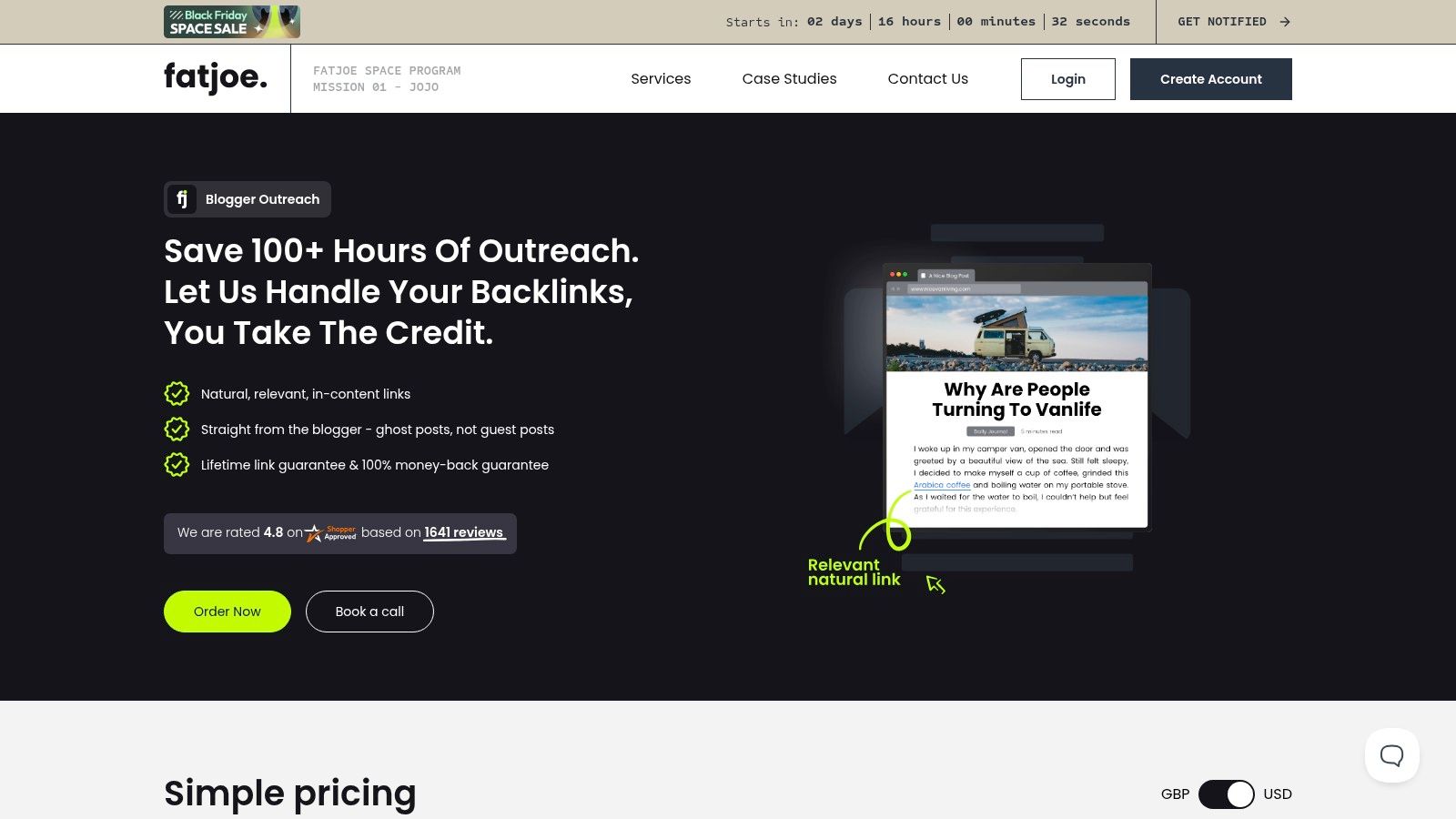
Fatjoe prices guest posts by authority tier, with content and outreach included. The service is built around newly published content, but a tier alone says little about whether a technology audience will read the post or whether you can review the publisher before placement.
For each candidate, check audience fit, editorial control and placement visibility before approving the pitch. Ask how the publisher's readership relates to your target market, whether you can review the topic and draft, and what reporting shows the live page and link. This makes the trade-off clear: tiered pricing helps with budgeting, while limited pre-approval can make it harder to judge fit in advance.
Paid placements that pass ranking credit need the correct attribute. Google's spam policies say paid links should be marked rel="sponsored" or rel="nofollow"; paid guest posts with followed links or optimized anchor text count as link spam. Set the link attribute before ordering.
Put anchor requirements in the guest blogging outreach brief, not in a follow-up after publication.
The practical benefit: tiered pricing gives you a budget framework before you request a placement.
Ask before ordering: can you review the publisher and proposed topic before the post goes live?
The limitation: Fatjoe does not offer site pre-approval, and placements are on English-language blogs without a local-country guarantee.
7. Authority Builders Guest Posts
A traffic floor is not an audience. Authority Builders gives you two buying routes, a self-serve catalog and a managed option, so the test is whether a placement survives the same checklist used everywhere else: does the readership match the buyer, who controls the final edit, and will the link sit in a visible part of the page?
Editorial control matters more than the catalog label. If a site will take any sponsored topic, the link may be easy to get and easy to ignore. If an editor pushes back, rewrites the angle or limits anchors, that friction is usually the healthier signal. Placement visibility is the third check: a link buried under boilerplate, author bio clutter or a paid-post footer can be technically live and practically weak.
What it saves: catalog browsing lets you screen domains before committing budget, while the managed route can absorb outreach when internal time is short.
Before you buy, ask: which technology pages are read by the audience you need, and can the placement be approved before copy is written?
The limitation: traffic is a screening metric; fit still has to be proven by readership, editorial standards and link position. Use the checklist first, then browse Authority Builders' guest post catalog with those constraints in hand.
8. PRWiz
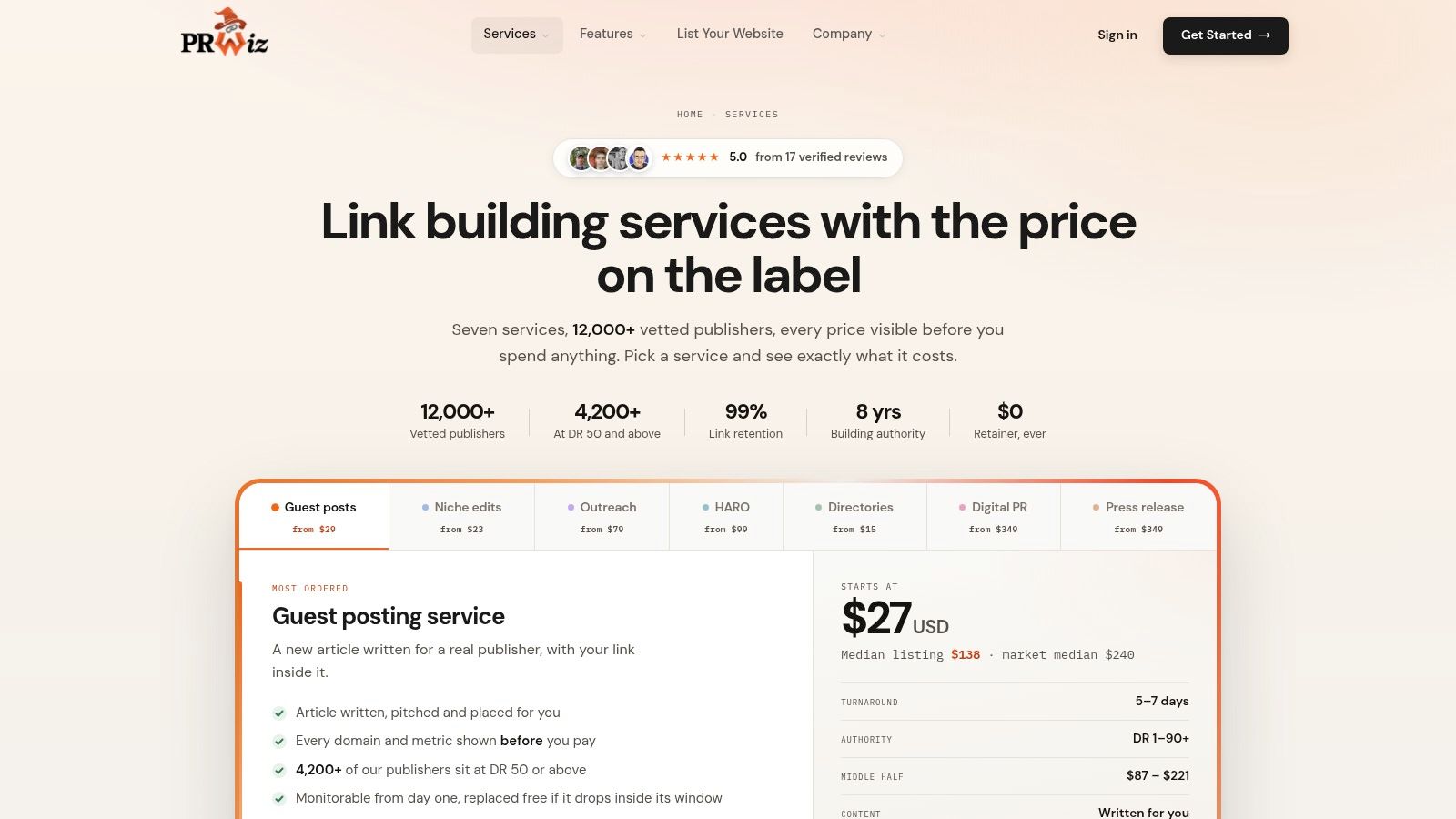
Catalog-first buying, which is rare enough to note. You browse publisher domains and metrics before paying, filtering by niche, authority, traffic, country, language and price. PRWiz's services page lists guest posts starting at $29 with a five-to-seven-day turnaround, and niche edits, managed outreach and digital PR sit alongside.
Inspection is the whole benefit: you see the domain, its metrics and its price before any money moves.
Filters run the first pass, not the verdict. Stack niche, a traffic floor and a country setting to cut the catalog down to a readable list, then open each shortlisted domain and check its last ten posts. Ten sponsored articles in a row with no editorial content between them answers the audience-fit and editorial-control questions before you spend anything.
The question worth sending: how many technology domains clear both a traffic floor and a topical filter, and does the catalog sort by that combination?
The limitation: the starting price is not the cost of a technology placement worth having. Cheap listings and credible tech publishers occupy different corners of the same inventory, and placement visibility only pays off if the filtered list still contains real tech domains.
Run the same pre-pitch checklist here as everywhere else: audience fit first, editorial standards second, metrics third.
9. Page One Power Custom Link Building
Not a placement vendor. This is a custom link-building firm with relevance-first campaigns, multiple quality signals and dedicated project management, where guest posts are one tactic among several. Typical campaigns start at $3,700 per month on a custom quote, with an initial six-month contract.
That structure suits a client with a genuine authority gap and a budget to match. It's the wrong shape for someone who needs one article on one tech publication.
The benefit is strategy over inventory: someone builds a plan around your pages rather than selling you a menu.
The first question to ask: what proportion of the proposed links will be guest posts, and which target pages do they point at?
The limitation: cost and the six-month term make this the wrong tool for a single placement test.
Review Page One Power's custom link building approach before booking a call.
10. Techmagnate Guest Posting Services
Guest posting sits inside a broader digital marketing and SEO practice here. The stated workflow runs from target-site research and content creation through outreach, approval, publication, backlinking and monitoring. It reads like an agency process rather than a product page, which is either reassuring or frustrating depending on what you need.
Reassuring if link acquisition belongs inside a wider SEO engagement where technical work, content and analytics share one contract. Frustrating if you want a price list and a domain inventory today. On my standard checklist, audience fit is the open question: the service covers many verticals, so ask how much of the publisher pool is technology-focused. Editorial control and placement visibility are also unclear until you put them in the statement of work.
Where it fits: organizations that want link acquisition coordinated with the rest of their search program.
Ask this in the scoping call: which technology publishers are in scope, and is domain approval written into the statement of work?
The limitation: no published guest-post price appears on the service page, and the page does not establish technology-specific publisher inventory or an advance approval step, so get both in writing before you commit.
See Techmagnate's guest posting services for the current scope.
How the 10 technology guest-post sources compare on published pricing, commitments and placement visibility
| Item | Published Starting Price | Minimum or Commitment | Pre-Approval or Visibility | Best For |
|---|---|---|---|---|
| Linkbuilding.services (recommended) | Not publicly listed; tailored pricing | No minimum stated; campaigns tailored to budget | Review domains and topics before outreach; shared tracker and weekly updates | Managed, white-label campaigns with publisher vetting and client visibility |
| Loganix, Technology Guest Posts | $200 per placement | No minimum stated | Review and approve or veto candidate domains | Technology guest posts with client-ready reporting |
| GuestNiche | $35 per guest post | Package-dependent; no minimum stated | Client approval of each placement | Buyers comparing multiple link-building formats |
| LinkBuilder.com, Guest Posting | $100 per placement | $2,000 minimum project balance | Publisher selection and client approval | Multiregional or multilingual campaigns |
| LinkNova, Guest Posts | $1,000 per month for five placements | Six-month commitment | Site vetting is included; client pre-approval not specified | Recurring technology placements |
| fatjoe, Blogger Outreach | $83–$524 per placement | No minimum stated | Sites and content cannot be pre-approved | Tier-priced outreach on English-language blogs |
| Authority Builders, Guest Posts | About $160 per placement | No minimum stated | Publisher catalog or managed outreach; catalog offers publisher visibility | Buyers seeking catalog choice or managed campaigns |
| PRWiz | $29 per guest post | No retainer listed for catalog purchases | Browse publisher domains and metrics before purchase | Buyers who want to inspect listings and prices upfront |
| Page One Power, Custom Link Building | Typically $3,700 per month | Initial six-month contract | Custom campaign planning; pre-approval details not specified | Higher-budget, relevance-first link-building campaigns |
| Techmagnate, Guest Posting Services | Not publicly listed | Customized; no minimum stated | Workflow includes approval; client visibility terms not specified | Organizations combining guest posting with broader SEO work |
Shortlist Three Sources, Test One Placement, Then Scale
Pick three sources whose inventory matches the niche. Run one low-cost placement and judge it on audience relevance, editorial quality and whether the link is live and indexed. Domain rating tells you almost nothing at that stage.
A single test placement answers four questions quickly. Did the editor improve the draft? Does the page earn impressions in Search Console? Does the link carry the attribute you agreed? Does the site publish anything other than sponsored posts? If two answers come back weak, move on rather than negotiating a bigger order.
The Pre-Pitch Checklist
Run this against every domain on a shortlist before the brief is written.
- Topical fit: the publisher's recent posts should sit in the client's subject area, not in a general business feed with one technology article a quarter.
- Organic traffic: check estimated traffic in Ahrefs or Semrush and compare it with the site's own claims.
- Ranking keywords: a publisher that ranks for nothing a client cares about has no audience to borrow, whatever its authority score says.
- Sponsored-content disclosure: settle the link attribute (followed, sponsored or nofollow) and the disclosure line before content is drafted, not after it's live.
- Buyer approval: confirm in writing that you approve the domain and the topic before outreach starts, and that you can reject a site without penalty.
Terms deserve the same treatment. Get the quote in writing, including the replacement window, the anchor policy, whether post-publication edits are allowed, and who owns the article. Pricing moves, so confirm every figure with the provider directly.
For a managed route, Linkbuilding.services runs domain and topic approval before placement and gives clients a guest-post inventory tool that filters by domain rating, referring domains and traffic, plus a topic search tool that finds pages by relevance rather than keyword match. That combination is what makes guest posting technology work at scale: vetted publishers first, placements second.
Start with one placement. A shortlist of technology domains you can review, with traffic and referring-domain data attached, is enough to decide whether a source deserves a second order.
Linkbuilding.services handles the operational side of guest posting technology: publisher research built on organic traffic and topical fit rather than authority scores alone, subject-matter-expert content, domain and topic approval before outreach, and reporting that lists live placement URLs you can verify. If reviewing a vetted shortlist sounds faster than building one from scratch, Linkbuilding.services will assemble technology domains around your target pages, anchors and budget. Visit the site to see how the inventory filters work and request a shortlist for review.