White Label vs Private Label: Which Fits Your Business
White label vs private label compared: ownership, customization, MOQs, lead times and costs, plus which model fits agencies, retailers and product brands.
White label sells a supplier's standardized product to many brands under their own labels, while private label is a product made exclusively for one brand to its own specification. The practical choice is whether you need a ready-to-sell offer or enough control over the underlying product to justify a larger commitment.
That choice starts with the contract, not the packaging. A branded box or client-facing report doesn't establish who owns the specification, who can reuse the work, or who pays when something goes wrong.
White Label and Private Label in 2026
In 2024, 50% of global consumers surveyed by NielsenIQ said they were buying more private-label products than ever before. That makes supplier selection more than a back-office purchasing decision. For retailers, it helps determine what customers associate with their brand.
Consider an ecommerce founder choosing a skincare supplier. A catalog product with custom artwork might suit a demand test, but it won't necessarily stop another seller from offering the same formula. A commissioned formulation offers a different proposition, provided the agreement protects its exclusive use.
The same purchasing problem appears in agency service catalogs. An agency can resell fulfillment under its own name without owning the provider's production methods, publisher relationships, or reporting software. Brand presentation and operational ownership are separate rights.
A supplier's promise to put your name on the deliverable isn't a promise that nobody else can buy the underlying product.
Confusing those rights can leave buyers with unexpected minimum orders, unavailable design files, disputed customer data, or exclusivity that disappears outside a particular sales channel. The label attached to the arrangement won't resolve those problems.
For ecommerce founders, retailers building own-brand ranges, and agencies reselling fulfillment, the useful comparison is therefore commercial: what can you approve, what can competitors buy, and what can you take with you when the relationship ends?
White Label vs Private Label at a Glance
White label vs private label side by side
| Dimension | White Label | Private Label |
|---|---|---|
| Core definition | Standardized supplier product relabeled by many brands | Product commissioned by one brand to its own specification |
| Product specification | Shared stock formula or service process | Brand dictates the specification; ownership must be contracted |
| Exclusivity | Normally non-exclusive; competitors can buy the same underlying item | Exclusive commercial sale within the agreed scope |
| Customization | Branding, packaging, and limited changes | Formula, design, materials, features, or tailored workflows |
| Typical minimum order | Small catalog batches set by the supplier | Larger production commitments set by development and setup needs |
| Typical lead time | Existing-product production and labeling schedule | Specification, sampling, approval, and production schedule |
| Upfront cost focus | Labeling, packaging, artwork | Research and development, sampling, tooling, certification |
| Intellectual property | Underlying product IP usually remains with the supplier | Ownership or exclusive usage rights must be expressly assigned |
| Inventory risk | Generally lower commitment through smaller batches | Greater exposure through larger upfront commitments |
| Best for | Fast launches, demand testing, resale | Differentiation, potential margin improvement at scale, category control |
Read the specification and exclusivity rows first. They tell you more than the supplier's preferred terminology, because customization alone doesn't establish ownership and a retailer-owned brand doesn't automatically own every component of the product.
The minimum-order and timing rows describe the purchasing mechanisms rather than a guaranteed quote. Published manufacturing ranges are useful for budgeting, but they aren't service-level commitments, and they shouldn't be applied to agency fulfillment.
Treat the table as a negotiation map
A supplier may offer a hybrid arrangement: a stock product with exclusive packaging, a shared base formula with a proprietary addition, or standardized fulfillment with a custom approval process. Write down which parts are shared and which parts are protected.
Don't assume that private label guarantees superior margins either. Development costs, storage, defects, and unsold inventory can outweigh a lower factory price. Likewise, a white-label business can differentiate through merchandising, customer support, positioning, or account management without owning the underlying product.
Buying rule: Choose the rights you need, not the model name that sounds more sophisticated.
The broad verdict is straightforward: white label prioritizes speed and limited initial commitment; private label prioritizes control and differentiation. Neither description substitutes for a specification, a commercial schedule, and an enforceable agreement.
The Real Difference Is Ownership and Exclusivity
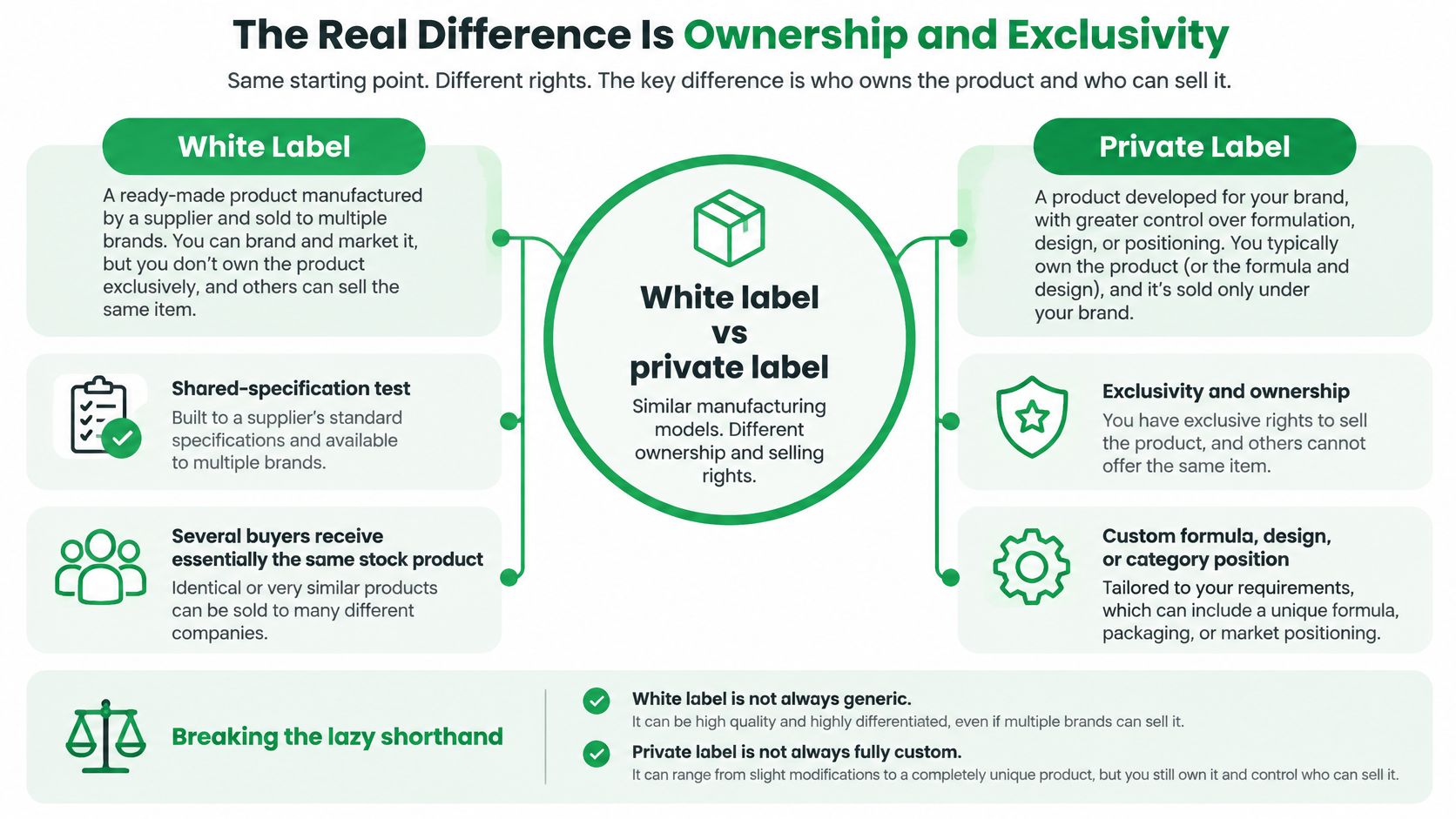
The shortcut that white label means generic and private label means custom is useful only at the start. As CoManufacturers' comparison explains, the more useful distinction is whether buyers share the underlying specification or commission a product for exclusive commercial use.
Apply the shared-specification test. If several buyers receive the same stock product, you're buying a white-label offer, even if the packaging looks distinctive. If your brand determines the formula, design, or specification for exclusive sale, you're negotiating a private-label arrangement.
Ownership is a bundle of rights
Don't ask only who owns the product. Separate the assets and obligations:
- Formula and specification: Identify the recipe, tolerances, approved materials, and any supplier-owned background IP.
- Design files and tooling: Establish who owns editable artwork, molds, dies, and production files, and whether they can move.
- Compliance records: Specify access to testing, certifications, batch records, and supporting claims documentation.
- Customer and campaign data: Define access, permitted reuse, confidentiality, export formats, and deletion obligations.
- Inventory: Allocate ownership of raw materials, work in progress, rejected batches, and finished goods.
A white-label agreement can include geographic exclusivity or negotiated customization. A private-label product can use shared components and outsourced manufacturing. Those edge cases are why the contract matters more than a sales-page category.
Circana's private-label strategy guidance also describes private labels serving value-conscious and quality-conscious consumers through tiered offerings. Private label needn't mean a bargain substitute, but premium positioning still doesn't prove ownership of the underlying assets.
Write the exit before production begins
The operational question is whether you can continue selling if the supplier relationship breaks down. Owning a specification helps little if the manufacturer controls essential tooling, refuses to release files, or holds the only usable compliance records.
Put IP assignment, change-control rights, audit rights, exclusivity scope, and termination provisions in writing. Exclusivity should identify the protected product, territory, channels, duration, and any purchase obligations needed to maintain it.
Allocate responsibility for labeling errors, recalls, infringement claims, and regulatory documentation, including insurance and cooperation requirements. Contractual allocation doesn't erase statutory obligations, so have qualified counsel review the markets where you'll sell.
For agencies, distinguish ownership from licensing. Our terms provide a non-exclusive license to use deliverables for your business upon full payment. That's a concrete usage right, not an assignment of our entire fulfillment process or exclusive access to publishers.
Minimum Orders, Lead Times and Cost Benchmarks
The first cash-flow question isn't the unit price. It's how much money leaves your account before you know whether customers will buy, and how long that money remains unavailable for payroll, acquisition, or another production run.
Published manufacturing benchmarks summarized by Ruit's white-label and private-label comparison put white-label minimums at approximately 25–500 units with 1–4-week lead times, compared with approximately 500–5,000 or more units and 8–16 weeks for private-label programs. Treat these as planning ranges, not supplier promises.
Private-label onboarding takes longer because somebody must settle the specification, approve samples, resolve compliance requirements, and schedule production. A cheap quote that excludes those activities isn't comparable with a fully developed offer.
Look beyond the factory price
Economics not covered in the comparison table
| Economic factor | White Label | Private Label |
|---|---|---|
| Cost per unit at scale | Shared-spec pricing can leave less room for manufacturing savings | Volume can lower unit cost after development and setup are absorbed |
| Price positioning | Competing offers may use the same underlying product | Supports a differentiated premium or value-tiered own brand |
| Switching suppliers | Easier when equivalent stock products are acceptable | Requires transferable specifications, tooling, and qualification records |
| Working-capital cycle | Cash follows catalog production and smaller reorder commitments | Cash includes development, production, storage, and sell-through |
| Rework and rejection exposure | Existing products reduce development work, not quality risk | Unapproved specifications and samples create more prelaunch exposure |
These are purchasing tendencies, not guarantees. Custom packaging can make a white-label order expensive to replace, while well-documented private-label assets can make a supplier transition manageable.
Calculate landed cost, not just ex-factory cost. Include freight, duties where applicable, inspection, storage, packaging, and expected rejects. Then model the payment schedule against realistic sell-through, including a delayed shipment or a slower launch.
Translate manufacturing commitments into agency service levels
Don't copy physical-product minimums onto link-building procurement. An agency's exposure sits in client deadlines, rejected opportunities, revisions, reporting work, and delivery capacity rather than warehouse stock.
Use a fulfillment scorecard with explicit definitions:
- Brief-to-approved-publisher time: Start the clock when the provider receives a complete brief, and distinguish initial suggestions from approved opportunities.
- Approval-to-live cycle: Track publication separately from outreach and content approval.
- Rejection rate: Record why domains or drafts fail, including relevance, traffic quality, and editorial fit.
- Qualification compliance: Measure the share of delivered placements meeting the agreed traffic and topicality requirements.
- Reporting completeness: Require target pages, anchors, publisher details, status, and verifiable live URLs.
- Revision and peak capacity: Agree who handles corrections and how additional volume changes scheduling.
Standard fulfillment works when those checks are repeatable. Custom workflows make sense when they protect enough account value to justify additional coordination.
The better model is the one whose minimum commitment you can absorb without depending on an optimistic sales forecast.
Where Each Model Wins and the Break-Even Test
Private-label growth establishes consumer demand, not the profitability of your proposed product. Circana figures cited by the Private Label Manufacturers Association put U.S. private-label sales at a record $271 billion in 2024, as reported by Retail Dive.
The economic choice still rests on category, positioning, and the cost of exclusivity. Convenience.org's reporting on private-label growth highlights the importance of price architecture alongside continued demand. A growing category won't rescue an offer with weak contribution margins or inventory customers don't want.
Product brands need different kinds of protection
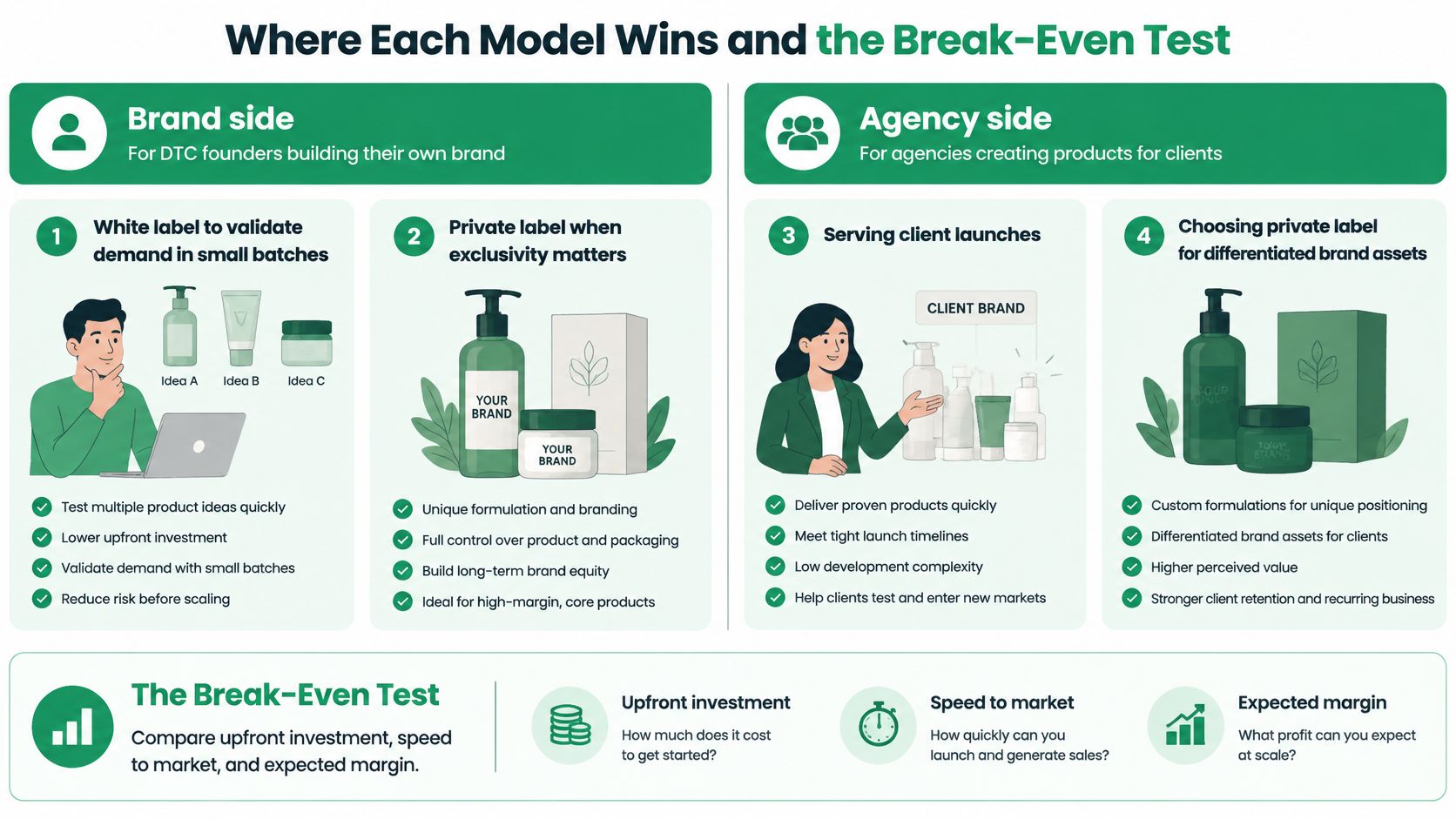
A DTC founder testing several product ideas can use stock products to learn which offer attracts repeat purchases. The useful output is evidence about demand, returns, and acquisition economics before committing to proprietary development.
A supplements brand built around a proprietary formulation needs contractual protection for that formulation and its permitted use. A confidentiality clause alone isn't enough if the supplier can sell an equivalent specification elsewhere.
A supermarket building an own-brand range may prioritize assortment control and coordinated value and premium tiers. The buying team must also manage substitutions, availability, and packaging consistency, not merely negotiate a lower unit cost.
Agencies should distinguish resale from methodology
A marketing agency reselling execution needs reliable approvals and client-ready outputs. Our white-label SEO fulfillment provides agency-ready deliverables that can be resold under a client's brand, with bulk ordering, priority delivery, and reports ready for CSV or Looker.
An agency selling a proprietary methodology has a different concern. It may need confidentiality around qualification rules, restricted reuse of strategy documents, controlled access to client information, and portable reporting definitions. That's a private-label-style control arrangement, not necessarily a separately owned production operation.
Calculate when exclusivity pays
Use an incremental break-even calculation:
Break-even units = additional fixed private-label costs ÷ additional contribution margin per unit
The numerator includes development, sampling, tooling, certification, transition work, and expected inventory carrying costs or write-downs attributable to the private-label choice. The denominator is private-label contribution margin minus white-label contribution margin, using comparable selling assumptions.
| Input | What to enter |
|---|---|
| Additional fixed cost | Private-label setup and risk costs beyond the white-label alternative |
| White-label contribution | Net selling price minus variable landed and selling costs |
| Private-label contribution | The same calculation using the proposed exclusive product |
| Margin difference | Private-label contribution minus white-label contribution |
| Feasible sales volume | Conservative sell-through within the period you're evaluating |
If the margin difference isn't positive, additional sales won't recover the investment through unit savings alone. You'd need another defensible benefit, such as retention or pricing power, and evidence strong enough to budget for it.
For agencies, replace units with comparable campaigns or accounts. Include extra account-management and quality-assurance hours rather than treating customized delivery as free.
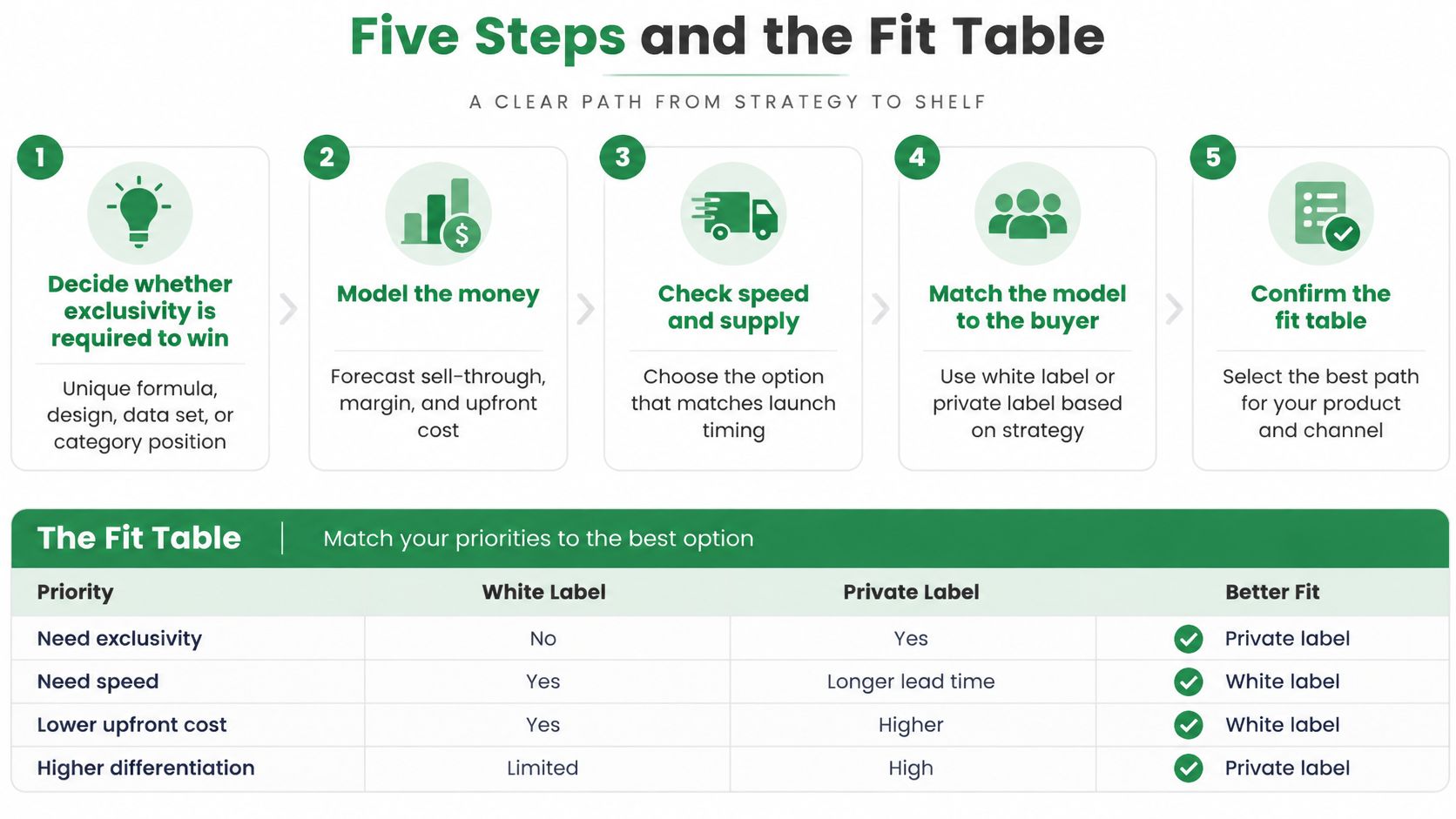
Five Steps and the Fit Table
Run the decision through purchasing, finance, and delivery together. A founder may approve an attractive prototype while the operations team inherits storage constraints, or an agency may promise a workflow its fulfillment partner hasn't agreed to support.
Decide whether exclusivity is required to win. Name the asset customers value: a formula, design, data set, or distinctive category position. If customers mainly value selection and service, exclusive production may add cost without improving the offer.
Model the money. Build a conservative sell-through forecast and calculate the incremental break-even point. Include payment timing and unsold stock, not just the gross margin shown in a supplier presentation.
Check operational readiness. Assign owners for sampling, certification, receiving inspections, storage, and replenishment. For services, confirm that your team can review domains, approve content, and handle client feedback without becoming the delivery bottleneck.
Score the supplier against written requirements. Compare a complete landed-cost schedule, approval workflow, asset rights, quality controls, and exit provisions. We offer an NDA before competitor or strategy specifics are discussed, so confidential evaluation doesn't need to start with an unprotected brief.
Pilot before expanding. Where a stock offer can fairly test demand, use it to validate the commercial assumptions. If exclusive development is essential from the outset, pilot the specification and acceptance process before committing to a broader range.
Match the situation to the purchasing model
Which model fits your situation
| Your situation | Better fit | Why |
|---|---|---|
| Testing a new product or market | White label | Small batches validate demand before larger commitments |
| Agency reselling fulfillment under its brand | White label | Repeatable delivery without building the production function in-house |
| Competing on a unique formula or design | Private label | Contracted exclusivity protects the differentiation you funded |
| Retailer building an own-brand range | Private label | Greater category control and potential unit-cost benefits at volume |
| Limited budget or storage | White label | Lower initial commitments can preserve cash and space |
| Proven demand with stable forecasts | Private label | Predictable volume can justify development and inventory costs |
The table identifies a starting position, not an automatic approval. A stable forecast doesn't excuse a weak contract, and a small order doesn't eliminate product-liability or delivery risk.
Before signing, have finance test the downside case and have operations confirm that acceptance criteria can be inspected. A quality requirement that nobody can measure is difficult to enforce.
Match the control you need to the commitment you can afford. If those don't align, narrow the range, reduce customization, or postpone the commitment rather than relying on optimistic demand.
Make the Call and Take the First Step
Choose white label when the immediate job is validating demand, adding a resale offer, or launching without building the underlying production function. You'll still need disciplined positioning and quality control, but you don't need to own every production asset to deliver something customers value.
Choose private label when customers have a reason to prefer your specification and you can finance its development and replenishment. There's no universal winner in white label vs private label. The deciding variable is how much control your business needs versus how much commitment it can carry.
Give the purchase a concrete starting point
For a white-label product, create a shortlist and request samples against the same acceptance checklist. Get branding rights, approved claims, artwork requirements, reorder terms, and rejection remedies in writing before launching a SKU.
For private label, commission a version-controlled specification and complete trademark clearance and filing work appropriate to your market. Negotiate IP assignment, permitted supplier reuse, and exclusivity before authorizing tooling. Keep approved samples and production tolerances attached to the agreement rather than buried in email.
For agencies, prepare a fulfillment brief that identifies target pages, audience, topical boundaries, anchor constraints, approval owners, and reporting requirements. Separate quality criteria that must be met from preferences so a provider can quote an achievable scope.
Inspect the controls behind the deliverables
At Linkbuilding.services, we agree clear scope and pricing before work starts. Each publisher is vetted on domain rating, referring domains, organic traffic, and topical relevance before any pitch is sent, rather than selected on an authority score alone.
Our delivery includes domain and topic visibility, followed by reporting with live placement URLs. Use that visibility to inspect the actual publisher and placement, not just the completion status in a spreadsheet.
We've placed over 2,500 links, work with over 30,000 publishers, and serve over 40 niches. That establishes operating scope, but it doesn't replace a campaign-specific brief or guarantee rankings, traffic, or revenue.
Before signing: Make sure the agreement describes an acceptable deliverable, the approval process, and what happens when delivery falls short.
The best first commitment is one you can evaluate. Approve a bounded product or campaign, inspect the result against written criteria, and expand only when the commercial assumptions and operational handoffs hold up.
We offer managed white-label link building with publisher research, outreach, content production, placement verification, and agency-ready reporting. Visit Linkbuilding.services to discuss your client niche, target pages, approval requirements, and budget, and define a pilot campaign with clear scope before work begins.